Author Archive
“Our inward winters take many forms- failure, betrayal, depression, death. But every one of them, in my experience yields to the same advice. ‘The winters will drive you crazy until you learn to get out into them.’ Until we enter boldly into the fears we most want to avoid, those fears will dominate our lives. But when we walk directly into them- protected from frostbite by the warm garb of friendship or inner discipline or spiritual guidance- we can learn what they have to teach us. Then we discover once again that the cycle of the seasons is trustworthy and life-giving, even in the most dismaying season of all.” Parker J. Palmer
Truth. Running from our fears, or even our depression, is not a long term workable solution. It keeps us trapped. Palmer even adds the one important caveat. We can only face fully into our fears or depression to the extent we have sufficient internal and external resources, and since our cupboards are never fully stocked, there are always limitations on what we can fully face and for how long without some reprieve. It is far more like tacking into the wind than sailing a straight course forward, and at times we simply must let the storm blow us where it will. Those with meager resources have the least ability to leverage their way forward. As with our calf muscles, we can overtax and strain our psyches and end up worse off for our excess efforts–more vulnerable and weak than before. In that sense, it is the overall direction we set that is life-giving, but we must keep close watch on our resources so as to live within our emotional means or we will run a deficit.
I so appreciate the truth Palmer expresses. I spent most of my life fleeing depression–not in diversions as some do, but in desperately seeking for solutions, cures, answers. Desperation rarely opens the best way forward, and so I stilted my progress, narrowed my options, scrambled down false turns. Kimberly taught me to slowly become accepting of my depression, to embrace the feelings and be sympathetic to myself in my suffering, to wait patiently for answers to come in the slow process of deeper self-understanding.
This is not at all the same as “giving-in” to feelings–allowing them to control me and take me where they will, which is a dangerous road to travel. We seem trapped by a false dichotomy: to either capitulate to our feelings or subdue them. We see it as a blatant power struggle, and there is no good way for us to respond from that perspective. Feelings are like a road map–they inform us, they do not control us–and if we fear their power, the solution still lies in understanding them more fully in a self-compassionate way, not in pushing them away in fear or shame. Feelings that are denied have far greater control over us than those which are acknowledged. They may control us by forcing us into the opposite choice–risk rather than safety, fight rather than flight–but they still control our decisions, only now more obliquely, beyond our awareness, making us far less able to recognize and resist their impact.
We accept our feelings into our lives as friends, not as dictators… or as captives. How would you compassionately embrace your fearful friend? You would acknowledge her feeling, show understanding for that feeling, legitimate her feeling as a feeling. Wise and mature counselors will not try to “fix” the feeling (judge it, correct it, change it). Feelings are always true and right as feelings. They tell us something important about ourselves (not necessarily about our situation). Because emotions are complex, they are often clues rather than direct assertions about our inner world (our anger may mask fear, our pride may cover insecurity). We must patiently listen and learn over many years to slowly gain fluency in their language, but if we do, a whole world of self-understanding and healthy responses are opened to us.
We need good stories, stories of courage and generosity and unexpected kindness. In this dark world, we need to share stories of endurance and empathy and reconciliation–not to falsify reality, to romanticize the present or expect fairytale endings here, but to remind us that there is some good still, some glimmer of light to warm our hearts.
Bubblewrapping ourselves with comfortable lifestyles to avoid this broken world may bring picket-fence peace, but is not living by faith. Faith is never a denial of the bad. The very reason we are called to live in hope is that our present is rife with heartbreak. The tintinnabulations of good that we catch are echos of a future yet to be. So we tell those little stories of good to recall our coming deliverance, to remind ourselves that the infinite and eternal glory of God that surrounds this dark closet of our earthly days is the far greater reality, though it only reaches us through the cracks of our prison. Those glints of good we share with one another makes our suffering more endurable though it may not lighten our present pain.
So come let us sing to one another in the dark and encourage our hearts with hope of redemption. God is good, and one day we will see it and feel it and breathe it, but until then let us cheer ourselves with the little sparkles of good that we daily encounter.
Of the many heart-warming stories out there, here is a good one.
Oliver Sacks is dying. This brilliant and eloquent neurologist is one of my favorite authors, and reading excerpts from his autobiography this morning reminded me of one large reason–he is a man of profound, lived, empathic grace. I have often tried to forgive others by brute force, knowing it is the right thing to do and willing myself into a gentler mindset, but without off-setting any of the blame I levy against them. This “forgiveness” requires no understanding, empathy, or reconsideration of my valuation of them and their behavior. They are bad; I am good–so good that I even forgive their sin against me. Instead of using their failure to reflect on my own shortcomings, on how we are similar, I use their faults to contrast with my virtue so that I understand neither them nor myself any better than before. I “forgive” from a place of moral superiority rather than from a humble view of our mutual sinfulness so that my very forgiveness becomes a source of distancing and shaming rather than true reconciliation. Their role is to humble themselves, admit how bad they are, and then I will magnanimously agree with their estimation–“Yes, you are bad, but I forgive you.” As long as I don’t hold a grudge or wish them ill, I can claim to have forgiven them even if I continue to think badly of them.
But Sacks, by just being himself in relationship to others, showed me how inadequate my supposed grace is. He not only forgave those who had deeply wounded him, but showed his understanding of their human struggle. He could see why they reacted to him as they did and could empathize with their situation and viewpoint. He did this without devaluing his own pain or pushing himself to engage more deeply in a wounding relationship than his soul could well maintain, but he found a way to protect himself without maligning those who injured him. To understand and empathize with others does not require us to then subject ourselves to ongoing harmful behavior. In fact, it is when we keep healthy boundaries that we are most able to empathize freely with those who behave in hurtful ways. I learned first from Kimberly that the justification for my boundaries lies in my own needs, not in the other person’s faults. Assigning blame is an entirely different consideration than what boundaries I need for my own well-being. Taking full responsibility for my own boundaries frees me up to give grace with much more abandon because my love is no longer an opening for their hurtful behavior. Forgiveness is not a moral power struggle, it is an acceptance of our mutual frailty and fallenness.
I was raised on clarity like Iowans are raised on corn—it was the staple that nourished our grip on reality, giving us security and power, confidence and perseverance. Dad gave me all the answers before I had even stumbled onto the questions, saving me the trouble of sorting it out myself, and he shared his take on life with a degree of certainty that silenced doubt before it even had a voice. My parents, being deeply religious, anchored all this clarity to God himself so that doubt was not only foolish but dangerous, a personal affront to the Almighty.
As a child I was handed the blueprint for life, the map and compass, and I followed it faithfully each step, landing in Calcutta as a missionary at 30 years of age, having somehow escaped the indignity of adolescent questioning.
Unfortunately, life is not so neat and tidy, but constantly pokes through our carefully boxed up constructs, threatening the whole structure. “You can do anything if you try hard enough.” Really? “Thankfulness leads to contentment.” But if it doesn’t? Reality seems to stubbornly resist fitting into our prefab structures, challenging our paradigms. So we fight back—pretend there’s been no breach, or try to block up the gaps in our worldview by tweaking the architecture, or construct awkward explanations for the exposed holes, the received truth that doesn’t play out as we’d expected. But for me to make substantive changes, to move around the support beams, would force a complete rethinking of reality as I knew it, a stroll into insanity, so I clung to my views, blaming myself for failing to make it work. It took four years of unrelenting depression to shake my grip on my framework of truth.
And so, at the age of 40, I stumbled into the adolescence I soldiered past in my teens. Discovering my basket was full of unworkable answers, I set about looking for the right ones. I still wanted certainty, just not a defective set. But honesty is a bitch, fertile though she is. Once you let her in, she barks at every discrepancy and won’t be shushed. Each fresh answer I uncovered brought more questions. I was in a fog of confusion that I could not escape, stuck, unable to follow a path I could not see. I kept walking, but I seemed to be going in circles. I kept praying for clarity, but she had abandoned me and obscurity had firmly grasped my hand.
Facing confusion with calm is a plus, and parts of Christianity outside my heritage even find obscurity beneficial, oddly enough. Books like the fourteenth century “Cloud of Unknowing” and “The Dark Night of the Soul” by St. John of the Cross warned against leaning too heavily on reason and intellect, which could obstruct as well as open the path to insight. Just this morning I read two psychologists discussing a client in that conundrum:
“You know, that’s the thing about intelligence. It can really get in the way of wisdom, the mind being such a good place to hide from all the messiness that comes with our feelings. Maybe what your patient needs to do is get out of his head and get into his heart. Stop thinking so much and let his feelings get the better of him, let loose with a good cry or a fit of anger, whatever it is that’s stirring down there at that mysterious place he’s afraid to go to.” (Eric Kolbell in “What Jesus Meant: The Beatitudes and a Meaningful Life”)
The thing is, I don’t mind feeling my feelings, but doesn’t my progress depend on then understanding them in order to resolve them? For me the key was still clarity. But what if it wasn’t. What if clarity at this point was the problem instead of the answer. It was just this discovery John Kavanaugh made in my adopted city.
When the brilliant ethicist John Kavanaugh went to work for three months at “the house of the dying” in Calcutta, he was seeking a clear answer as to how best to spend the rest of his life. On the first morning there he met Mother Teresa. She asked, “And what can I do for you?” Kavanaugh asked her to pray for him. “What do you want me to pray for?” she asked. He voiced the request that he had borne thousands of miles from the United States: “Pray that I have clarity.” She said firmly, “No, I will not do that.” When he asked her why, she said, “Clarity is the last thing you are clinging to and must let go of.” When Kavanaugh commented that she always seemed to have the clarity he longed for, she laughed and said, “I have never had clarity; what I have always had is trust. So I will pray that you trust God.” (Brennan Manning in “Ruthless Trust”)
Fear or desire may drive us to demand answers, but Pandora learned that trying to pry open life’s box of secrets leads only to trouble. God has his own time frame for sharing his insights with us, and patience is the truest mark of trust. I have not yet found my way through the fog, but often the way has found me, working into my soul silently, healing and growing me on the sly, startling me with its results: humility, patience with myself and others, empathy, sensitivity, endurance, faith. Obscurity comes with a sleigh full of good, though it doesn’t feel like Christmas. As a friend once opined, “It’s too bad life’s lessons don’t come in a box of chocolates.” The best work is often the hardest work and longest to complete, but it is the most rewarding.
I’m not completely in the dark. I find some general directions to take, the fog sometimes lifts, but lack of lucidity can be freeing, opening up options I would otherwise avoid because I was locked into an inflexible clarity—rationality that blocked thinking, faith that hindered trust. The grace of God is so much bigger than I ever imagined.
We are often warned not to get stuck in the past, but it is just as common a problem to get stuck in the future. Both viewpoints can pull us away from living fully in the present. But unlike our past, our future is a mystery, which could drastically change in an instant. Since we have no control over our past, we feel our only security is in controlling our future, but those expectations can be miscalculated in a hundred ways and so can hijack our present. In this sense we can lose control of our present by the demands of our planned future, so that, ironically, in thinking to gain more control over our lives, we lose control.
The answer is not in control of our past (by trying to ignore its impact) or control of our future (by careful planning and decision making), but in learning to live in the present by faith. Good plans and decisions are worthwhile, but our security lies rather in the hands of God. As the Good Book says, “The heart of man plans his way, but the Lord establishes his steps.”
–some words I shared on Facebook yesterday
I love children’s books with powerful truths. Leo Lionni has written “Fish Is Fish,” a story of a fish imagining the world as described by a frog. Here is Fish’s mental picture of a cow:
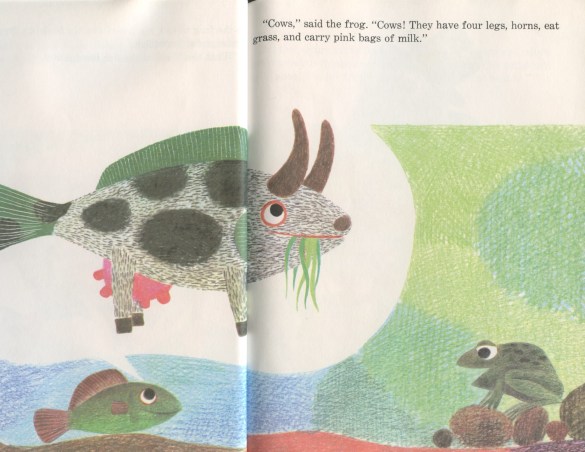
It is basically a fish with four legs, horns, and a “pink bag of milk.” It is a profound parable of how we see everything from our own perspective, even when we do our best to be “unbiased.” We unknowingly skew everything to match our preconceptions, experiences, personality, etc. so that we can wholly misunderstand others even when we listen with best intentions. Seeing things from another’s perspective is an art and skill that require patience, humility, empathy, curiosity, and practice, and it is one of the most powerful expressions of love we can grant.
My constant refrain this year past, muttered or sighed or groaned: “I am SO tired!” Many times every day and out loud to myself–in the kitchen, on walks, at work, and even in my mind as I spot tasks that stare grumpily at me, like the window air-conditioner sitting on our coffee table that I brought up from the basement two days back. I’ve barely managed to keep up with life: washing clothes and then leaving them in the laundry basket to fish out for work, while I dump dirty clothes on the floor next to it; watering plants just before they die, or not; cooking raw meat just before it rots. I’ve dropped other things after dragging them around mentally like a ball and chain, such as the $8 rebate from Ace Hardware that expired… well I actually didn’t give up on that, it just ran out before I mailed it in. Unfortunately, I never give up on things. I just accumulate them like sandburrs on bare feet.
I could sit here on the living room sofa and write a discouraging list of tasks that I can literally see from here: A dvd player to take to Goodwill–it’s been sitting accusingly at the end of the loveseat for two weeks; an old external hard drive to process, walnuts in a coffee container that need shelling, now practically buried behind accumulating paperwork, books, and other stuff that needs to be sorted and resolved; a briefcase full of files and lists neglected for many months; a dime-sized food stain on the sofa arm under my wrist that needs cleaning–it has been there for two months; and the latest addition–insulation that arrived yesterday, now propped against the wall, that needs to be hung in the attic. I’m not even mentioning the things that are in the room but just out of sight–I am fully aware of them–out of sight out of mind is a laughable proverb for those with a mind like my own. I haven’t even touched on the cars, yard, basement, shed, office–a thousand obligations wrap like Lilliputian threads around me. I could cut off the least important hundred tasks and make no difference to the overall affect.
Mind you, I go to work every day, pay my bills and mortgage on time, walk the dogs, take out the trash, shop and cook enough to keep us fed adequately, mow the lawn, exercise, wash my clothes. In other words, I am a normally functioning human, which seems enough for most folks. I’m amazed at the ability others have to simply ignore their overflowing in-boxes. Something needs to change in my outlook on life, somehow to live under the flow of grace in a way that releases me from this constant weight of obligation. For all the work I have put into grasping this principle over many years, one would think I would have found freedom by now. Even learning grace seems to be such an arduous, long-term effort–my thoughts, my habits, my feelings slide so easily back into my old ways. That sounds so wrong-headed even in saying it… shouldn’t grace be easy by definition? Law is so deeply engrained in my soul. It stains every thought to the roots. Well, let me celebrate each baby step and not add insult to injury by condemning my lack of growth in grace. It will come, it will take time, and this post is one more reminder to myself to re-orient my soul in line with God’s unconditional acceptance.
Monday I was hiking with my doggies in the Blue Ridge Mountains and noticed my neck cramping on one side. To stretch out the kinks I started rolling and rotating my head, wondering what I’d done to my neck. And then it dawned on me. instead of pulling ahead as usual, Mazie and Mitts had fallen in behind me, and as the path was narrow, I held both leashes in one hand. My right arm swung freely, but my left arm was pulled back by the leads, and over a couple of miles that tension worked its way up to my neck.
I spent decades paying little attention to my body, and so harming it. I have only learned in the last few years to listen to this complex, integrated structure–I would never have guessed that a sore neck could come from an arm slightly skewed. When an injury’s throb is felt in a separate body part, it is called “referred pain.” Those are the trickiest to self-diagnose and so misleading that the real problem often escapes us.
During those years I listened no better to my psyche than my body. I shouted down my feelings and became emotionally deaf, unable to decipher its most rudimentary language. Emotions were to be embraced, vanquished or transmuted according to an accepted moral code. I thought every feeling was a straightforward response to external stimuli. My anger was incited by “stupid” drivers. My anxiety was the result of critical bosses. My shame was the direct product of my tardiness. Emotional “referred pain” was not even a speck of consideration… until the conventional interpretations became so convoluted in the telling that even I recognized something was fishy. They rang false, though I couldn’t detect the crack in the bell. It was my indecipherable, unrelenting depression that forced me to finally admit my emotional cluelessness and rethink my psychological map.
I discovered that my pride was tangled up with fear, my affection enmeshed with insecurity, and a seeming calm and patience was simply an emotional disconnect to protect myself. I realized that my anger ignited from inside, not outside, that it was a cover-up for shame, and my shame was grounded in a legalistic denial of grace. It was all so much more complex than I realized, but this self-reflection, softened by grace, opened me to a remarkable level of integrity and clarity and personal growth. My whole sense of spirituality and relationships was reorganized. I finally had the tools I needed for fundamental transformation instead of the spiritual strictures of a flawed system.
I have been working for years to learn my emotional ABCs. Slowly I untangled the knots so that patterns stood out in relief and dynamics materialized. What is the real reason for these feelings? What leads me to freedom and understanding rather than fear and blindness? What does my soul need in the way of support? What pulls it down or picks it up? I wonder–do any cultures teach their children to be heart-interpreters rather than heart-controllers?
Addendum to clarify yesterday’s post
Working an unskilled, low-paying job makes me feel humiliated (as I shared yesterday), but that feeling is based on a lie. I have nothing but respect for those who work such jobs, which are usually far more taxing and less rewarding than typical middle class jobs. Minimum wage workers are usually treated like minimum worth commodities, used and discarded, so they have to survive in very difficult situations and are often treated with disrespect. It is not the job which is inherently humiliating, but the false valuation of society. I do not wish in anyway to lend credence to the notion that such jobs should be despised or devalued–it is a defect in myself, not in the work, which brings about my shame. Yes, feel with me my shame in an understanding way, “I would feel the same in his shoes,” but also realize with me that such shame is misplaced. Hard work is always a credit to the worker (unless the business is evil) and should never be seen as beneath us, beneath any of us. Honest work should always be a source of pride, never of opprobrium.
[*by “pride” I mean self-satisfaction, not self-aggrandizement]
For five years I have worked in Lynchburg College Library as a circulation supervisor at night (8 pm to 2 am). It has been a vital part of my emotional survival because it is low stress, but I get furloughed at Christmas for a month and 3 months for summer, so it has put a strain on us financially. Last fall I finally landed a second part-time job, selling fridges at Home Depot for $9.25 an hour. My career has been a slow but inexorable descent by demotion. From respected missionary to struggling pastor to harried social worker, and finally out of ministry of any sort into secular, unskilled labor. From minister’s collar to blue-collar… to no-collar. From meaningful work to trivial, from salaried to part-time poverty wages, from insured to Obamacare. And as long as I’m confessing my low-status, I also have a job as substitute janitor in junior high school: even on the toilet-swabbing team I’m a bench-warmer.
As a 54-year-old with two Master’s degrees, I felt humiliated with my entry level job for teenagers, and it took me two months to work through the shame enough to admit it to my fellow librarians. It is quite possible that some student I have supervised in the library will be the junior high teacher next fall who is spitting his gum into the trash can as I pick it up to empty. I’ve acclimated enough to my new roles that I think I could handle it without chagrin… or maybe I’m kidding myself. Like coming out of the closet, any closet, the initial shock of exposure is the hard part, and after that it is just a matter of learning a new level of humility and the grace to remember that my worth has no connection with my occupation. It is freedom and growth through downward mobility.
It’d be a lot easier to wash dirty feet if I could take up the towel of my free will instead of being handed the towel and told to wipe down. A leader who volunteers for menial labor can earn high praise for his humility, augment rather than diminish his reputation, and so ironically can undermine his growth in grace. Being humble contrasts with being humiliated precisely because the latter is out of our control, like being nailed to a cross. It is a rich person choosing to wear rags in contrast to a person who only has rags to wear. In my experience, actual poverty, though it is more scary and painful, has more power than voluntary poverty to open me to grace. Blessed are the poor in spirit for theirs is the kingdom of heaven.


 Janathan Grace Reflections