Parker Palmer starts out his piece for today, “On this solemn day of mourning and honoring those who died on September 11, 2001, people of a certain age will remember exactly where they were when terrorists attacked New York City and other East Coast targets, killing 3,000 people and taking the Twin Towers down.”
Yet how we remember is key to our own heart’s wholeness. For many, “never forget” was focused not on those lost or the first responders but on punishing the enemy, on vengeance. Being called by Christ to forgive our enemies and love those who do harm (which is quite distinct from submitting ourselves to harm), we often turn to judging and condemning. Instead of patriotism being genuine self-reflection and taking full account and responsibility for our own failures as a nation, we use so-called patriotism to whitewash our failures.
Parker Palmer continues, “Denial is well-known among those who study addictions and family systems. It’s a way for individuals and groups to avoid facing painful realities about themselves and taking responsibility for them. Exhibit A: Everyone in the family knows that Dad drinks too much, and they worry silently about the implications for him and others. But no one is willing to talk about it. “Sure, Dad likes his cocktails,” they say to themselves, “but he’s not an alcoholic. That kind of thing doesn’t happen in this family.” So the family closes ranks, explaining Dad’s behavior away to protect their myth of who they are.
“Americans have long clung to a “family myth” about this nation. The U.S.A. is a “light to the world and a city set on a hill,” a nation especially blessed by God, one that has made a few mistakes but done far more good than harm. In the wake of 9/11, we felt no need to look inward and ask, “What might we learn from this attack on our homeland about becoming better citizens of the world we share with others?” Denial kicked in immediately to protect our family myth. Over the past twenty-five years, our role in the world has become more toxic than ever.
“On September 20, 2001, President George W. Bush addressed Congress, using a line that might have helped us do some introspection and set a different course for the 21st Century: “Americans are asking, why do they hate us?”
“Unfortunately, he jumped to an answer that comes straight from The Denial Playbook: “They hate our freedoms—our freedom of religion, our freedom of speech, our freedom to vote and assemble and disagree with each other.” In other words, “We are so noble, so pure that others get jealous to the point of wanting to kill us. 9/11 has nothing to do with what’s wrong with us. It’s all about what’s wrong with them.”
With this mindset of “someone has to be punished” we went on to attack Iraq who had nothing to do with 9/11, killing 200,000 civilians, never thinking that perhaps this habit is why others hate us. Especially since 9/11 we have demonized those of the Muslim faith and this has only gotten worse in recent years.
Above all we followers of Christ must be self-reflective and humble. Instead of saying about nonChristians “they hate us because we are holy,” it would be well to consider our own failings. Rather than blaming others and living in denial of our own failure to love as Christ loves, let us look inward, not to blame ourselves but to deepen our love. When tragedy strikes, healing comes through opening our hearts, not closing them, opening to our own pain and opening to the pain of those who harm us.
Recently our beloved dog Mazie refused to eat for two days. Kimberly needed to talk about arrangements for her death because Mazie is old and has health issues. I tried to feed Mazie breakfast, and when she turned away again, I started crying heavily. She has been a precious part of our life our whole marriage. This is the third time we thought we were losing her, though she pulled through once again. How will I bear it when she is gone? The next day I wrote the following reflection.

Death came knocking yesterday.
He did not stay.
just tapped twice and peered inside,
because he is concerned for me
and does not want to shock me
when he comes for his appointment.
He wanted to get acquainted,
to let me know he is in the neighborhood.
He is much more gentle than I feared
and more understanding.
He does not want to shove me suddenly
into the dark river unexpectedly
but hopes I will hear his reassurance
that I will not drown,
and that life itself is richer and fuller
when I remember that all blossoms die,
and in their passing leave behind
their rich fragrance
while making room for new life to spring up.
Living awake to certain loss
widens my heart, breaks it free
of its defensive, guarded posture,
helps me breathe in deeply
the goodness of today so its fragrance
in its passing lingers full in my heart,
blessing it and opening it
to the hope of good to come.
I later rewrote the poem in metered rhyme, but I like the rawness of the original. Here is the edit

Stark death came knocking yesterday.
He just tapped twice and did not stay
But gently smiled in real concern
That coming suddenly would turn
My heart to ash and crush all good.
So being in the neighborhood
He wished to get acquainted now,
Prepare me for his scheduled blow,
As not to double pain with shock
And slash before I’d taken stock.
He’s much more gentle than I feared,
And moved with understanding cared
That I not unexpectedly
Be swept away so tragically.
He hoped I’d see his real intent
To help me be more confident
That life itself is richer by
Remembering that all blossoms die,
And in their passing leave behind
Their fullest fragrance in my mind
while furrowing new life to bring,
from torn up soil fresh buds will spring.
If I can live awake to loss,
Expand my heart, and breaking toss
away its guarded, armored stance,
It helps me breathe in deep and long
The good today before its gone.
The fragrance as it slips away
Fills up my heart, opens its way
To hope for all the good to come.
The good that’s passed is always home.
All my life my mind has secretly been constructing an autobiography, pulling together all the tangled pieces of my past and turning it into a coherent storyline that defines me. Sadly, I am not kind to my protagonist. My mind narrates the time I joined with neighborhood kids in grade school to call our friend Bobby “Roto-rooter,” laughing at how mad it made him, and I wince with sadness and shame. I recall scolding my dearly loved collie Taiho, who had done nothing wrong, just to see the cute look of remorse on his face, and it seems so mean. The older I got, the worse I did, and in my retelling, the good that I did weighs lightly against the heaviness of my perceived failures. I become my story’s villain, a cautionary tale.
Most novelists are kinder to their protagonist. As I read, I find myself hoping good for the main character, even if she is a scold or he is a criminal. I am sad when she loses her best friend or when he ends up under a bridge in the rain. I am sympathetic to their failures and losses, understanding of their vices, and whispering to warn them against harmful choices. Just show me their humanity, and my heart is all in for them. What would it be like if one of these writers told my story? If they showed the good generously and the faults compassionately and made the reader love me like a dear friend? Would I be able to accept such a telling of my story or would it feel undeserved, even untrue like the overindulgent words of a doting mother?
Just yesterday it occurred to me that I do have a flawless Biographer of my story who writes with the kindest, most gracious heart ever known, a retelling of my life that is perfect and trustworthy in a way my own memory and judgment could never be. Imagine if my life were told from the perspective of boundless love–every failure told from pure sympathy, every wrongdoing wrapped in understanding, every flaw traced with caring fingers. What if the Author of my story, while clearly seeing my shortcomings, was my cheerleader who found deep joy in who I am in every moment of my life. What if Love defined me? That is the story I long for. I believe, help my unbelief.
Our closest relationships are the source of our greatest longing and deepest pain, so we armor-plate our souls against the danger. The only access is through the chinks in our armor where both arrows and salve can reach our core, and we martial all our defenses to these vulnerable spaces, blocking out both suffering and compassion. It is a terrifying dilemma. For love to touch and heal our wounds, we must reveal them and face possible rejection. The closer our relationship, the more power it carries to heal and to harm.
We all hide our so-called weaknesses with our individual schemes: humor or dominance, popularity or withdrawal. The better our defense mechanisms work, the safer we are from pain but the farther from deep relationship. My major defense was over-achieving, stuffing the gaps of failure with redoubled efforts at success… until the whole structure imploded. My greatest sacrifices and determination could not stop failure. And out of that ruin, genuine life began to grow. Those of us with broken defenses suffer most, but are closer to genuine connection and healing.
Kimberly tried to find safety by making everyone around her happy. She was good at it. They called her “Sunshine.” But inside she was dying as she stifled her own feelings and views to make room for everyone else’s. Both of us were too wounded to keep our shields up, but we found in each other a tenderness that invited deep connection. Our shared brokenness created a level of intimacy that few experience.
Eleven years ago on a forested mountain covered with treacherous ice, sparkling like slivers of glass in the sun, Kimberly said “Yes!” to me. I slipped on her finger a ring that we designed together, two light blue opals, the color of her eyes, surrounding a teardrop diamond. My wedding ring was a simple circle of beaten gold, showing the rough marks of the hammer blows that shaped it.
Our stories have always been forged by pain and sorrow, and we were embracing this together, the sadness and the beauty. It is the seeping wounds of cut limbs bound together that creates the miracle of grafting, the agony and glory of each coursing through the veins of the other. It is not just slow healing that we find, but a hybrid bouquet that far surpasses the beauty of either flowering branch on its own.
How perfect that our 11-year engagement anniversary should combine Valentine’s day and Ash Wednesday. How apropos that I inadvertently wore black pants and a red shirt yesterday to school where I had my one class called “Spirit and Trauma.” I came home to a living room full of lit candles, and Kimberly and I shared with one another our struggles and hopes, inviting God to pour in his grace.
Beginning with advent, our motto has been “find the beauty,” and for this season of Lent we have refined it to, “find the beauty in lament.” This week we will remember the goodness that has come to our marriage through our brokenness. “There is a crack in everything. That’s where the light gets in.” Our deep, genuine, close connection is the bond of shared sorrows through stumbling love. This week we will name each facet of that unique beauty of brokenness to one another.
At my dad’s funeral, my sister Amy shared how dad planned great trips for his children and grandchildren, taking them on real adventures that created memories for a lifetime. Pop took me on a trip to Washington D.C. when I was twelve, and it was truly memorable. For Amy, this “extravagant love” was the epitome of her recollections of a loving father.
Yet true love may not show itself in extravagant gestures or great sacrifices. Sometimes the power and glory of love infuses the mundane. In fact, the grand display can easily be a cover to hide our unwillingness to love as we should. There are foolish and useless sacrifices… even selfish sacrifices. A mom can pay dearly to send her boy to college in an effort to run from the shame of her own inadequacy. A father can give everything up to make his son a great athlete.. but is this love for himself or his son? The ultimate sacrifice of true love is not in giving to the other, but in receiving them into our hearts, inviting them in to reveal their real selves, delighting in their oddness and mystery, allowing them to shape the very direction of our soul’s growth.
We tend to be so self-oriented that we equate our view with what is normal and right, even reading Scripture with that lense. “Do unto others as you would have them do unto you” does not mean that we treat others as copies of ourselves, assuming that what pleases or saddens us, what excites or frustrates us is the same for them. Each of us is unique in our experiences and perceptions. True love is not simply making room for the differences of others, but valuing those differences, trying to see and understand the world as they see it, gaining a new perspective and value system and appreciation for life that we did not have before. I cannot truly love without being personally transformed by it.
This is especially difficult for parents because they have responsibility for teaching and training a child, helping them mature into kind, insightful, responsible adults. But if the child is not given the freedom and encouragement to find out who they really are apart from, in distinction from, in contrast to their parents, then their lives will be hollowed out, learning good behavior but divorced from their own hearts. Is a parent able to learn profound truths from their little ones, a new outlook on the world, a new way of being? A real relationship in contrast to a coercive one empowers each other’s uniquenesses, especially when those differences are a source of conflict since those are the secret keys to unlock our own spiritual insight and growth.
The beauty and glory of true love is that it enriches the giver far more than the recipient. It is the pathway to our own daily salvation.
I have little time before work and only 9 usable fingers, having chunked off the flat of my thumb in my belt sander–a story for another day–so this will be quick and rough, but I have thoughts I want to put down. I watched an old episode of Joan of Arcadia recently and remembered why I liked it–the constant reminder that God does not play by our rules and often leaves us in the dark, even (or rather especially) about our own lives. That is, I hate the experience, but I am grateful for the camaraderie of someone who also feels slapped in the face by life… every day… and cannot find a way to duck the swing.
I have been struggling more deeply with depression for the last few months (which is the reason for my absence here–depression reduces life to survival and little more). It feels awful, so much like an actual physical trauma that I find myself catching my breath with the pain, and more recently grasping my head in my hands as I double over. So I dig through my piles of options for some way to reduce the misery, but while I’m looking, my feelings change. How do you address something which is unpredictable, indiscernible, uncontrollable. I don’t mean I don’t have any influence over my feelings, but it is like driving with a knee around mountain curves… in the fog. So my feelings are constantly in the ditch–it is all I can manage to keep from going over the embankment.
Some days I wake up feeling okay… as long as I just lie there in a drowsy stupor. That makes me think that naps might be a way to avoid my misery… which is true, but not helpful since I can’t live the rest of my life in a coma. It just delays the returning blackness, it doesn’t lighten it. So basically any strategy for avoiding life and its attendant feelings–loving on my dogs, watching TV, reading Facebook–is only a distraction from feeling anything deep or meaningful, it doesn’t resolve or heal or soften those bad feelings that come flooding back the moment I come out of the circus show.
For my religiously minded friends with the easy and certain solution–yes, I keep trying prayer and Bible reading as I am able, I keep looking for a church that doesn’t make me feel even worse afterwards. These have not brought any fundamental relief or changed my experience of life. And for my friends who have found some relief in medicine–I’ve tried several iterations, no luck so far.
Honestly it is not my staggering emotions that are the fundamental soul problem so much as the lack of control and confusion. If I believed that my depression were God-ordained and inescapable, it would relieve me of desperately seeking solutions (which puts a great deal of pressure on myself, and temptation to self-blame). I could settle for learning how to manage the life I am given. But since I have small influences on my emotions, it keeps me actively engaged. Were I to conclude that I had no real control and that my emotional experience of life was wholly in the hands of God, I could accept my lack of control, but that would exacerbate my confusion, not only over why this was God’s choice for me, but how I am to respond to it.
Regarding the first, the very values God promotes are undermined by my depression, not simply because of the inherent self-focus needed and the sapping of all motivation, but because of its intense draining of energy: I don’t have the normal resources from which to draw to be generous-minded, hard-working, other-oriented. Patience looks more like resignation, hope seems more like stubbornness. Wisdom seems to be stymied–if I have too little insight for my own life, what do I have to give to others? And to find any joy present in this mess would require a complete re-definition.
Regarding the second, my response to intractable emotions, it is hard enough to find a rhythm for the dance of life when one’s emotions are consistent, even consistently miserable. A strategy, plan, step-by-step approach can be developed when the playing field is stable, but when it constantly changes, it throws off all efforts to establish patterns, learn dynamics, and create a workable approach.
* * * * * * * * * * * * * * * * * * *
That was yesterday. I ran out of time before I could post. But the gears started to spin as I wrote. To suppose that patience as resignation or hope as stubbornness is somehow a poorer, weaker form of the real virtue is to undermine the very breadth and variegated beauty of each virtue, to stereotype, slot, and truncate the vast panoply of experience and expression of each facet of goodness. We have often tried to distill attributes into some pure or regnant form, a person that most exemplifies some particular value, say of courage or discipline. So the essence of real love is seen as mother love, as though there is only one kind of love and everyone should emulate it. But what if there are many unique and invaluable forms of love that are missed by this reduction, that look different from mother love but have their own irreplaceable value: what of the simplicity and humility of a child’s love, the equality and intentionality of a friend’s love, the intensity and intertwining of a spouse’s love… and so even those of us under the heavy weight of depression have a unique offering of love, one of deep understanding and empathy and acceptance. Perhaps depression does not inherently limit, sap, or dull our virtues, but instead refines, strengthens, sharpens them with a special coloring. Our virtues have their own beauty and power, unique role and expression, a glory all their own.
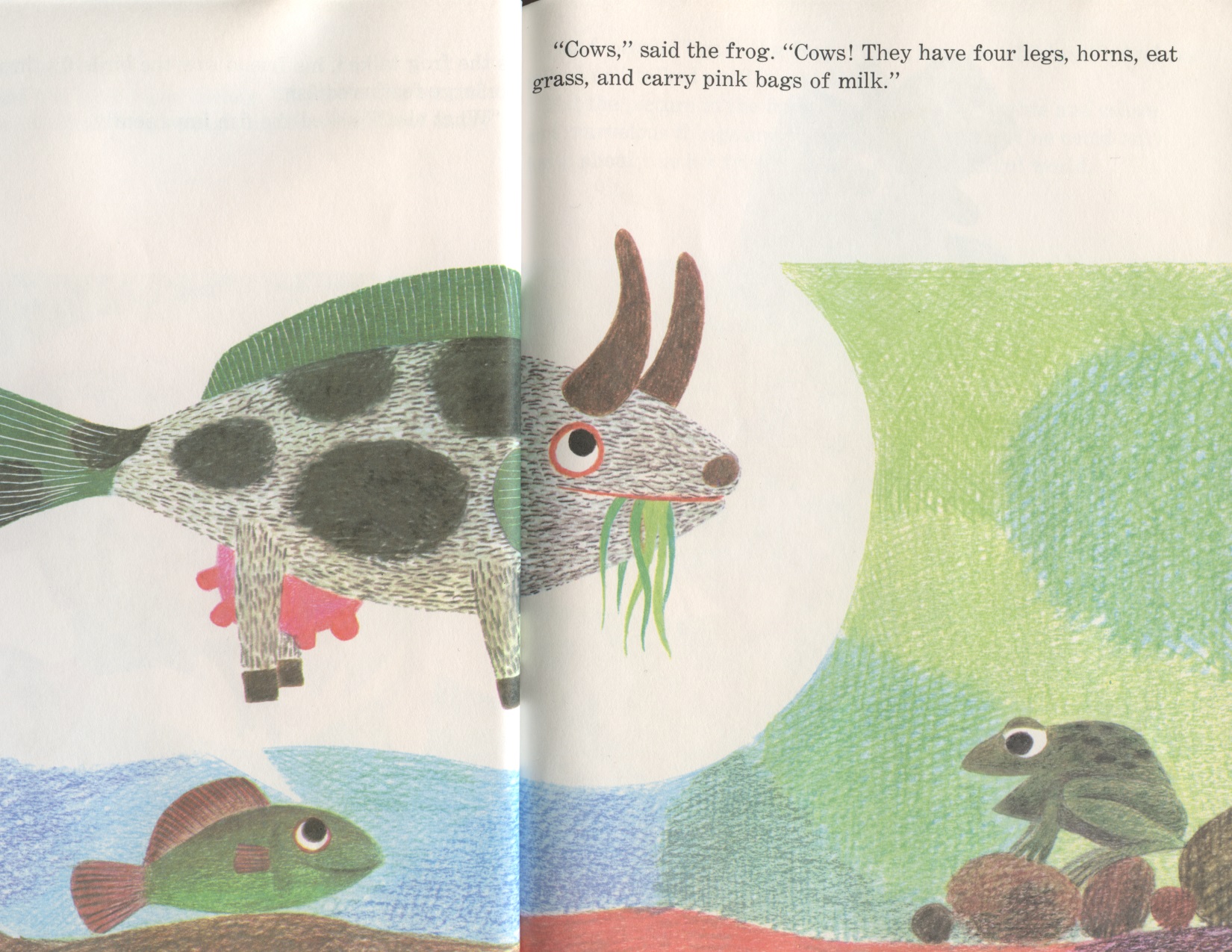
I love children’s books with powerful truths. Leo Lionni has written “Fish Is Fish,” a story of a fish imagining the world as described by a frog. Here is Fish’s mental picture of a cow:
It is basically a fish with four legs, horns, and a “pink bag of milk.” It is a profound parable of how we see everything from our own perspective, even when we do our best to be “unbiased.” We unknowingly skew everything to match our preconceptions, experiences, personality, etc. so that we can wholly misunderstand others even when we listen with best intentions. Seeing things from another’s perspective is an art and skill that require patience, humility, empathy, curiosity, and practice, and it is one of the most powerful expressions of love we can grant.
This afternoon Kimberly and I were listening to an NPR Fresh Air interview of musician Sam Baker. He was the victim of a bombing in Peru by the communist group Shining Path, which prompted one of his striking lyrics: ‘Everyone is at the mercy of another one’s dream.’ Yes, we daydream of weddings and families, homes and careers, but our plans collide: mother and daughter over weddings, husband and wife over child-rearing, homeowner and banker over late mortgage payments. If we can’t agree over a music station driving to Walmart or where to hang wet towels, how can we compromise our deepest, longest held dreams. Must I abandon my dreams to fulfill yours or do we each halve our hopes? Does relationship shrivel potential?
Group goals differ from personal goals, and each has advantages and disadvantages over the other. Choosing relationship changes dreams, but if we are innately social beings, then purely individual plans are misguided and incomplete. We can only be our true, whole selves and fulfill our potential within the context of relationship. It is in togetherness that our richest dreams are shaped. With God’s help even difficult relationships can enhance our journey; we can turn the barricades thrown up by our enemies into stairsteps to the stars, just as Sam’s devastating injuries gave him a new and better purpose, to write songs on albums titled Mercy and Say Grace. I want to live in such a way that those who cross my path, even briefly, find help on their way rather than hindrance, encouragement rather than pain.
* * * * * *
After the interview I told Kimberly I like NPR anchors. They are nice people. Even when they disagree with their guests, they are polite and respectful. On his website, Sam reflected about his interaction with (NPR’s) Terry Gross, “I talked to her last week in Philadelphia at WHYY. I am a long time listener and a fan and was nervous (and a bit intimidated) to talk with her. She is gracious and charming and I am deeply grateful.” Kimberly replied to me, “Those gentle people are the only ones I want as friends.” I said, “That’s funny because you didn’t marry one!” Mind you, I try to be gentle. I’m just not very good at it, like a lumberjack with a bone china teacup, and I often feel deeply flawed as a human being for not being nicer. So why would Kimberly choose me?
We’ve had this discussion many times. In spite of warming up to nice, she keeps choosing real instead, because (as it turns out) you can’t really have both–no one can always be sweet and still genuine. When we let our insides out, the shadows appear. Kimberly was raised on nice, and didn’t discover her anger until she met me. She fearfully buried that part deep inside from everyone, even herself, and it was killing her. The folks who keep the ugly locked inside not only hurt themselves, but short-circuit their relationships. If I trust you only with what’s admirable, then you don’t know me and can’t love me for who I am. To truly connect at the heart level, we have to share more than happiness. As it turns out, I’m very good at real, both in being vulnerable and accepting others in their vulnerabilities, and that is what Kimberly needs most deeply. When she committed to our relationship, she gave up on her safe, carefully crafted dream and woke up to a reality far better.
Some dreams are in fatal conflict, and pursuing them tears everyone down. Surprisingly, fairytale endings often fit this mold because they are unrealistic, delusive, and usually selfish, and they depend on everyone involved having precisely the same unchanging vision. Trust me, after the credits roll, the sheen of Prince Charming dulls quickly as he wipes his mouth on the kitchen towel and forgets to replace the TP roll, and if Cinderella enforces her Hollywood dream, everyone else is going to be living a nightmare pasted over with smiles. May we all learn to dream together, to find the richest, fullest expression of ourselves in the symphony of relationship.
Go in peace, go in kindness,
go in love, go in faith.
Leave the day, the day behind us. Day is done.
Go in grace. Let us go into the dark, not afraid, not alone.
Let us hope by some good pleasure, safely to arrive at home.
I woke up this morning with spare change on the clock to get to church on time, but my soul was out of sorts, so I lay still, sensing its pulse instead of pushing myself out of bed. For the last decade I’ve honed the skill of listening to my feelings without judging them, but I’m only gradually learning to then respond with compassion, a crucial second step. Since I spent most of my life judging my feelings and driving them out with shame–calling them stupid or weak or petty–it was a giant step for me to learn to accept them as legitimate and meaningful, and it took years of stiff work.
That tenacious acceptance opened a huge cache of information about myself, a way to sort through my junk and set the furniture back on its feet. But with my cognitive bent, I’m slow on intuition, a key conduit to feelings. I often get stuck in my head, my thoughts going in circles like bugs around a rim, emotionally trapped, unable to move forward until I understand it.
I failed to realize that understanding someone and embracing him are quite distinct, and I don’t need to diagnose him in order to love him. Empathy can be profoundly healing even without an emotional biopsy. When I focus on fixing a “problem,” I default to analytics, but I can’t support the feelings when I treat them as the problem, a roadblock instead of a signpost. A hug is often better than a flow chart, not just for my wife, but surprisingly for me, the thinker.
When I’m busy dissecting feelings, I can forget compassion, especially for myself. Love seems a distraction from analyzing and engineering a solution… unless love IS the solution. “1+2 = love” does not make sense because feelings cannot be reduced to equations or formulas. But if love is not the answer, then perhaps I’m asking the wrong question, and if I’m not ending up at compassion, then I’m really off track. How would it shape my experience of life if I lived for love, not just for others, but for myself?
I know how to be a good friend to others: to listen, love, be gentle and patient, kind and thoughtful. But I don’t treat myself that way. I bully myself. I push and prod, roll my eyes, belittle pain, ignore my needs, devalue my efforts. I’m a really bad friend to myself.
So this morning I lay in bed, fully present to God and myself, ignoring the clock, being patient and gentle and sympathetic to my struggles like a good friend should. I took a feel-good shower instead of skipping it and rushing to church, and I discovered that being a better friend to myself made me a better friend to those I met. I’ve found a new buddy, and I think I’m going to really like him.