 No arguments with my last Ayn Rand post, with my “selfish” assertion that I should care for my own needs before I care for the needs of others? My primary moral concern is myself, according to Rand, and I agree with her. I am ultimately responsible (before God) for my own soul, and it is immoral for me to make a choice that undermines my spiritual well-being, even if someone else might apparently benefit by that action. I must not sacrifice truth or goodness, purity or faith, love or integrity for any cause, however good, because the end never justifies the means. I must not be false to myself in order to benefit another. No good ever comes from choosing against myself.
But what about a mother sacrificing herself for her children or a husband for his wife? Is there no place for self-sacrifice? I think I can best approach this question by considering personal gains and losses. We all suffer losses in this life–not only those forced on us by circumstances, but those we choose for ourselves, for our own benefit. I choose to lose income for a more fulfilling job, I choose to curtail freedom for the joys of marriage, I choose to forgo speaking my mind for the sake of peace. In other words, I sacrifice the good for the better; the lesser for the greater, and ultimately, I am ready to sacrifice everything, even my physical life, for that which is fundamental to who I am–my heart and soul.
I think the term “self-sacrifice” is prone to misunderstanding in this regard. I must never sacrifice my true self for anyone or anything. I may often choose to suffer a loss for the benefit of myself or others, even great loss in extreme circumstances, but I cannot undermine my soul for the sake of anyone. It would be immoral and ungodly.

IS THERE ANY LEFT FOR ME?
Many would agree with this theoretically, but in practice I think we regularly, though unintentionally, trade away our soul little bits at a time. Instead of telling a friend that I need some quiet time, I keep talking on the phone. Instead of taking a refreshing vacation, I spend the week helping a family member move. Instead of taking a stand for myself at work, I yield once more to the boss’s insistence. I don’t tell my spouse what I really think; I wear scuffed shoes to save money; I let the kids choose the radio station. All of these choices seem godly, and they may be… unless they are slowly grinding down my soul, quenching my life, tripping up my dance with God.
I am learning to listen to my heart when it tells me what I truly need, and if I need it, then it is my moral obligation to meet that need to the best of my ability. Others will push me to compromise myself and will make me responsible for meeting their wants and needs. They are in essence making me their savior, but that role belongs to One alone. If they truly need something, it is God’s responsibility to meet that need, whether or not he uses me. Grace is the breath of life, and I must put on my airline oxygen mask before helping my child with his or we will both succumb. 

 Ayn Rand’s philosophy is simple: the purpose of humans is to live fully as humans, pain and pleasure direct us towards life or death, and we must choose life. I find myself agreeing with her. “Choose life!” God tells Israel repeatedly through Moses. Surely life lived to the fullest is God’s design for us, and misery or joy seem to be fairly reliable indicators of what benefits or harms us. But some caution niggles in the back of our brains: if we avoid pain and pursue pleasure, are we not hedonists?
Rand decries hedonism: “When… the gratification of any and all desires is taken as an ethical goal… men have no choice but to hate, fear and fight one another, because their desires and their interests will necessarily clash. If ‘desire’ is the ethical standard, then one man’s desire to produce and another man’s desire to rob him have equal ethical validity…. If so, then man’s only choice is to rob or be robbed, to destroy or be destroyed, to sacrifice others to any desire of his own or to sacrifice himself to any desire of others; then man’s only ethical alternative is to be a sadist or a masochist. The moral cannibalism of all hedonist and altruist doctrines lies in the premise that the happiness of one man necessitates the injury of another.” Hedonism and altruism are alike in this: one person’s well-being must be sacrificed for the sake of another’s.

Rand Is a Rationalist
“The Objectivist ethics,” Rand explains, “holds that human good does not require human sacrifices and cannot be achieved by the sacrifice of anyone to anyone. It holds that the rational interests of men do not clash.” She sees a benevolent world in which every person can find genuine, full happiness regardless of the actions of others. I’m not sure how an atheist such as Rand can be so optimistic, but if the God of all grace rules the world, hope is an inescapable, logical conclusion. A theist might read her statement “the spiritual or life-giving interests of men do not clash.” If God is committed to what is best for me, then I fulfill his will by living out this truth. God must see to it that the choices I make in pursuing what is best for me do not undermine what is best for another.
*Rand is an individualist, so we must still refine her thoughts with the Biblical truths of community and interdependence.
The Giving Tree (for those who don’t know) is a children’s book that tells the simple love story of a boy and his tree. As the boy grows, he loses interest in the tree except as it can benefit him, so the loving tree slowly gives itself away a little at a time to the boy–apples to sell, branches for a house, until finally…
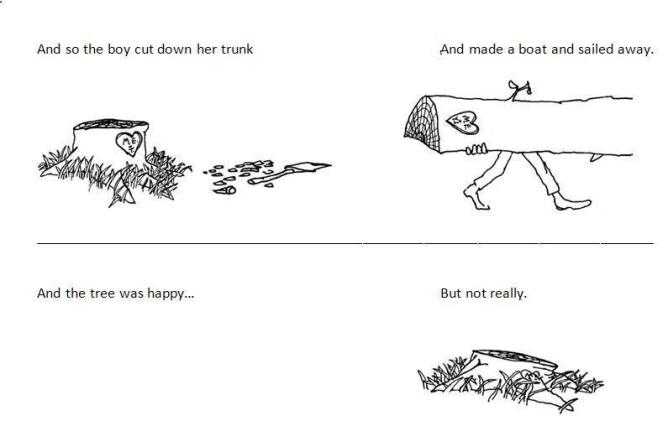
Many see in Shel Silverstein’s book an example of unlimited, sacrificial love. I see a brilliant example of co-dependence. Is it a virtue to harm myself in order to help others?
A year or two ago I read a quote from Ayn Rand’s book “The Virtue of Selfishness,” and was intrigued by her siding with selfishness against altruism as our ethical necessity, our moral calling. (She did not distinguish between selfishness and self-care, which is a complex contrast to untangle.) Here is an example of her perspective, which rings true to a lot of my own life experience:
Altruism declares that any action taken for the benefit of others is good, and any action taken for one’s own benefit [i.e. selfishness] is evil…. Observe what this beneficiary-criterion of morality does to a man’s life. The first thing he learns is that morality is his enemy: he has nothing to gain from it, he can only lose; self-inflicted loss, self-inflicted pain and the gray, debilitating pall of an incomprehensible duty is all that he can expect. He may hope that others might occasionally sacrifice themselves for his benefit, as he grudgingly sacrifices himself for theirs, but he knows that the relationship will bring mutual resentment, not pleasure—and that, morally, their pursuit of values will be like an exchange of unwanted, unchosen Christmas presents, which neither is morally permitted to buy for himself…. If you wonder about the reasons behind the ugly mixture of cynicism and guilt in which most men spend their lives, these are the reasons: cynicism, because they neither practice nor accept the altruist morality—guilt, because they dare not reject it.
I had that guilt of never doing enough for others, but instead of cynicism I practiced and accepted the altruistic morality of denying my own needs (because the needs of others always trumped mine). This conviction that my own needs did not matter left me with a sense of worthlessness. Is selfishness evil? Is it always virtuous to give? I’d like to explore in a few blogs some of Ayn Rand’s views.
 In July I stopped posting because I was depressed (over my failing lawn enterprise). In August I kept silent because I was no longer depressed (with my fall job returning) and had no interest in poking my emotions. Let sleeping dogs lie… they need their rest. Now that I’ve had my breather, I’m waking up to the world again, renewing my personal search for the real and true, but I’m going at a more leisurely pace. I think I’ve been in much too big a hurry to grow up. I need to learn to relax into time.
Matthew 1:4 Ram fathered Amminadab and Amminadab fathered Nahshon
Wouldn’t it be great to be Billy Graham’s brother? I’m not so sure. How would you be introduced at parties? Whose exploits would your children talk about around the dinner table? In public, whose reputation would you be most concerned to protect? CNN, Time, NBC would all contact you… with only questions about Billy. Imagine your whole life and personhood defined by someone else.
Amminadab knew that feeling. His name appears nine times before the gospel of Matthew, in four separate books of the Bible, and we know nothing about him. But we know about his son Nahshon. Even in the middle of a genealogical listing, the registrar pauses to trumpet Nahshon: “Ram was the father of Amminadab, Amminadab was the father of Nahshon, the leader of the people of Judah.” The only reason Amminadab’s name crops up at all is to note his relationship to Nahshon… except for his first appearance, when he is footnoted as the father-in-law of Aaron, the high priest of Israel.
We all live in someone else’s shadow that is cast by the spotlight on their better performance in cooking or speaking, patience or punctuality. As I do life with others, it is naturally hard to feel good about myself, hard to avoid competing with Jennifer’s achievements, hard to resist comparing Jason’s friendliness to my own. But when our culture also constantly rates us against our fellow, noting how we fall short, it becomes nearly impossible. I can either sign up for this game where I must be a winner (in everything) to feel adequate, or I can opt out and be labeled a loser. That is, I can constantly chase after the adequacy that is just beyond my grasp or I can give up in despair and accept my own worthlessness… or I can stumble into grace.
When you consider Amminadab, Nahshon, Aaron and Moses in the light of their descendant at the culmination of Matthew’s genealogy, they all rank shoulder to shoulder. We all stand equally shadowed by Jesus’ glory. But here the simile breaks down, for Jesus does not diminish us by his greatness, but transforms us by it. We stand not in his shadow, but in his glory, and this comes not as the borrowed, vicarious glory of a famous relative, but in his fulfilling in us all he designed us to be. Jesus being all he is makes me all I am and can be. May we be such life-givers to one another.
Matthew 1:3 Perez fathered Hezron and Hezron fathered Ram.
 Hezron and Ram have no stories, no histories, no parts to play. They are nobodies, appearing in the Old Testament simply as names in lists of genealogies. The vast majority of Israelites who lived then are not mentioned at all. They plowed and played; they held one another as their crops failed and laughed with delight at their grandchild’s first words; many worshipped God faithfully and walked with him daily but are completely unknown to us, very much like Hezron and Ram.
Since the Jewish Bible is primarily about the nation of Israel, the leaders of the nation and events that directed its course are inevitably featured. Still, it seems that God considers the “movers and shakers” as the important ones, the ones to write home about, the role-models to recommend. Compare how much we know of David in contrast to his brother Eliab, the firstborn. If you want to be on God’s A-list, you have to make a big impact in the world, make a name for yourself in his kingdom. And to do that, all you need is faith.
This view of the Bible seems oddly familiar to me. When I was growing up, the heroes were folks like Lincoln, rising from an obscure log cabin to the White House, or like Einstein, stepping out from behind a clerk’s desk to become the foremost scientist of his time. I grew up believing that I could be anything I wanted if I had enough self-confidence and commitment to the vision. This is the American dream, and ours is the land of opportunity where the only limitations are our faith and determination. This take on life provides a value system, a goal, and a means to that end, and without realizing it, I bring all of this to my reading of Scripture.
I measure the strength of my faith by the greatness of my deeds—am I like David? The completeness of my commitment will make me a Daniel. The weight of my godliness will get my name written down next to Job’s. I can be one of God’s role-models for my generation. If I simply make myself wholly available to God, he will make something great of me. But what if I give it everything I’ve got and never make it out of the log cabin or clerk’s office? Do I lack faith, is my commitment faulty, am I unusable? Does God find me of little value?
Perhaps something is wrong with my perspective of what God wants, what is important, and what I should value and aim for in life. I don’t think God was less pleased with the unnamed in Israel who sincerely followed him. But this culture runs in my blood—I invariably measure the value of my contribution, for instance, by how many folks read and find benefit from my blog. The engine is not more valuable than the engine mount bolt… without the bolt, the engine will fall off and the airplane crash. Every role in God’s kingdom is vital, irreplaceable. If that’s my theology, why do I so often feel like a loser?
 It seems a still deeper issue clouds my view of what really matters to God. Does he care more about what I do or who I am? Why do I find myself so obsessed with doing rather than becoming or relating? Why does accomplishment determine my value–“I may be only a bolt, but I’ll be the best bolt ever made”? How drastically would my outlook and life change if my focus were rather on who I am and how I relate to others? How would it impact my understanding and application of Scripture? If it is David’s faith rather than his triumphs, skills, and leadership that is to inspire us, what would that faith look like in the life of a farmer, a seamstress, or a store clerk, in Hezron and Ram and me? Rabbi Zusya said, “In the coming world, they will not ask me, ‘Why were you not more like Moses?’ They will ask me: ‘Why were you not Zusya?’” Considering how God filled the earth with “nobodies” instead of “somebodies,” he must value us a lot! Or to put it differently, everyone is a very big “somebody” to someone else, even if that someone else is only God. Did I say, “only God”?!
Things were going fairly badly this last weekend. My several hundred dollar chain saw died before Friday’s storm, which not only was a loss of that amount, but prevented me from making money clearing trees for the thousands who had trees down (about every other house on our street, for instance). A huge tree from our yard was uprooted and crushed our neighbor’s shed, and I was trying to find out our home-owner’s insurance deductible (but the insurance company was closed for the weekend). Our power went out, and hundreds of dollars of food was spoiling in our fridge and freezer. We had no air conditioner or fans or ice on the very week the tempurature decided to climb above 100F. My mower stopped working in the middle of cutting a lawn on Saturday, and I had no way of getting it up the steep ramp into the back of my truck (it weighs 500 lbs.). I had to finish the 1 acre lot with my push mower (in said heat). We had no internet to know what was going on (when the power would be back on, for instance), and my brother, undeterred by our lack of electricity, suddenly showed up in town for a visit (from the West coast)… we offered him warm orange juice and a candle to use the bathroom. In this sweltering heat, we soon found out the electricity would be out for a week.
The financial hit was troubling me most as I have been unable to drum up enough clients to make my summer mowing economically feasible for us. On Monday, I reached State Farm and found out that since this was an “act of God,” my neighbor’s insurance would be responsible to cover the costs. My wife and I had been planning to visit a nearby friend (her “step-aunt” I guess) to celebrate the 4th and spend the night. When they found out our electricity was down, they very graciously opened their home to us and allowed us to pack our refrigerated food into their fridge and freezer. So here we sit in a beautiful lakeside house for the week, forced to have a vacation we could never afford. As we were packing up to drive down here, Kimberly brought out a netbook she had but never uses. I forgot it was around, and suddenly I realized I have the replacement for my laptop (which I’ve been badly missing for 2 months) only smaller and so much handier. I figured out how to get the mower onto my truck (backing it up to a bank where I had towed my mower and pushing it in on the level ramp), and on Monday I was able to fix it with a $6 spring. All in all, the week has been a wonderful refresher.
Gilles Le Cardinal shares a vital life concept he learned from those with disabilities, an idea he called revolutionary
Because it is about how our weaknesses can be fecund and fruitful. Especially for handicapped people, but also for others. And that was something I discovered from handicapped people, when they said you do not have to hide what is imperfect in you. And this changed me. Because in a competitive world, you must hide what is weak or wrong. Someone will try to beat you when they discover a weakness, try to take advantage of the weakness. When two players on different teams play, they try to defeat each other. And that is exactly where the handicapped disagree. They respect our mutual weakness.
And then Ian Brown, the author who quoted this conversation, a father of a severly disabled boy named Walker, goes on to write a naturalistic explanation with more respect for “the least of these” than many a Christian perceives.
One is revealed by one’s need. There is no need for posturing…. So you can perhaps forgive me for thinking, some days, that Walker has a purpose in our evolutionary project, that he is something more than an unsuccessful attempt at mutation and variation. For thinking, probably vainly, that if his example is noted and copied and “selected,” he might be one (very small) step towards the evolution of a more varied and resilient ethical sense in a few members of the human species. The purpose of intellectually disabled people like Walker might be to free us from the stark emptiness of the survival of the fittest.
Which, I might add, is a tendency we all have to cope and get ahead in this world, even we who are not evolutionists.

WHAT LANE?!
Kimberly has a conjunctive view of life and I a disjunctive, she responds to input by assimilation and I by differentiation, she creates a unified mosaic and I a careful pattern. We are very different and we are blessed, enlightened, and expanded by that difference, but it often shapes up into an emotional disagreement where we both feel the other is rejecting our viewpoint. This happened again on Monday when we were reading about Sabbath rest on the seventh day of creation, and I was inspired by the thought that we were called to imitate not only God’s rest, but God’s creativity, to express our true selves to the world as our gift and offering during the first 6 days of the week. I was excited about that image and wanted to explore its potential.
I heard Kimberly respond that many jobs (such as an assembly line) had no room for creativity. I sensed she was objecting to my idea and countered with illustrations of how creativity is possible even in dull jobs. She heard my resistance to her input and needed to defend her own view. This is a very common conflict between us. Thankfully, this time I was not too emotionally invested in the topic and we were able to explore the conversational dynamic itself dispassionately.
Berly receives new ideas with openness, assuming they fit into her worldview. She is inviting, embracing, inclusive. This not only goes against my personality, but my brain. I simply cannot understand an idea unless I can differentiate it from other ideas. As I am faced with new ideas, I evaluate them so that I can determine how they fit into my worldview. If I cannot fit them in, I reject them. Kimberly understands her world relationally and I understand mine logically… this does not mean that she is illogical and I am antisocial, but that she is intuitive and I am analytical. (In fact, I just had to edit that sentence, because I originally wrote “Kimberly organizes her world relationally” which is biased towards my view… you can see our problem!) I grow constantly by listening to her perspective.
In the case of my creative approach to occupation, Kimberly was feeling the need to support those who had no space for fresh ideas. Because of a harsh boss, family crisis, emotional distress and the like, many people at work just hang on to their jobs, barely fulfill their duties, and my pushing for creativity would be oppressive, something for which they had no emotional energy. She suggested that there might be many other ways of improving one’s work situation which would trump creativity as the next important step. In other words, creativity is always a possible play, but it is only one card in the hand. I agreed with her.
 Kimberly was not challenging my view as wrong. She was not disagreeing, but supplementing, trying to include those whom my view seemed to ignore. She works under the assumption that when she proposes a different point from mine, there is room for both views; whereas I am inclined to see incompatibility and competition in something that is different. Over the last couple days reflecting on this dynamic of ours, I realized how often I create conflict in discussions where there need be none. Inclusive thinking does not come naturally to me… I lack imagination and motivation for that exercise. Kimberly’s idea did not restrict mine, but added to mine. I can still fully explore the possibilities of bringing creativity to my occupation while also exploring other facets of growth and engagement at work. I realize now how often I fail to learn from those with whom I seemingly disagree and build a block for them against my own view by assuming incompatibility. Interaction is about understanding one another, not simply understanding ideas.








 Janathan Grace Reflections