These reflections are just my thoughts, things that have helped me. Please forgive me if I sound dogmatic. I don’t mean to be. If these thoughts don’t help you, then by all means dismiss them; or if you disagree, argue with me in a comment (though remember my tale is not done).
It seems we all try to control others in various ways, and we are usually blind to what we are doing. We think, and even say, that we only want the best for them, not realizing that if they are pressured or forced to make better choices, those new behaviors will not nourish their heart, but shrivel it, because they are not freely choosing out of a loving relationship with God and others.
Sometimes, especially with children, control is necessary for their own safety and health, so that they can live long enough without significant damage to grow into understanding. But if this is the default teaching method, the greatest life lessons the child will learn are that her feelings don’t matter, that she must live from obligation (another word for bondage or lack of freedom), that what she does is more important than who she is.
Let me give a simple and common illustration from my own upbringing. My mom and dad naturally wanted to keep in close touch with their children when they “left the nest.” I was the youngest and last to leave, so their feelings were especially acute towards me. I was on my own for the first time and enjoying my freedom, and I didn’t keep in touch as much as they would like with letters and phone calls. Not only did they miss me, but I expect it made each wonder subconsciously, “Does he really love me?”

I Need You to Change!
Under the force of these emotions, they believed I was remiss in connecting with them. I was to blame for their bad feelings, feelings which I could so easily allay. It would cost me very little (so they thought) to keep in touch, and they pressured me in this direction. When I phoned them, their first statement was usually, “Well, we haven’t heard from you in a long time,” by which they intended to push me to show my love by calling more often. To the extent I bowed to this expectation, I was reacting from a “should” and not from compassion. In fact, the more pressure I felt, the less I was able to respond from genuine love. To my parents it felt like love when I deferred to their wishes and called more often, but somewhere deep inside they must have known that “loving” acts resulting from pressure do not mainly spring from love.
If they had shared their genuine feelings without making me responsible to fix them, it would have drawn out a natural love… I would have wanted to phone them instead of “having” to phone them. If they said, “We really miss you and miss hearing from you,” and genuinely did not hold me responsible for their feelings, but were only sharing their feelings, it would have made a world of difference. Of course, then they could not trust that the outcome would be to their liking since they granted full and genuine freedom.
Sharing your feelings with me without the assumption that I should fix them is a huge invitation into your heart and opens me up to welcome you and share my heart. But telling me about your feelings in order to get me to conform will make me resistant and closed. I will hear the message that I am bad unless I change and I will react to protect myself. If I do yield because of the pressure, because I believe I am responsible for your feelings, it will damage us both, and hurt the relationship. It may feel good, but it will encourage a legalistic view that love is conditional, dependent on my behavior.
I learned from an attractive friend of mine that insecurity does not only come to the daughter who is shamed for her looks, but also to the daughter who is praised for her looks in a way that makes her think her worth depends on it—she may seem proud, but is really filled with fear. The issue is not whether someone is valued, but why they are valued, and if they are primarily valued for conforming to our expectations (being a “good” child), they will always fear “misbehaving” lest they lose their parent’s love which appears to them very conditional and therefore precarious. The same is true in friendships and marriages.
If I am loving towards my wife when she does as I wish, and withhold love (act cool, snipe, act the martyr) when she does not, she will respond out of fear of losing my love. As long as she conforms, she will feel good about our relationship, but it instills a deeper insecurity. That isn’t to say I should never get frustrated or irritated or discouraged. That isn’t to say I should never express those feelings to her. Feeling all my feelings and expressing my feelings are key to good relationships.
But when I share my feelings as a means of getting her to do what I want or need, she feels unsafe with me, and she closes up her heart to protect herself. From my family’s perspective, why would I share an aggravation or disappointment unless it was to get her to change? If I didn’t need her to change, I would say nothing and just deal with it in my own heart and mind, I would silently accommodate. It is when I felt I needed her to change that I would share my displeasure, in order to get her to change and so free me from my unhappy feelings. It was her turn to accommodate. Let us just say it was a very bumpy ride for several years.
We all know we have some influence over our emotions, and there are various reasons we may find it beneficial in particular situations to manipulate our emotions: if emotions are impairing our functioning on some crucial matter, if we cannot control our expression of emotion and that expression is damaging others, if we don’t have enough space (time, safety, etc.) to process our feelings just now. In such cases we are not ignoring our feelings or pushing them away, but we are asking them to wait for a bit until we can address them.
If as a rule we listen and support our feelings and what they are telling us, then the exceptions I suggested above won’t undermine our spirits. If as a rule we try to control our emotions instead of listening to them empathically, it is as healthy as trying to control your spouse—the more “successful” you are at this effort, the more damage is done. It took me a very long time to begin to deal with my emotions based on the principles of grace instead of the principles of law.
I can manipulate my emotions by suppressing them or by aggravating them and neither approach is healthy. It is one thing to listen graciously and patiently to my anger until it has told me all it needs to say; it is quite another to pump up my anger. When I use various means to exacerbate my feelings, I am being just as untrue to my genuine emotions as when I refuse to hear them.
I find that the best question to ask myself regarding my feelings and my response to them is “why?” Why do I feel so angry? Why do I feel the need to stimulate them further? I used to ask myself these questions in condemnation, just as my irate mother used to ask us: “What is WRONG with you?!” This was not asked in a comforting way to find and relieve our suffering. The natural follow up to such a question was, “Just stop it!” And that really was my attitude towards my own feelings.

OUT!
When I was in India, I kept throwing my unwanted emotions out the back door, only to realize too late that it was not the back door, but the closet door, and the shelves collapsed under the weight of my ignored emotions, driving me into deep depression. Trust me, when you ignore or shame your emotions, it does not fix them or get rid of them, it just forces them to keep working behind the scenes where they sicken and weaken your spirit.

Give me half!
Kimberly and I read this together Sunday and found the subject quite relevant:
As Jesus is teaching, someone in the crowd calls out, “Teacher, tell my brother to divide the family inheritance with me.” He wants Jesus to correct a personal injustice he has suffered. He thinks that if Jesus changes his brother, and he gets his share of the loot, he will be happy. He locates the cause of his suffering outside of himself.
Jesus doesn’t bite the hook. “Who made me a judge or arbitrator over you?” If Jesus really cared about people, would he not jump at the chance to make things right between people? Most of us would! We love to get in there and decide who is wrong, who is right, and think we are fixing things. Jesus teaches us to see more deeply than that…. If Jesus had stepped in and made his brother split the inheritance, nothing would have changed. The man would still be stuck in his own spiritual poverty.
Our responses to others reveal more about ourselves than the other person…. Just when we think we are so loving, forgiving, non-violent, so full of God’s purposes, someone or something comes along and trips us up. Tha anger, the fear, the jealousy, the judgmentalism flare up in us again. And once more we find ourselves thinking it is this other person or this circumstance that needs to be changed. If we can receive persons and experiences into our spiritual lives and discover what they are teaching us about ourselves, we will find that the real answer is not in the change that happens around us but within us. When we are engaged in that kind of transformative spiritual life, when true, deep love, when true peacefulness, when true forgiveness and compassion are being formed in us, then we are people who foster change in others and the world.
We don’t know what happened to the person in the crowd that day, what he did with Jesus’ teaching. He was at an important juncture in his life. He could remain the prisoner of expectations and demands related to his brother and to life around him. Or he could look at himself, come to greater self-awareness, and turn toward a life of true security, freedom, and joy.
Kimberly is worried that some folks may think I am reporting on current discussions, that we are in some kind of tiff. I’m actually reporting a synopsis of hundreds of conversations over the last seven years. We are mostly on the same page now, but it took years of hard work to get here, and has been worth every effort.
When I was struggling with a deep sense of inadequacy and shame as a pastor in Arlington, a friend recommended a counseling couple. As I sat with them in their living room, they explained that my poor self-worth came from believing lies, especially lies about God. That may have been true, but it only made my sense of humiliation worse. Not only did I feel shame, but I was wrong for feeling shame. It is hard to hear, “You are deceived,” and feel positive about yourself, and “The God you worship is a false god,” is not particularly comforting either.
If this couple had identified with and shown empathy for my struggles, it would have made a huge difference. They could have said, “We have all been tricked into believing lies foisted on us by family, church, and culture. We are the victims of these deceptions.” This may have really been their thought, but I could not get past the shame of living a lie. When I asked Kimberly, “Doesn’t my anger or sadness or fear point to something that should not be in my heart, some skewed perspective for which I am guilty?” the question itself seems to invite a shaming answer.
“Well, did you know these beliefs were false?” she asked. “Did you deliberately avoid the truth? When you were at last shown the way did you run from it?”
“No,” I said, “I set my feet to it, not perfectly, but as best I could in spite of the fear and pain.”
“Yes, something is in your heart that should not be there, just like Somali pirates should not be on oil tankers, but you are no more guilty of it than the ship’s captain. You did not create this darkness, but are rather victimized by it. Don’t shame yourself for these lies which deceived you, but have compassion on yourself for the harm you still suffer because of them.”
Such soothing words of grace! If I keep shaming myself for my struggles, it will push me away from God’s grace. I’m afraid that if I openly admit what a mess I am, God will agree and put me on the bench till I get my act together. Instead he embraces me and says, “I’ve been waiting for you to discover your wounds and show them to me so that I can begin to heal them.”
Emotions often reveal the unhealthiness of my heart. If I rebuke and punish myself for this junk, I become more lost in the mazes of my shame and more afraid of the truth. I’ve discovered that when I show myself compassion, like a child who is sick, the truth loses its monster mask and I am much more able to open my heart to it. The truth comes to me as a companion and help rather than a testy and impatient headmaster.
After dozens of conversations I started to understand that Kimberly believed feelings are neither good nor bad, they just are. “Excuse me, but haven’t you read in the Scriptures all the evil that comes from anger?” I respond.
“Well,” she says, “if God himself gets angry, it can’t be all bad.”
“Ah, yes, but everyone knows there is ‘righteous’ anger and ‘unrighteous’ anger. If you start feeling the bad kind, you are sinning, and must stop feeling that way. You can get angry for the wrong reasons or for the right reasons, and you should not get angry for the wrong reasons, so if you do, you have to repent.” She clearly did not believe the childhood morality I was taught.
“So,” she responded, “if emotions can be immoral, it means you choose them or refuse them. Is that how your emotions work? Because my feelings come without thinking, often without warning.”
“No,” I reply, “you can’t control your initial emotional reactions, but you can choose to hold onto them or to let them go.”
“And how do you let them go?”
“You tell yourself they are wrong and think of all the reasons why you shouldn’t feel that way, and you can talk yourself out of those feelings.”
“So, Jani, basically you should all over your feelings… you beat down your emotions with the law?”
Long pause as I think about this. I decided long ago that motivating myself with shame is a bad idea. Is that what I was doing? Wasn’t I just listening to my conscience, examining myself, and repenting? Should I not feel guilty for wrong feelings and stop myself from having them? I knew I didn’t have total control over my emotions, but I had enough control to force out the bad ones. I had done it many times.
“I guess I agree with you that my motivation should not be legalistic. So maybe I should work from the motivation of wanting good relationships, and everyone knows anger pushes people apart.”
She responded, “In my family, politeness was a much greater threat to true connection than anger. I have often seen anger bring people closer together because it forces honest communication and each person ends up telling the other person how they really feel. What do you think makes anger bad?”
“Well, you don’t like me getting angry at you!”
“It is not your anger that is a problem for me, but your blaming me.” Okay this REALLY does not make sense. If she was not to blame, why would I get angry? Getting angry over an innocent behavior is just wrong. How can you possibly separate anger from blame? If there is anger, someone is to blame! How could she say that all feelings are legitimate?
“So you think there is nothing wrong with being angry as hell at an innocent person?” I ask.
“Well, what do you mean by ‘wrong’?” she responds. “If you mean ‘are some emotions immoral,’ then I would say no. If you mean ‘are my emotions accurate or correct,’ I would say it depends on what you are measuring. Feelings are unreliable interpreters of someone else’s behavior (your rage does not prove that I’ve done something wrong). But feelings are great interpreters of your heart if you listen to them carefully. Emotions always tell you something about yourself rather than about the other person.”
Wow, that’s really a revelation to me. She is delinking my negative feelings from her culpability, a bond I thought inseparable. I could only imagine my anger being justified if she were truly at fault, but she is insisting that my feelings of anger are legitimate in themselves, even if she has done nothing wrong, nothing “deserving” of anger. They are legitimate for the very reason that they do not measure her misconduct… they simply alert me to what is going on in my heart, and do so quite accurately. If I merely shove my anger away or talk it down without considering what it is telling me, I can gain nothing from it.
After mulling this over for awhile I ask, “Okay, so maybe emotions are not evil in themselves and are just a gauge of my heart, but aren’t some of them a gauge of my bad heart? Doesn’t my anger or sadness or fear point to something that should not be in my heart, something for which I am guilty? And isn’t it possible to hold on to or nurse these negative feelings and so keep myself under their power? And doesn’t it matter how I express my feelings?” I was determined to prove my “negative” feelings were bad in some way!
When Kimberly said, “You are responsible for your own feelings,” I could only think, “If I am responsible, then I have control over my own feelings, and I should not be irritated. I lack self-control, I am not ‘walking in the Spirit,’ I am bad.” You can imagine that the continuing conversation did not go well as I tried to defend myself from the accusation that if I were aggravated, it was my own fault.
Mind you, that was not what she was saying. In fact, she might have used the words, “You need to take ownership of your own feelings,” but that sounded the same to me. She rightly perceived that I was angry and blaming her and expecting her to quit. No one likes to be blamed or manipulated with angry tones of voice, so she reacted in self defense, but a very gentle self defense. She was not returning blame for blame, but that is what I heard.
“Look, I was not irritated in the least until you started slamming the cabinet doors. You started slamming, I got irritated. If you had made less noise, there would have been no irritation. Cause and effect. If you don’t want me irritated at you, don’t bang the doors.” It simply made no sense to me to see it any other way. I had reasonable expectations, and if they were reasonable, she should meet them.
“I’m not telling you that you can’t get irritated, you have every right to get irritated. I’m just not responsible for your irritation.” A long silence on my part as my brain cells tried to break the code: “I only have the right to get irritated if she is doing something obviously irritating, and if she is, she should quit. How on earth can you separate the two… if I am right in getting irate, then it is her responsibility to change. If I am wrong in getting irate, then it is my responsibility to change by repenting of my frustration.”
In my perspective, if there were tension in a relationship not caused by miscommunication, then someone was right and someone was wrong (or both were partly wrong). The way to resolve the tension was to determine who was at fault for what, have them apologize, and the other would forgive them. Over and done. That was always the way it worked in my family. Frustration is either legitimate or illegitimate, if legitimate, the offender repents, if illegitimate the frustrated one repents (“I’m sorry I snapped, I was tired… it was a hard day… I have a headache”).
My wife’s approach made no sense at all—first she irritated me, and then she blamed me for being irritated (as I thought). You can imagine how many rounds of conversation we went through as I tried to figure out what she meant, desperately avoiding her conclusions because they would only squeeze into my paradigm through the slot of shame—whenever I have unhappy emotional reactions, I am at fault and must stop feeling as I do. But she kept insisting I had the right to feel my feelings. Does she mean I can feel these things, but should not express my feelings? She wanted me to express my feelings to her… just not blame her. But if she had done nothing wrong, then wasn’t it my fault for feeling frustrated? I was lost, driving in a loop with no exit ramps.
My wife speaks Chinese to me… at least that’s how it seems when I know the vocabulary she uses but cannot make sense of the message. I love her and so I repeatedly, intently try to follow what she is saying. When someone’s presuppositions are entirely different from mine, they make statements and assert conclusions that are meaningless to me, like: “A subjective cucumber chairs England with pneumonia.” Where do you even begin to ask the questions? And if it is completely coherent to Kimberly, she doesn’t know what needs explaining.
Me: “Do you mean a green cucumber that you eat?”
Kimberly: “Of course, what other kind is there? Now do you understand?”
It has often taken me months and even years through scores or even hundreds of conversations to slowly grasp her meaning about relational things far more complex than cucumbers. Over my head is not a light bulb popping on, but a fluorescent “tube light,” shadowed on both ends from overuse: blink… dark… blink blink-blink… dark… dark. Presuppositions are stubborn things and lie hidden behind blind spots.
The issue I raised at the end of Response #4 actually has several entangled, powerful, and unnoticed assumptions. I mentioned the first—that I felt responsible for others’ feelings. If someone does not like what I am doing, then I should stop doing it unless I have an overriding reason to continue. I am responsible for their feelings. Your irritation is because of my behavior—direct cause and effect—and I am responsible to change my behavior so you can stop being irritated. Your irritation is very reasonable; anyone would be irritated over this; only a saint would not be affected. Your irritation is controlled by my behavior.
This is a society-wide assumption, so that if anyone says, “Stop doing that! You are irritating me!” the only proper response is to say, “Sorry, I didn’t realize it was bothering you,” and to stop. We have no sense of distinction between the statements “I am irritated,” and “you are irritating me” or “you are making me irritated.” When we say the first, we really mean the last two; we are not taking responsibility for our own feelings of irritation, but are putting the responsibility squarely on the shoulders of the “misbehaving” person. Of course, we distinguish between reasonable and unreasonable irritation, usually based on our own perception of social norms, but that must wait for another discussion.
I, for one, completely operated by this principle—my behavior caused your irritation. It was so obvious and clear and universal a concept, and I never heard it refuted. When Kimberly said, “I am not causing your irritation,” it made no sense to me at all. “What do you mean you are not causing my irritation?! When you bang the kitchen cupboards, it irritates me. My irritation comes from the banging cupboards… where else would it come from?” Can you understand my confusion?
I may have been more confusing than clarifying in my Response #4. So I want a re-do (wish I could do that in life!).
I had very little understanding of legitimate relational boundaries for most of my life. If two of us had conflicting needs, I thought I was responsible to deny my own and “consider others as more important than myself.” Anything less was selfishness. I also believed I was given more resources by God than others (after all, I came from McQuilkin stock, a line of highly honored preachers, missionaries, and college presidents), so the greater burden should rest on me. This was the scaffolding for serious self-neglect.
If I starved myself to feed the hungry, I would die quickly, but when I starved myself emotionally, there was no such forced resolution… I kept living, breathing, and relating. No matter how much I gave, I felt I was not giving enough. So I pushed myself further and further until I nearly killed myself in India. Self preservation was not in my DNA. After all, I subscribed to the motto, “deny yourself, take up your cross, and follow me.”
If I had the resources, and another had a need, I was obligated to meet that need. I thought the only morally legitimate way to deny helping Bob was to help Bill instead. To use my resources on myself was simply selfish. It was not a true need of mine. Christ was all I needed, and instead of receiving what he wished to give me, I became simply the channel for his giving to others, a teflon heart towards God’s grace. I didn’t realize what harm I did myself and others by working out of a serious personal deficit. I did not understand how healthy relationships worked.
Of course, the more I expected of myself, the more I expected of others… not as much as I would give, but still a fairly high standard. When they did not give what they were “able” to give (in my estimate), I judged them as unspiritual, uncommitted, and selfish, and I resented having to make up for their slack. Denying myself everything for others only worked if they denied things for me.
I was blind to the distinction between healthy and unhealthy giving. That difference might best be illustrated with actual gifts, the kind with wrapping paper and bows.  There is quite a long list of unwritten, unspoken guidelines that must be followed in our society if we wish to be an acceptable member. The one with more money may spend more; the amount of money or time spent is a reflection of how much the recipient is valued; gratitude must be expressed (whether or not the gift was a true expression of love), often in writing; and the list goes on. We speak of a ‘gift exchange,’ a social arrangement which prescribes rules and follows social norms to avoid anyone giving too much or too little. But the original meaning of “gift” (Charis in Greek) suggests something freely given out of love without thought of return. Otherwise we are really talking about trading, a legitimate financial arrangement, but one that follows law, not love.
 As long as everyone follows group expectations in an exchange, this arrangement works swimmingly, but once we try to move towards a gracious approach, one that does not include payback, the old rules do not apply. If I must give everything to everyone without consideration for reciprocation, then I am in serious trouble if others do not do the same. All my resources (whether time, money, emotional reserves, energy, etc.) will sooner or later be exhausted, and then I have nothing for myself or for others. Without receiving adequate “reimbursement,” the system fails. The path of grace seems unworkable unless everyone else is equally “gracious.” Instead of being responsible for my own upkeep, they become responsible for me, and I for them. I am at the mercy of the goodness of others… if they are not good enough, I cannot survive. This sounds to me suspiciously like co-dependence rather than interdependence. Am I not ultimately responsible for myself?
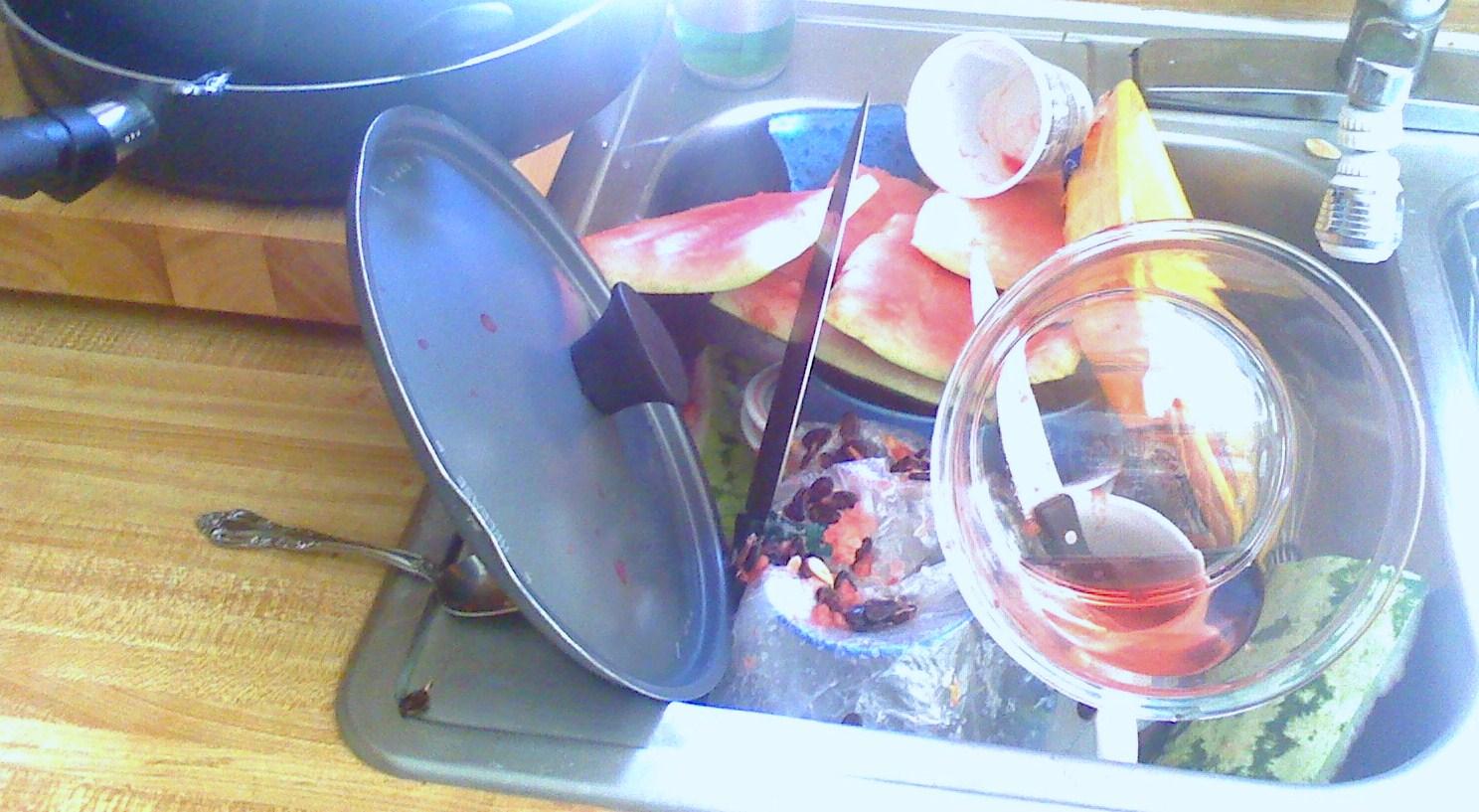
I do the cooking in our house because I enjoy cooking and my wife does not. I usually make huge messes when I cook: countertops flecked with flour and fruit juice and butter, stove top smoking with burned on spills, a sink overflowing onto the large cutting board with stacks of dirty pots and pans.

Last night as I finished cooking supper I commented, “I should have a neat cook come watch me and give tips on how to minimize the mess.” Kimberly replied, “that’s who I am! If you want to improve, you just have to put a much higher value and concentration on cleanliness as you cook. But do you really want to go that route? It might stifle your pleasure in cooking.” She was exactly right. So now I have been set free to blissfully make messes (as long as I clean up afterwards). I have a wise and understanding wife.








 Janathan Grace Reflections