Archive for the ‘love’ Tag
My sister Mardi emailed me this a few years ago:
 On NPR I heard a really sweet story of a Dad and his little boy. The little boy had had a serious illness, had nearly died and had a long hospitalization and lots of surgery and treatments. Through it all he had clung to his Teddy Bear, Toby. Even after he had gotten better, he carried Toby with him everywhere. Then when he was 7 the family was on vacation and when they got home, Toby was missing. They told him and he said “I don’t know how I can go on without Toby” and then he said “I feel like I’ve lost my soul”!
Well, his Dad promptly got on the next plane back to Anaheim and went straight to the hotel. The hotel people looked and looked and asked the staff and found that the bear had been found by a cleaning person, but it was in a trashcan and so they had thrown it out. Undeterred, the father asked where the trash was put. They showed him the large (size of a semi truck) dumpster in the back. Good news, the truck had not yet come to pick it up, it was scheduled to pick it up the next day….bad news, it was completely sealed with no way of getting into it. But, as they were talking about it, the truck drove up! The father convinced half a dozen of the hotel employees to go with him and help him look for Toby. He said that they were all parents and understood why he needed their help. He also offered $100 to the person who found the bear. So they all get in a van and follow the garbage truck to the recycling facility. (at this point I am crying in the car as I am listening to the story unfold) Now, this facility is not just a city dump; it is a huge building with many bays where the trucks pull up and cranes lift off the dumpsters. Inside is an area the size of an airplane hanger with all sorts of equipment and vehicles and people working. The people at the facility are not going to let them go in there. But after a lot of talking they agree to shut down the equipment and let them look for Toby….but only for 15 minutes.
 Well, when they empty out the dumpster on the floor, he said it was a huge mountain of garbage, bigger than he could have imagined. It was all runny with a lake of brown garbage liquid with all these plastic bags sitting and floating in the brown goo. The hotel people jump in and start tearing open bags looking for the bear. The father is overwhelmed by the enormity of the task but begins tearing open bags too. Then a number of the employees of the facility put on their gloves and begin wading through the muck tearing open bags too! (I’m bawling in the car). There are now about 18 people looking through the mountain. But as the father looks at the size of the pile and the number of bags, he realizes in despair that it will be really impossible to look through it all. And in his heart he just says “Toby, we’re not going to be able to find you unless you somehow show yourself”. He said that he is not a particularly spiritual guy, he’s an accountant and auditor…. a “just the facts, ma’am” kind of a guy. But as that thought went through his mind, he tore open a bag, and there was Toby, dry and clean. Everyone, of course was jubilant. The father immediately calls home to tell his little boy that he had found Toby. He said his little boy was happy, but seemed kind of matter-of-fact and the father realized that for the little boy it seemed that his father had just gone and gotten his bear back. The child had no idea of the super-human effort that had been accomplished for him.

GOOD TO SEE YOU... FINALLY
If Kimberly’s reactions had not provoked mine, I could have avoided my negative feelings and the issues behind them, but I and my relationships would have suffered. I needed her insecurities to push mine out of the shadows. From a hundred examples of this, let me share in this post one of our early conflicts.
When Kimberly and I started dating, she was living in Lynchburg and I in Arlington (of cemetery fame). Once a week I drove the 6 hour round trip to be with her. Occasionally she would drive to Arlington. I went to Lynchburg to spend the day with Kimberly, and I expected she would do the same when she visited me. However, she had other friends in Arlington with whom she wanted to connect. I was disappointed when she went off in the afternoon to visit her friend, and when she came back late for the dinner I was cooking, she could feel the cold winds blowing. I was quiet, polite, distant. She could have just ignored it and I would eventually have warmed up again, but instead she asked what was troubling me. I tried to pass it off, but eventually replied.
Me, a bit resentfully: “You said you were going to be here by 4 o’clock.”
Berly, defensively: “I know, but my friend needed a listening ear. I called you as soon as I could.”
Me, exposing the bigger issue: “When I come to Lynchburg, I spend the whole day with you.”
Berly: “You don’t have any other friends in Lynchburg to see.”
You can imagine the next two hours of conversation as I explained how reasonable my expectations were in the face of her uncaring behavior, and she explained how she could care about me without meeting my expectations. Even though we were both defensive, we tried to hear and understand one another over the cacophony of our feelings. We slowly came to realize that I place a high priority on time spent together, that this is my gauge of how much someone cares about me.
 Now, unfortunately, I must digress to clarify how our approach differs from other approaches. Let me first contrast it to the “apologetic fix,” the resolution of choice in my family of origin. The conversation would have gone:
Me, a bit resentfully: “You said you were going to be here by 4 o’clock.”
Berly, apologetically: “I’m so sorry. I should have been here on time,” followed by an effort to be sweeter and more solicitous than usual to win back my favor.
That would be it. We would both feel better. The resulting “peace” would be a sufficient reward, tricking us into thinking we had a healthy, happy relationship. Berly would realize my expectation and shape herself to conform in the future, not out of love (since she was responding to my shaming pressure), but in an effort to keep the peace. She’d “should” on herself to reduce her insecurity in my conditional love.
The second, more discerning approach would simulate our actual conversation, and Kimberly would realize time spent together was my “love language,” so she should do what she could to satisfy this need of mine. That would be the end of it. Conflicts would arise to the extent she failed to meet my expectations, but she would keep trying to adjust, reminding herself of my need and becoming more sensitive to it. This second approach is more healthy because it does not depend on shame as the motivator. In fact, the motivation can be from genuine love if the one who changes can do so without much personal cost (if it does not feed her insecurities). Notice that in both these alternate approaches the resolution is fairly simple and straightforward and depends on conformity to expectations, my underlying insecurities (if there are any) stay hidden and unresolved. The more the expectation is legitimized, the more the one conforming will see it as an “ought,” and such an obligatory response easily usurps a genuine love response.
Kimberly was unwilling to deny her own needs and feelings to satisfy mine. She stood up for herself in the face of my resentment. This only increased my insecurities about her lack of love for me (as I perceived it), and when my fears were exacerbated, I could see my issues more clearly. I realized that my anger was not a simple reaction to the current situation, but was protecting me from experiencing the underlying raw fear of not being truly loved, not being truly lovable.  Kimberly could easily relieve my insecurity in relationship to her by spending more time with me, but my fears would remain and continue infecting other relationships. I would keep protecting myself from others by blaming, pressuring, loving conditionally when I felt devalued.
My true need is not for friends to choose my company more often so that I feel loved. Trying to resolve my insecurities at this level will only block access to my deeper need, fears that I am unworthy of love. What is the source of this insecurity, what subconscious ideas are keeping me trapped in fear, how do I bring healing to this fundamental place of need? If I fend off my fears by enticing others to give me more quality time, I will never look for the answer to these questions.
 Fortunately, Kimberly’s issues did not allow her to salve mine: if she agreed with me that she was not enough, she would be denying her own needs and feelings. Unfortunately, given my presuppositions, I could not rationally separate loving someone from taking care of them. The first resulted in the second, otherwise it was fake. I did not disagree with Kimberly, I simply did not understand her. But I kept trying until I slowly realized that her gibberish was crucial to the healing of my soul and relationships. I was trapped in a world where others’ responses decided my worth. What I needed was to discover unconditional acceptance, to unhitch my lovability from how others did or did not love me, and hook it to a love that is unwavering and limitless towards me no matter how “unworthy” I may be, a love that is not drawn out more by my worthiness, but that proves my worthiness by loving me despite all.
And I need that divine love shown to me, however limitedly, through the heart of another in my world… the very thing which is Kimberly’s amazing gift. She is committed to accepting me and loving me for who I am, the good and the bad, the broken and partly mended, the prickly and tender. She shows me God as the Gracious One that he is. When I share my fears of being unworthy of love, not as a means to manipulate her, but simply to share vulnerably, it opens wide the flood gates of her compassion for me, and slowly I begin to see that I am lovable despite my many shortcomings, that my woundedness does not invite shame but sympathy. This peace and joy touches the deepest reaches of my heart and begins its healing work.

Something tells me we'll find a way.
I finally have enough emotional space in my life to continue my conversation about the conflicting needs in my marriage. I will first restate my perspective on emotions so you can understand my explanations (whether or not you agree).

(ONE WAY TO MAKE TRUTH A LIE)
No one likes unpleasant feelings, and so we all try to escape them. I think that is actually their purpose–like bodily pain that alerts us to physical harm, emotional pain alerts us to psychological harm, though it is the source of the pain rather than the pain itself that needs to be addressed. In other words, our unpleasant emotions are valuable and beneficial in protecting us. But since they hurt, we want to avoid the feelings themselves, and when Christians teach that such feelings are wrong, we believe we ought to avoid them: fear is a lack of faith, sadness is a lack of joy, despair is a lack of hope, anger is a lack of love, and so on. Not only do you feel bad, but you are wrong for feeling bad. As a result many of us have tried to directly control our emotions as a moral obligation, “get over” our weak and “sinful” feelings, talk ourselves into feeling better by controlling our conscious thoughts with “truth.” My own perspective is that when truth is wrongly applied it is simply another form of untruth.
Talking down our feelings may work with superficial and circumstantial emotions (ones which do not connect to deeper underlying issues). But if they are revealing more profound issues, I believe this approach waylays our attempts at growing more mature and healthy, like using aspirin to fight migraines that come from a brain tumor. I think we undermine our growth whenever we disrespect our own feelings (through denial, dismissal, shaming, etc.). As long as our coping mechanisms successfully distance us from our true, unhappy feelings, we are unlikely to recognize and work through our big issues.Coping mechanisms can be more addictive and blinding than pain killers when they are habitually used as the answer to our pain.

Neither Kimberly nor I would have faced our painful feelings if we could have successfully avoided them. I have numerous coping mechanisms: redoubled effort, procrastination, comparing myself to others, busyness, self-castigation & repentance, fixing, passing blame, detailed planning, control… and I could go on. Unfortunately, all these combined could not protect me from those unwanted feelings. I needed help. I needed to find a spouse that would shore up my inadequate defensive arsenal, someone who would be so sweet and supportive and gracious that I could find peace and security at last. I was sure I had found this in Kimberly.Kimberly had spent her life hiding her true feelings from others because she quickly learned the world did not like her unhappy feelings. She badly needed someone to accept her fully as she was, and she found that in me, or so she thought. I had very little discomfort with her depression and felt honored that she would share with me these vulnerable parts of herself. She discovered that she could trust me to accept all of who she is.
 But as we grew closer and more fully knew each other, as we grew in trust and shared more vulnerably, our conflicting coping strategies poked out.
  To protect myself against this assault, my coping mechanisms kicked in, and when she smacked against my defenses, she put up a wall. I would feel blamed and shame her in defense. She would withdraw into self-protective silence or try to explain her words in ways that simply hurt me further. The tension escalated, and all we knew to do was to keep talking it out… for hours… for days… for months and years.
We were committed to the relationship and to honestly working through our issues, we respected and loved one another adamantly, so our only way forward was to try to understand the painful dynamics. I explained myself over and over to Kimberly and she asked questions and tried to understand. She told me about herself, repeating the same confusing messages week after week while I struggled to make sense of it. Our way was slow, painful, scary, confusing, but we found ourselves on a journey of deep self discovery and healing wounds. We were constantly dumbstruck by this unexpected dynamic–that understanding and sharing our pain with someone who loved and accepted us was so amazingly transformational and life-giving.
A story from NPR:
Last year, my young son played T-ball…. Needless to say, I was delighted when Dylan wanted to play…. Now on the other team there was a girl I will call Tracy. Tracy came each week, I know, since my son’s team always played her team. She was not very good. She had coke-bottle glasses and hearing aids on each ear. She ran in a loping, carefree way, with one leg pulling after the other, one arm windmilling wildly in the air.
Everyone in the beachers cheered for her, regardless of what team their progeny played for. In all the games I saw, she never hit the ball, not even close. It sat there on the tee waiting to be hit and it never was.

STRIKE... 13?
Sometimes, after ten or eleven swings, Tracy hit the tee (in T-ball, the ball sits on a plastic tee, waiting for the batter to hit the ball, which happens once every three batters). The ball would fall off the tee and sit on the ground six inches in front of home plate. “Run! Run!” yelled Tracy’s coach, and Tracy would lope off to first, clutching the bat in both arms, smiling. Someone usually woke up and ran her down with the ball before she reached first.
Everyone applauded.

WOW! Look at This BUG!
The last game of the season, Tracy came up, and through some fluke, or simply in a nod toward the law of averages, she creamed the ball. She smoked it right up the middle, through the legs of 17 players. Kids dodged as it went by or looked absentmindedly at it as it rolled unstopped, seemingly gaining in speed, hopping over second base, heading into center field. And once it reached there, there was no one to stop it. Have I told you that there are no outfielders in T-ball? There are for three minutes in the beginning of every inning, but then they move into the infield to be closer to the action, or, at least, to their friends.
Tracy hit the ball and stood at home, delighted. “Run!” yelled her coach. “Run!” All the parents, all of us, we stood and screamed, “Run, Tracy, run, run!” Tracy turned and smiled at us, and then, happy to please, galumphed off to first. The first base coach waved his arms ’round and ’round when Tracy stopped at first. “Keep going, Tracy, keep going! Go!” Happy to please, she headed to second. By the time she was halfway to second, seven members of the opposition had reached the ball and were passing it among themselves. It’s a rule in T-ball–everyone on the defending team has to touch every ball.
 The ball began to make its long and circuitous route toward home plate, passing from one side of the field to the other. Tracy headed to third. Adults fell out of the bleachers. “Go, Tracy, Go!” Tracy reached third and stopped, but the parents were very close to her now and she got the message. Her coach stood at home plate calling her as the ball passed over the first basemen’s head and landed in the fileding team’s empty dugout. “Come on, Tracy! Come on, baby! Get a home run!”
Tracy started for home, and then it happened. During the pandemonium, no one had noticed the twelve-year-old geriatric mutt that had lazily stettled itself down in front of the bleachers five feet from the third-base line. As Tracy rounded third, the dog, awakened by the screaming, sat up and wagged its tail at Tracy as she headed down the line. The tongue hung out, mouth pulled back in an unmistakable canine smile, and Tracy stopped, tight there. Halfway home, thirty feet from a legitimate home run.
 She looked at the dog. Her coach called, “Come on, Tracy! Come on home!” He went to his knees behind the plate, pleading. The crowd cheered, “Go, Tracy, go! Go, Tracy, go!” She looked at all the adults, at her own parents shrieking and catching it all on video. She looked at the dog. The dog wagged its tail. She looked at her coach. She looked at home. She looked at the dog. Everything went to slow motion. She went for the dog! It was a moment of complete, stunned silence. And then, perhaps, not as loud, but deeper, longer, more hearfelt, we all applauded as Tracy fell to her knees to hug the dog. Two roads diverged on the third-base line. Tracy went for the dog.
Two roads diverged in this little girl’s life. One is the road of rules and expectations, the other is the road of love. The roads of our lives are much the same. Will we go for the safe, predictable road of rules and expectations? Or will we go for the One we love…?
Yaconelli: Wild Abandon (quoting a story by Bill Harley on NPRs “All Things Considered”)
This interaction occurred several days ago on Facebook with a friend who got a brief response from me after she posted a quote. You can see she is very gracious and open. I have changed the names for privacy’s sake. Our FB interaction is followed by a personal message I wrote to her.
Jennifer: “You either pass on your fears or your faith” to think about…
Janathan: sometimes how I express my faith stirs up your fears and my fears expressed calm your fears. to think about.
Jennifer: good point Kent, still reflecting on your comment. My initial thoughts on the area of fears … sometimes expressing or admitting our fears ‘demystifies’ them, & I can see value in that,.. also hearing others admit their own fears helps me realize i’m not the only one… I think what I appreciate about the above quote is the thought of being able to ‘transform’ a paralyzing fear into a faith action. Rather than being immobilized by fear, moving towards trusting God with it. Fear does not come from Him… whatcha think??

FAITH CAN MAKE YOU SMILE!
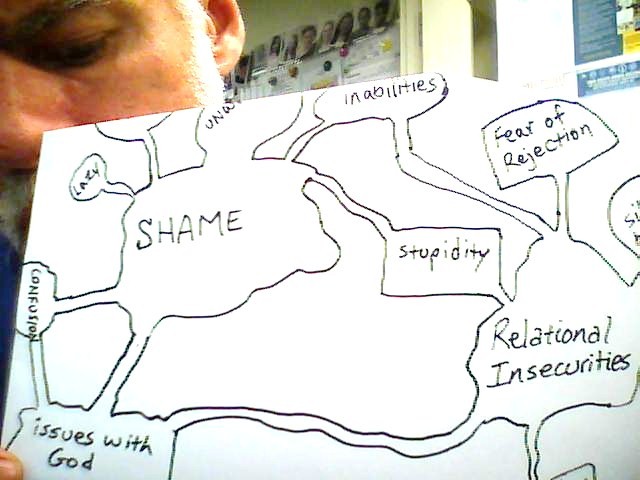
Janathan:I think I’m wary of what seems over-simplification to me, assuming solutions when I haven’t taken sufficient time to fully understand the emotional dynamics at work (a definition of “pat” answers). We might say ‘love’ and ‘faith’ are simple, clear, easy to identify… until we start realizing how common misconceptions are, confusing love with lust, possessiveness, admiration, etc. I think we have to agree that all emotions were created by God and of high worth. God created fear in us, and the Bible regularly commands us to fear. My biggest fears tell me something really important about my own woundedness, and if I try to simply control this fear with ‘faith” and not understand my deeper heart issues, I think it causes real personal and relational problems. What is your perspective?
Janathan: On the other hand, one can be equally disrespectful of one’s own feelings by exacerbating them rather than listening to them (though I think conservative Christians tend to err on the former side… as one well-known writer titled a book “Emotions, the Believer’s Greatest Enemy.”
Jennifer: hmmm i don’t like simplistic answers either.. and will often ‘chew’ on a thought for a long time (including your quote 🙂 but at the same time, I’ve had to face some of my biggest fears,… and in the midst of those fears have often found myself unable to do anything else with but transfer them to God. “perfect love casts out all fear” is a concept i don’t fully understand yet it seems to involve trusting the Source of Love to such an extent that we have nothing that’s too big for us to face. The kind of ‘fear’ you refer to,.. i would associate with a respectful fear.. and not an immobilizing fear. appreciate your thoughts..
HIDDEN UNDERGROUND
Janathan: I agree, Jennifer, sometimes fears are so intense we have to find a means of calming them before we can begin to understand them. I think there are many ways of doing this, such as adding a safety net or sharing our fears with someone who is safe for us (this is an act of faith as well). I know I have had numerous misconceptions of faith in my past, misconceptions I still struggle with. One of the biggest ones was to use “faith” to shame my feelings, in which case my feelings went underground, seeming to be conquered, but simply adding another layer of distance between myself and my heart.
Jennifer: hmmm good points. I’ve had to work through ‘fear of admitting fears’…. because as I looked back on my life i realized that the fears i ‘verbalized’ (admitted out loud) were exactly the ones that i ended up having to face in reality. 😦 Still working thru that one, but I think one of the lessons I’ve come away with, was that God wanted me to experience His peace even in the midst of my biggest fears (and I did,… for the most part! 🙂 From what I can tell, fear doesn’t GO AWAY.. we just learn to manage it. I’ve prayed endlessly for God to take away my fear of flying.. but it’s still there. What I had to face was my fear of dying instead.. With cancer, I had to face my fear that His plans weren’t good ones (from my perspective),.. but as I look back,.. so much GOOD came from having it.
Beth: Such thought-provoking comments. You’ve both alluded to the idea that fears have a variety of sources. Yes, fear can be emotionally based, but it can also be based on objective facts and truth. Jesus said “… I am the truth…”. Truth is his very essence and thus he also knows all. I’ve learned that I can trust my God more than I can trust myself. We can all be easily manipulated (emotionally) and we can also manipulate others and we can even manipulate ourselves. But God can not be manipulated. Thus I choose to put my trust in Him who is truth, and pray that he gives me the wisdom to discern the source of my fears and take control of all my thoughts. (2 Cor 10:5 “…destroy arguments and every lofty opinion raised against the knowledge of God, and take every thought captive to obey Christ.”)
Jennifer: thanks for your input Beth… i like the verse about ‘taking your thoughts captive’ … i think it fits the discussion. Though I have to admit.. i’m a very practical person… and as much as I understand the ‘exercise’ of doing that,.. i still don’t understand what are the practical, tangible results.? In other words,.. what actually changes in relationship to our fears?
Beth: Making our thoughts “captive and obedient” to Christ is definitely practical, with tangible & transformational results. Emotionally based fears are often reinforced by our thought life. “For God has not given us a spirit of fear, but of power and of love and of a sound mind” (2 Tim 1:7). It seems that fear and faith can not co-exist. Paul repeatedly tells his readers we have real power to control our thought-life, leading to transformational living. “Do not be conformed to this world, but be transformed by the renewal of your mind, that by testing you may discern what is the will of God, what is good and acceptable and perfect.” (Rom 12:2). As we renew/change our thinking, our emotions and behaviour will realign accordingly. When our focus is Christ and his attributes, it will result in our minds being filled with his presence and peace (Phil 4:8-9). Faith and fear do not co-exist.
Kent McQuilkin: Ah, Beth, what a very different view you and I have on emotions and faith!
Jennifer: Will need to reflect on your thoughts Beth… Sometimes it just takes time for a truth/principle to move from my head to my heart,.. and then into action. 🙂 Curious about your view on emotions and faith, Kent. 🙂
Wow, Jennifer, where do I even begin? I understand Beth’s view, I was raised with that view. There are good and bad emotions and we must choose the good and refuse the bad. The good emotions are telling us the truth about the world and God, and the bad emotions are telling us lies. We encourage the good emotions and discourage the bad emotions by thinking the right thoughts about each, often using Scripture as the basis. We talk ourselves out of the bad emotions and into the good ones. This is how faith works to free us from bad emotions–I keep telling myself the truth until I believe it (and truth comes from propositions, not from feelings, which can’t be trusted), and as I slowly believe more, my bad emotions dissolve.
 In a sense I believe and follow this approach for superficial matters. As everyone knows, emotions can be very changeable and fleeting (which makes us reluctant to trust them). If Kimberly does something that slightly irritates me, I throw some “truth” at my feelings (“she also has to forgive me for my irritating behavior” or “she’s just tired”) and let it go. I can do this because I am secure in our relationship—I know she cares deeply for me and respects me and my feelings. It is just an emotional hiccough I feel. However, if the feeling persists, I know it is telling me something I need to hear.
To suppose that emotions are fickle and unreliable because they constantly fluctuate is a serious misunderstanding I think. What I see with my eyes constantly changes—I see a chair, then a table, then you, then my book… does this mean my visual perception is unreliable? On the other hand, if I kept staring at the chair and it turned into a cat and then into a pecan pie, I would have major doubts about my visual perception. Just like my eyes, my emotions are “reading” constantly changing situations, so that to be consistent, they must constantly fluctuate, but when that situation returns, that emotion returns. Emotions are remarkably consistent and reliable measures of how our situations are impacting us. We realize this when we use all our reasoning powers to change our feelings about someone, and one look from them brings those feelings flooding back. In other words, our emotions are telling us something profoundly true and accurate, stubbornly so, though we may misinterpret them easily if we have been raised in a culture that teaches us to doubt them.
I think that is where we get thrown off the track. We assume that our emotions are measuring the facts about the current situation, and this consistently proves false. But that is like blaming the gas gauge for giving the wrong mileage. Our emotions can tell us things about the current situation that our minds cannot (we call it intuition), just like our gas gauge can help us estimate how many miles we have driven. But that is not their purpose. Emotions primarily tell us about our own hearts, not about external situations. This was very hard for me to grasp at first. I thought my anger against a friend measured his guilt. It doesn’t. It simply says something is going on in my heart that I need to figure out. Whether he is guilty or not is a very different issue, related but different.
If my emotions are given to me by God, they are all good and valuable when treated as they were designed. But if I suppose some are bad, then I will refuse to listen to them, perhaps quite effectively drowning out their voice, the voice of truth. I may credit Biblical thinking and faith for this result, but I feel strongly that such an approach ultimately hurts rather than helps me. If anything, I have discovered that faith can do the opposite—it can give me the safety and courage to identify and listen to my unwanted emotions instead of pushing them away. I think that blaming and fixing my emotions is much like using my finger to push the gas gauge needle to “full”.
 It is true that I want to be free of those feelings of fear, anger, sadness (and even joy and peace) that are harmful for me and my relationships, but after failing in a life long effort at using the typical “biblical” approach I described above, I learned that listening to my emotions with compassion and understanding was the only way to discover my true brokenness and needs and take the long term, deep approach for transformation. I put “biblical” in quotes since I find myself now with quite different understandings of verses like “take every thought captive” (ones that do not involve pitting my reasoning against my emotions—wouldn’t it be wonderful if our emotions and intellect could work as partners instead of competitors?)
I’d be interested to hear your thoughts.
Janathan
 At last we come to this. Kimberly and I have needs that conflict–satisfying her need exacerbates mine and vice versa. I could fill a book with examples, literally. Promptness is a high value of mine and we are going to be late, so I am driving fast, but safety is a high value for Kimberly. Whose need gets trumped? She needs to talk and I need to think. She needs a clean car and I need a functional one. She needs us to be more tactful with folks and I need us to be more straightforward. She needs to spend more money and I need to spend less (in certain categories). She may need more together time and I may need more alone time. She’s freezing and I’m burning up.
I was raised to 1) evaluate if this is a true need or just a want 2) if it is just a want (and almost everything was), then sacrifice your desires for the other person 3) if this is not adequately reciprocated and I feel resentment for the “unfairness,” then I hint with my eyes, tone of voice, sighs, coolness, a “joke,” etc. 4) if this does not fix the injustice, then we “talk” about it (which means I tell you in so many words that you are wrong, you apologize and change). This was my understanding of fairness and compromise–in my family we manipulated each other to get the other to meet our needs–and it generally worked, at least for us younger siblings. We made demands of one another, taking responsibility for each others needs instead of taking responsibility for our own. In this environment, personal boundaries were significantly infringed, but the incursions were roughly equivalent, so it was workable. Of course, this only functions in a context where the expectations are set, determined by an authority (our parents). Someone has to settle what is fair if fairness is to be the default standard for behavior. Pushing or choosing for one’s own wants and needs was generally seen as selfish.
I quickly discovered this approach did not work with Kimberly. My system was reciprocation and her system was freely giving with no expectations. She insisted that my expectations did not determine her obligation. If I had a need, it did not mean she had to meet it, because she also had needs and she did not insist that I meet them. She explained the value of healthy boundaries in relationship. She would listen and empathize with my need if I cared to talk about it; she would offer suggestions for how my needs could be met; but if I then pushed her with an “ought,” it would stifle her free love, it would not only wound her, but hurt our relationship, setting it on legalistic grounds rather than on grace. I have needs, my needs are legitimate, she loves me and cares about my needs, but caring about my needs is quite different from caring for my needs. I cannot demand that she neglect herself to serve me (even if I neglected my needs to serve her). My resentment towards her “unfairness” suggested that I was not giving out of love and grace (which expects no reciprocity), but out of a fair-trade agreement.
 She told me to only give to her (or compromise) freely, and if my gift had strings attached, I was not ready to give. In that case, she would look out for her own needs. If I say, “I don’t care where we eat,” “You choose where to dine,” “I’ll go where you want,” and this eventually leads to, “Why don’t we ever eat where I want to go?” then I am being dishonest with her and with myself. We should tell one another plainly what we want, and then look for some solution that provides for both our needs (or at least does not block either of us from meeting our own needs). I have learned to trust Kimberly to give me what she can in a healthy way, and whatever is still lacking I take responsibility for instead of placing on her. She trusts me in the same way.
This set things on a very different footing for me. I always assumed my expectations were justified, were self-evident and obvious. If so, then she should change to meet them. Why did Kimberly disagree? I began questioning whether my expectations were self-evident. I always assumed I “needed” to be on time… the what was given and I only had to resolve the how, how can I get her on my schedule. But suppose punctuality is not a necessity or even of high value. Instead of asking what should be done, I started asking why do I feel this way. Why did I have such a high level of anxiety about lateness? I thought I did this out of care for the other person’s time, but in fact I was operating from a fear of what others would think of me. My value depended on others seeing me as dependable, and punctuality was a big part of that evaluation. I tried to control others’ views of me (and thereby my true worth) by being prompt. My feelings cried out that I needed to be on time, but my true need was rather to feel worthy, and I could only satisfy this need by grounding it in something more firm than others’ opinions. I had to learn to be okay with being sometimes tardy, it is human, and part of finding this path into freedom was allowing myself to actually be late. Kimberly’s need for me to drive slower was an invitation to reconsider my own true need.
This was not a smooth, quick, or comfortable transition, and I still tend to drive with narrower safety margins than makes her comfortable. I am a work in progress (as is she), and what matters to her most is not slower driving, but acceptance and support of her feelings (instead of poking fun at her caution or otherwise suggesting there is something wrong with her view). Amazingly, once I was able to segregate my real needs from my false needs, I realized that my greatest need was what Kimberly was so great at giving–empathy and acceptance of my feelings rather than help avoiding my feelings by “fixing” the situation. If simple compromise works because neither of us feels very strongly about the matter, then we simply adjust for one another because we care. But if either of us feels an ongoing discomfort with this solution, we bring it up for discussion, not to figure out a better solution (and so avoid the true issue), but to uncover the real unmet need that is agitating our feelings.
BTW, Kimberly is a punctual person, she just is not driven to it as I am.
 I lived the first 40 years of my life with the assumption that if someone had a need I could meet, I was obligated to meet that need. No matter how much I gave, I was still being selfish if I had any resources left for myself. Such a view leads to spiritual and physical self-destruction. In grad school I knew that 12,000 people a day starve to death (no doubt that figure is higher today), so how could I spend any more than the absolute minimum on my own needs? If I used resources for myself that would cause one more person to starve, was I not killing them? Was I less responsible because they were half-way around the world instead of on my doorstep?
With this thought I calculated the cheapest possible way to survive so as to give more money to relief agencies. Since tea or coffee had no nutritional value, I thought drinking it was simply a sin… so was jelly on toast (although it was so dry I used margarine sparingly, or rather a cheaper margarine substitute, and felt guilty for it). I must eat nutritionally, for which my mother gave me the simplest advice as I left for grad school , “Eat one green and one red or orange vegetable a day.” I knew I also needed protein, starch and fruit. The cheapest fruit was to drink orange juice each morning with a piece of toast (starch).
I prepared my dinner one month at a time. The cheapest protein was a chicken whole fryer (39 cents a pound), and the cheapest green and orange vegetables were beans and carrots. At the beginning of the month I would cook one whole fryer, one bag of string beans and one bag of carrots. I then mixed a bit of each into golf ball size clumps, twisted six into a row inside my used bread bags, and froze them, making a month’s supply. I would warm one of these up to put on rice each evening when I came home from school.
I saw time as another resource to share, limiting my sleep to a bare minimum. I lived in Chicago for six years and never visited the famous sites, which seemed an unconscionable waste of time. But I could not strip myself of every resource, so I lived with a pervasive undertone of guilt for not living on less and giving more. That person’s need constituted my responsibility, and the needs of the whole world lay before me to meet at whatever cost to myself. 
Something was deeply wrong with this picture. Whose needs am I responsible to meet? If I shave it down to the bare minimum, I would say I am responsible to meet my spouse’s needs… but is even this true? Doesn’t my wife have many needs that I cannot fulfill? After all, no individual has all the spiritual gifts for meeting another’s needs. The problem lies here–whether I took on the needs of the world or of only one other person, I was still trying to play the role of God, and it was crushing me.
Over time I came to the conclusion that if someone has a need, it is God’s responsibility to meet that need, and he may or may not use me to do it. He is not dependent on my help. It is not the other person’s need which constitutes my responsibility, but the invitation of God to become involved (and he does invite, he doesn’t force). If I choose to live by grace rather than law, then someone else’s need is a potential opportunity rather than an obligation. But whether or not I get involved (and to what extent), it remains completely God’s responsibility to meet that person’s need.
My own wife must ultimately look to God and depend on him to meet her needs. If she makes me the final point of responsibility for her needs, then her needs are going to regularly go unmet and she has no recourse. She is trapped in a life that is unworkable and has no means of escape because she is dependent on me, and I am a flawed creature. She and I must receive the grace of God for ourselves, either directly or through whatever channel he uses. We cannot restrict his grace for us to one channel, not even our spouse. No human relationship was designed to bear such a burden.
Over a long time, I was able to shift the weight of the world (and every individual in it) onto God’s shoulders and off my own. I still struggle to let the burden go, and tend to blame myself if another person’s needs go unmet, but I now know that to carry such a weight will break me. I discovered that I can care without taking responsibility, that mourning the loss of another does not require me to jump in and “save” them. In fact, when I am always in “fix-it” mode, I tend to be distracted from loving and caring, especially if I am pushing myself with obligation rather than letting my involvement flow from a deep settled nest of God’s grace.
These reflections are just my thoughts, things that have helped me. Please forgive me if I sound dogmatic. I don’t mean to be. If these thoughts don’t help you, then by all means dismiss them; or if you disagree, argue with me in a comment (though remember my tale is not done).
It seems we all try to control others in various ways, and we are usually blind to what we are doing. We think, and even say, that we only want the best for them, not realizing that if they are pressured or forced to make better choices, those new behaviors will not nourish their heart, but shrivel it, because they are not freely choosing out of a loving relationship with God and others.
Sometimes, especially with children, control is necessary for their own safety and health, so that they can live long enough without significant damage to grow into understanding. But if this is the default teaching method, the greatest life lessons the child will learn are that her feelings don’t matter, that she must live from obligation (another word for bondage or lack of freedom), that what she does is more important than who she is.
Let me give a simple and common illustration from my own upbringing. My mom and dad naturally wanted to keep in close touch with their children when they “left the nest.” I was the youngest and last to leave, so their feelings were especially acute towards me. I was on my own for the first time and enjoying my freedom, and I didn’t keep in touch as much as they would like with letters and phone calls. Not only did they miss me, but I expect it made each wonder subconsciously, “Does he really love me?”

I Need You to Change!
Under the force of these emotions, they believed I was remiss in connecting with them. I was to blame for their bad feelings, feelings which I could so easily allay. It would cost me very little (so they thought) to keep in touch, and they pressured me in this direction. When I phoned them, their first statement was usually, “Well, we haven’t heard from you in a long time,” by which they intended to push me to show my love by calling more often. To the extent I bowed to this expectation, I was reacting from a “should” and not from compassion. In fact, the more pressure I felt, the less I was able to respond from genuine love. To my parents it felt like love when I deferred to their wishes and called more often, but somewhere deep inside they must have known that “loving” acts resulting from pressure do not mainly spring from love.
If they had shared their genuine feelings without making me responsible to fix them, it would have drawn out a natural love… I would have wanted to phone them instead of “having” to phone them. If they said, “We really miss you and miss hearing from you,” and genuinely did not hold me responsible for their feelings, but were only sharing their feelings, it would have made a world of difference. Of course, then they could not trust that the outcome would be to their liking since they granted full and genuine freedom.
Sharing your feelings with me without the assumption that I should fix them is a huge invitation into your heart and opens me up to welcome you and share my heart. But telling me about your feelings in order to get me to conform will make me resistant and closed. I will hear the message that I am bad unless I change and I will react to protect myself. If I do yield because of the pressure, because I believe I am responsible for your feelings, it will damage us both, and hurt the relationship. It may feel good, but it will encourage a legalistic view that love is conditional, dependent on my behavior.
I learned from an attractive friend of mine that insecurity does not only come to the daughter who is shamed for her looks, but also to the daughter who is praised for her looks in a way that makes her think her worth depends on it—she may seem proud, but is really filled with fear. The issue is not whether someone is valued, but why they are valued, and if they are primarily valued for conforming to our expectations (being a “good” child), they will always fear “misbehaving” lest they lose their parent’s love which appears to them very conditional and therefore precarious. The same is true in friendships and marriages.
If I am loving towards my wife when she does as I wish, and withhold love (act cool, snipe, act the martyr) when she does not, she will respond out of fear of losing my love. As long as she conforms, she will feel good about our relationship, but it instills a deeper insecurity. That isn’t to say I should never get frustrated or irritated or discouraged. That isn’t to say I should never express those feelings to her. Feeling all my feelings and expressing my feelings are key to good relationships.
But when I share my feelings as a means of getting her to do what I want or need, she feels unsafe with me, and she closes up her heart to protect herself. From my family’s perspective, why would I share an aggravation or disappointment unless it was to get her to change? If I didn’t need her to change, I would say nothing and just deal with it in my own heart and mind, I would silently accommodate. It is when I felt I needed her to change that I would share my displeasure, in order to get her to change and so free me from my unhappy feelings. It was her turn to accommodate. Let us just say it was a very bumpy ride for several years.

Mardi self portrait
Understanding and accepting that success has no actual value in itself, causes one to abandon the pursuit of success in achieving goals and instead to look for what other purpose God might intend for the activities and choices with which we fill our life. And I can come up with just one answer: Love. The only thing God wants us to spend our time, our effort, our knowledge on is love. Love is not concerned with results. If we are disappointed that our love is not returned then it is merely affection or goodwill, not love. Affection and goodwill are admirable pastimes. But love is not interested in results. Love is about abandonment of all interest in personal gain of any sort and has become enchanted with only one thought, the pleasure of the beloved
We cannot think that our own actions, efforts or knowledge actually achieve particular results. In any given instance, with any given project, goal or ambition, the results are not a product of our actions, efforts or knowledge. Results are given by God as a gift. Success in anything we attempt to do is not ours to achieve. It is not a result of anything we can do or know. It is not connected in any way to our abilities. It is a gift just as the rain is a gift and the sun is a gift and the families into which we are born (and to which we give birth) are a gift.
So if our efforts are not about getting results what are they about? Well they are gifts too, gifts to amuse us, to keep us busy, to exercise our minds. And if our purpose is not to achieve the goals we set then what is our purpose? Perhaps it is just to love. Perhaps the question we need to ask at each step is not “which choice will best work to help me reach this goal?” but rather “which choice is, in this moment, the one that expresses love, participates in love, opens the possibility of love flowing?” We become detached from trying to imagine and control the future results of our actions (which we cannot do anyway) and become invested instead in the present moment where God eternally exists in infinite love.
You notice that my theory has shifted from dealing with whole lives to consideration of individual events. It is concerned with success as the results of any goal we set and not merely as a general evaluation of life as a whole. Of course I still feel that each individual life is given a success ratio that is designed to teach each person unique and special lessons. But beyond that we can each look at every event in our life for which we are trying to manipulate a successful outcome and realize that success is not going to be a result of our actions and knowledge but will be a gift from God. It changes our perspective on what we do, how we do it and why we do it.
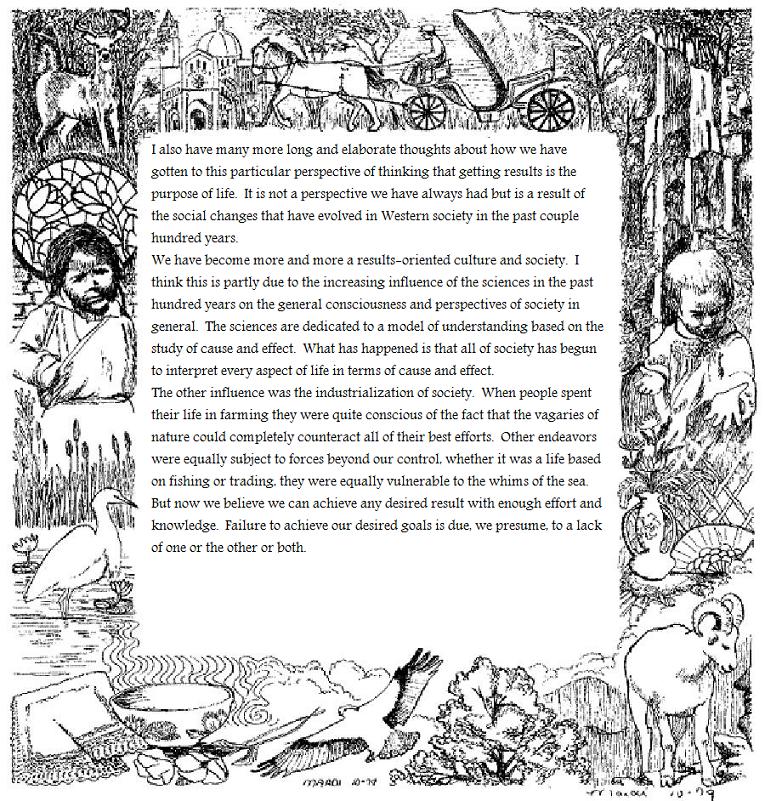
These assumptions have even permeated our religion and theology causing us to think and speak of our relationship with God in terms of cause and effect. We have developed the Protestant work ethic as if it were actually God’s plan for the world. We explain scripture as if it were a handbook of instructions for achieving the goal of union with God.
The problem is that both of these premises (the use of cause and effect to interpret life, and the belief that results are achieved through effort and knowledge) are based on incompletely understood material-based models and are incorrect and inadequate to the observed patterns of life. In fact the truth is that we cannot control even the smallest elements of our life. In life, as opposed to the material world, effects do not proceed from knowable causes. The correlation is only apparent and not actual. We keep trying to figure out how to make it work because we are terrified of the alternative option – recognizing and admitting that we are not in control of anything, nor can we ever get in control of anything. We are, in fact, totally, completely, helpless and dependent entirely on the grace, mercy and benevolence of God. Even people who purportedly love and trust God find this realization frightening. And people who don’t believe in God would be left with no hope at all.
Success in anything we attempt to do is not ours to achieve. It is not a result of anything we can do or know. It is not connected in any way to our abilities. It is a gift just as the rain is a gift and the sun is a gift and the families into which we are born (and to which we give birth) is a gift. We are responsible for doing our best with what we are given. But the results are not connected to what we can or cannot do. The results are given by God for his own inscrutable purposes. We can neither know nor understand his ways of granting his gifts. We cannot change or affect his choices and decisions. We can only accept everything that comes to us – as a gift.
And while our lives are all wrapped up in trying to achieve a success we will never attain, God is not in the least concerned or interested in success. For him success and non-success are equally unimportant. The only true purpose in life is love, not success. What he wants from us is our love. And he knows that all we really want is love in return. And for that we do not need to achieve anything.

Mardi: horse & baby

 On NPR I heard a really sweet story of a Dad and his little boy. The little boy had had a serious illness, had nearly died and had a long hospitalization and lots of surgery and treatments. Through it all he had clung to his Teddy Bear, Toby. Even after he had gotten better, he carried Toby with him everywhere. Then when he was 7 the family was on vacation and when they got home, Toby was missing. They told him and he said “I don’t know how I can go on without Toby” and then he said “I feel like I’ve lost my soul”!
 Well, when they empty out the dumpster on the floor, he said it was a huge mountain of garbage, bigger than he could have imagined. It was all runny with a lake of brown garbage liquid with all these plastic bags sitting and floating in the brown goo. The hotel people jump in and start tearing open bags looking for the bear. The father is overwhelmed by the enormity of the task but begins tearing open bags too. Then a number of the employees of the facility put on their gloves and begin wading through the muck tearing open bags too! (I’m bawling in the car). There are now about 18 people looking through the mountain. But as the father looks at the size of the pile and the number of bags, he realizes in despair that it will be really impossible to look through it all. And in his heart he just says “Toby, we’re not going to be able to find you unless you somehow show yourself”. He said that he is not a particularly spiritual guy, he’s an accountant and auditor…. a “just the facts, ma’am” kind of a guy. But as that thought went through his mind, he tore open a bag, and there was Toby, dry and clean. Everyone, of course was jubilant. The father immediately calls home to tell his little boy that he had found Toby. He said his little boy was happy, but seemed kind of matter-of-fact and the father realized that for the little boy it seemed that his father had just gone and gotten his bear back. The child had no idea of the super-human effort that had been accomplished for him.










 Janathan Grace Reflections