Archive for the ‘shame’ Tag
ME: More mornings than before are like this morning, I seem to wake to an unhappiness and talking to you while lying in bed does not seem to get me to a better space, so here I am again, completely unmotivated and unable to enjoy the morning, which is unfortunate. I find myself touched by some FB posts or pictures, but I don’t really know what to do with that. Perhaps coming here to sit with you about it would help. I so need to connect to my true self and the good of life. There is so much good to lean into even in the worst of times. Wendell Berry and Mary Oliver invite me into nature in this way. Nature is a lifeline to good because it has prevailed through all and will continue to do so because life is irrepressible regardless of the evil humanity does to itself and the world. It is a bigger story like You and eternity (but more easily accessible sometimes). Connecting to what is true in others through poetry, music, and art can help also. Too often the good feels like little pockets or bubbles that are immersed in the greater reality of the bad. After all, if good were greater, we would make constant progress as humanity when instead we seem to simply repeat cycles of self-destructiveness with recovery, and I’m not even sure the recovery comes from goodness. It may just be a counter force that is merely a lesser evil. The world is ruled by force so that our goodness does not shape the context, but is within the darker context. It influences the context, naturally, and keeps it from becoming even darker, but power always controls, and perhaps that is what Jesus came to teach us—that goodness shines clearer in the contrasting darkness and is strengthened within us by that challenge. “The kingdom of God is within.” Perhaps I am measuring the wrong thing, the context or container instead of the life within, just as the earth is a speck in the dark, lifeless universe and yet the earth is the center of what matters. But when I start to think of my response as the key instead of the dark situation, I see how defective my responses are. Do I have more light in me than darkness—darkness of fear, ignorance, reactivity, self-loathing? I am healing, but the journey is long and I have trouble seeing that the importance lies in the direction rather than the attainment. I should also take note that the context heavily impacts the inner life. It is always “uphill both ways.” The surrounding darkness is full of traps, obstacles, vortexes, deceptions and the like. The good in me is tangled and complex. But then I remember that grace is key not only as the target but also as the means. Grace above all, especially towards myself. I stumble often, but this does not define me. Grace defines me. If I succeed in giving myself grace, true, deep grace, I am living from the good into the good.
GOD: I’m so glad you finally landed back in grace! That is the whole of good. There is no true virtue except it springs from grace and grace heals all. Darkness that ends in grace is transformed, the wrong into good, and virtue that is outside of grace is a deceptive undoing of the good. Grace is all. This is my heart and to live in grace is to live in me. Of course it is a powerful and rich grace, not the cheap imitation that minimizes the impact of the darkness–but no darkness is beyond redemption, which turns it into a source of light. That is the real purpose of shame as it awakens you to the harm and invites you into the only remedy, which is grace, not greater effort. I love how you keep growing in this and coming back to it. The fact that you make your way back here clearly shows that it is at heart what you ground your life in, however distracted you may become at times. This dance between you and me is wonderful, joining our hearts in the one bond that holds against all, which is grace. I welcome you back here! So glad to see you here again! You are a joy to me!
The Author’s love story of me is beautiful, but there is still an inner resistance to that narrative. My brain accepts it, but my feelings cannot. I believe enough to choose grace, but I cannot relax and rest into it as something settled, reliable, and safe. Why is my own narrative so much stronger than God’s? Because it is not my narrative, I suddenly realize. This storyline I have always believed is so deeply rooted because it did not spring from me as I supposed but was handed to me fully developed, like an owner’s manual. I see now my trust in an overriding love is not so much thwarted by the harm I did (see my last two posts) but the harm done to me, the disapproval stamped on my heart, the disappointment leveraged against me in childhood and beyond.
My identity was fashioned by my parents as surely as my language was. My mother tongue is English. I was not given an option to speak in Chinese. I did not know Spanish existed. A tree was “tree.” It was not up for debate or question. It was so settled that doubting it would only show my ignorance. My parents knew language and I simply had to learn it from them. As everyone agreed on “tree,” it was a universal reality. In the same unconscious, inescapable way, I absorbed my sense of myself from my parents. I was who they said I was. It was no more up for question or doubt than my being a son, but it was rooted more deeply than language because their beliefs about me were handed down by God, they said, and how could I ever question Absolute, Eternal Truth?
My parents actively judged themselves and ran from their own shame, so they were poorly placed to teach anything else to their children. They believed about God what they were raised to believe just as surely as I did, and it shaped their whole view not only of themselves, but of me. When I disobeyed, my father grew stiff and cold. Even after I showed my shame and remorse, he slow-walked warmth and affection, as though acceptance shown too quickly would undermine his pressure of disapproval. He was suspicious my shame was not deep enough to make a change. This created the meaning for me of “repentance” towards a God who was often disappointed and aloof because of my behavior. My mother’s response was not cold, but hot, quick anger. And so I grew up believing that love and acceptance is a reward for good behavior and that I often was unworthy of it.
How incredibly difficult, after this molding, to grasp a grace that is never conditional. How could I even begin to construct such an imaginary world? No one I knew spoke the language of grace fluently. How can I now settle peacefully into a life built on grace when I am surrounded by a world of people who see unlimited grace as dangerous and delusional if not incomprehensible? The religious in particular persuade me to distrust grace. Seeing the universe through the eyes of grace changes everything. It not only fundamentally changes my perception of myself and everyone else and God… it changes my perception of “tree”… of “spider,” “comedy,” “hot,” and “superfluous” since it changes at core how I am present in the world and how I see the world.
It is a slow work to learn to see myself as graciously as God sees me, but he is the true Father who declares me precious beyond all counting. My work to redefine myself must begin where it first got derailed as a child, to challenge that origin story with a new way of being fathered, almost like an adolescent suddenly discovering they were adopted and needing to rethink their whole history. May I let go of my allotted image given by shame-reactive parents and see myself as beloved beyond all comprehension.
All my life my mind has secretly been constructing an autobiography, pulling together all the tangled pieces of my past and turning it into a coherent storyline that defines me. Sadly, I am not kind to my protagonist. My mind narrates the time I joined with neighborhood kids in grade school to call our friend Bobby “Roto-rooter,” laughing at how mad it made him, and I wince with sadness and shame. I recall scolding my dearly loved collie Taiho, who had done nothing wrong, just to see the cute look of remorse on his face, and it seems so mean. The older I got, the worse I did, and in my retelling, the good that I did weighs lightly against the heaviness of my perceived failures. I become my story’s villain, a cautionary tale.
Most novelists are kinder to their protagonist. As I read, I find myself hoping good for the main character, even if she is a scold or he is a criminal. I am sad when she loses her best friend or when he ends up under a bridge in the rain. I am sympathetic to their failures and losses, understanding of their vices, and whispering to warn them against harmful choices. Just show me their humanity, and my heart is all in for them. What would it be like if one of these writers told my story? If they showed the good generously and the faults compassionately and made the reader love me like a dear friend? Would I be able to accept such a telling of my story or would it feel undeserved, even untrue like the overindulgent words of a doting mother?
Just yesterday it occurred to me that I do have a flawless Biographer of my story who writes with the kindest, most gracious heart ever known, a retelling of my life that is perfect and trustworthy in a way my own memory and judgment could never be. Imagine if my life were told from the perspective of boundless love–every failure told from pure sympathy, every wrongdoing wrapped in understanding, every flaw traced with caring fingers. What if the Author of my story, while clearly seeing my shortcomings, was my cheerleader who found deep joy in who I am in every moment of my life. What if Love defined me? That is the story I long for. I believe, help my unbelief.
*This post was written 2-3 years ago and never posted
The evening after Christmas, we arrived home from a beach trip, and as we were unpacking, there was a knock on our door. A young woman stood there in tears and told us her sister Jiselle, our duplex neighbor, tried to kill herself on Christmas eve. Savannah had just flown in from Pennsylvania but Hertz cancelled her car reservation. Jiselle was in a care facility 1 1/2 hours away and Savannah was going to miss the one hour of visitation that was allowed. I immediately offered to drive her there.
We do not know Jiselle or her husband Jonathan very well, having only met a few times in our shared parking lot. Most of what we know we guessed–that she babysits, that he is currently deployed on a Navy ship, that their friends who sometimes stayed over were also in the Navy. They were polite but distant, so we supposed they had no interest in connecting with us socially, which is understandable as they are young enough to be our children.
As I drove Savannah to the in-patient facility, she shared with me how Jiselle felt bad for inconveniencing Savannah, asking her “Was I being selfish to try to kill myself?” Savannah was unsure how to answer, not wanting to make Jiselle feel guilty. I responded, “So do you think she was being selfish?” “Well, yes.” she replied. I tried to think of an analogy to help her see the situation more graciously.
“Suppose Jiselle was beaten brutally every day and you knew her only chance of escape was to flee the country and never see her family again. Would you think she was being selfish to run?” “No, of course not,” she answered. “Well, emotional trauma is more painful than physical trauma, and Jiselle was beaten by it every day,” I said.
Perhaps we should be praising Jiselle for hanging on as long as she did. It seems she was finally broken by her continual rejection of her own needs in order to satisfy others, especially a family who demanded she keep suffering so they would not suffer the grief of losing her. Who is truly selfish with that worldview? In light of this, I was troubled by an internet meme that has been circulating on Facebook:
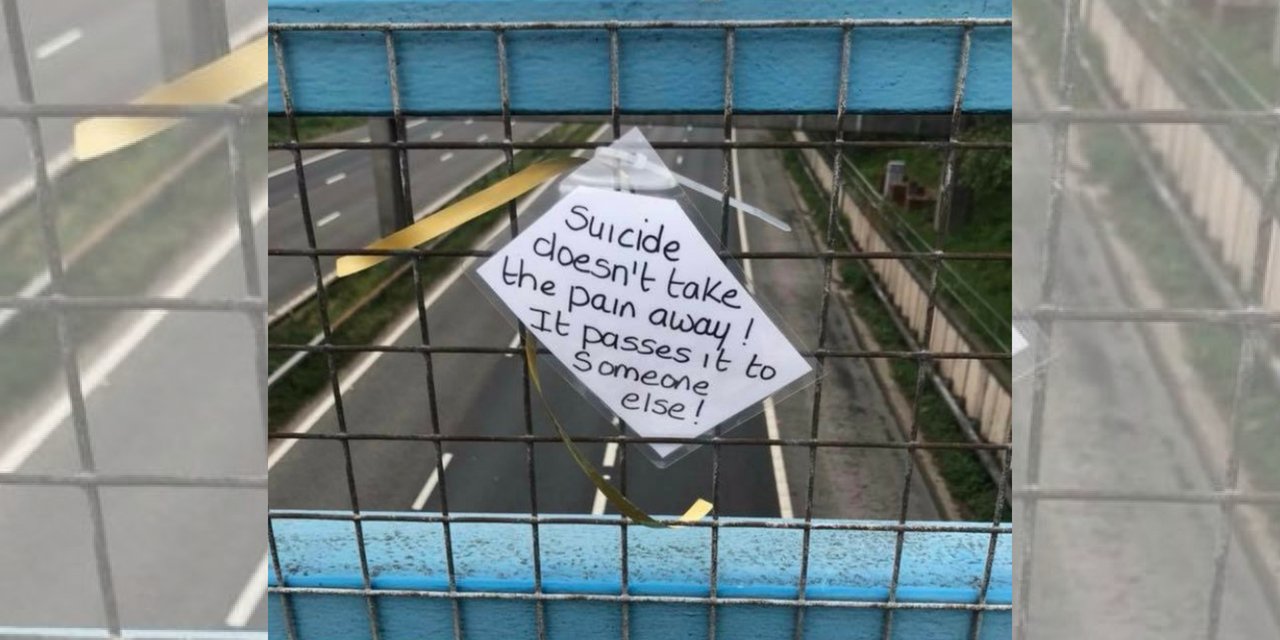
The sign uses guilt and shame to stop someone from jumping from this bridge. Instead of understanding and empathy it offers judgment. Suggesting that the pain of bystanders is more important than the pain of the sufferer is untrue and deeply devaluing, and it exacerbates the ache and isolation of the one suffering. Perhaps the message intends to redirect the jumper to another solution, but it doesn’t offer one, so it comes off sounding like “You must keep suffering so I don’t have to.” Suicide is the last, desperate solution to other failed fixes. Jiselle was in counseling and on meds and still felt too awful to live.
The real question is not, “Does she love others enough?” (as though her burden was not already too heavy) but “Have we loved her enough?” Why is the pain “passed on” at death? Perhaps the bridge meme should read, “Pass some of your pain to us now, so you won’t have to end it here” or “Shared pain prevents suicide” (posted in the church bulletin board instead of the overpass railing). May we embrace one another’s pain and offer to share the suffering rather than scapegoating the one who has run out of all hope.
I’m often plagued by insecurities, inadequacies about work, relationships, income, decisions, indecisions, and forgetting to put the wet laundry in the dryer. I feel like I’m at the bottom of a rugby pile on. I think I’d be okay if there were no people–no one to impress or hurt or misunderstand or fear. Hermits must be the happiest folks on earth… except the people they carry around inside their heads. Many think well of me, but that’s no reassurance. Their approvals are light as air–they’re nice, but they don’t decrease the heavy weight of judgments (imagined or real). If you do everything right in a surgery, but make one mistake, you screwed up. You don’t get points for the positives. Success is what ought to happen, so there are no accolades except for super-human efforts. I can’t beat the game by having more wins than losses because the losses always blot out the wins.
The worst is when I feel I’ve hurt someone, whether I’m guilty or not. Even their forgiveness does not relieve my self-judgment if they are still in pain… in fact, their kindness can make me feel worse still. So feeling bad about their hurt as well as my guilt makes it twice as hard, and I feel guilt even if my motives were good and my effort strong. I could have done better–I know this is true because I look back and see it. I can point out each misstep. I should have known, should have expected, should have listened, should have should have should have. I need to stop shoulding all over myself… yes, I should stop that!
My father tried to save us children from this stinging shame of not being good enough by giving lots of advice for improvement. He was just trying to help us be better… always better. He wasn’t harsh or mean about it, but he was relentless. So I learned from childhood that if things go badly, it was my fault for not thinking or planning or performing better. The only smidgeon of relief was to figure out how to make sure I didn’t screw up again. Failure feels terrible and any means to escape it feels intensely important, and our strategy was to try harder.
The only other way to relieve my sense of awfulness was to blame someone else. I learned as a kid that someone is always to blame for a failure, because if no one is to blame, it can’t be fixed. and fixing it is an urgent necessity. We had the wrong address… whose fault was it? The bill was paid late, who was to blame? If the fault was someone else’s, it relieved my shame. It was then my duty to make the guilty one see their fault and take ownership so we didn’t have to face this shame again. How well I remember the hard-faced disappointment of my father who was waiting for me to express the intensity of my shame through hanging head and muted words with a promise to never repeat the failure again. Even then he expressed coldness and distance for some time, perhaps to let the full weight of my failing settle into my determined commitment to never repeat that wrong. It felt like forgiveness was earned by self-abasement. This particular memory, common enough, came from my sneak-reading a book in class the teacher had told me to put away and who called my father to complain even though I had apologized to her.
In my dad’s dedicated campaign of betterness, the key ingredient missing was grace. In my family, grace was the leniency offered the weak. You did as much as you could, and if you truly were unable, grace was offered… somewhat grudgingly. It was basically pity… a suspicious pity, concerned that you were “taking advantage” of grace, pretending to be unable to do something you were quite capable of doing. By its very nature, pity is demeaning, which is the opposite of grace, thinking badly of someone because of their limitations. This pity was grudging because if I couldn’t pull my weight, he had to pull it. If mom couldn’t remember, he gave her suggestions for remembering, but in the end, he had to remember for her. If I did it wrong, he corrected me repeatedly, and then he had to do it for me. It didn’t really matter how big or small the matter was because a failure is still a failure, and often the failure was simply doing it too slowly. The impatience at someone’s shortcomings always proved that “grace” was not really grace.
This week as I reflected on this deeply hurtful upbringing, the reason for my sense of inadequacy became clear to me once again. Of course I struggle with this! How could I not find myself in this continual battle against the deeply engrained views and values of my childhood? It is like my mother tongue–if I speak, it is in English. Heck, I even think in English and feel in English. “Just Do It Better” was more deeply taught than colors and shapes and I learned it before I learned the alphabet. I am on a slow and staggered journey away from this land of betterment into a land of unconditional acceptance where love is no longer a reward for beauty but a nurturer of beauty. Love comes first. Always. I am fully embraced with all my shortcomings.
Check out this song:
It took years for me to accept my own ostrich-ness without embarrassment, recognizing and not running away from the disappointment others held towards me. I was sharply reminded of this at my dad’s funeral as I re-connected with acquaintances from long ago, the many who stood in line to offer me their condolences and politely inquire: “Where do you live now?” and “What do you do there?”
The simple answer is, “I work at Home Depot.” There is nothing simple about that response. It is freighted with cultural and religious baggage, and I immediately saw it in their faces when I answered, sudden flickers of questions and doubts tugging at their cheeks and blinking their eyelids. The middle-aged son of a college president working a minimum-wage job? Should they leave it alone and move on or ask me for clarification… and how could they do that circumspectly? Since I wasn’t sitting down with them for coffee, I started adjusting my answer to relieve their discomfort.
I understand their consternation. When I started working at Home Depot two years ago it took me a couple months of building courage to share the news on Facebook. As a culture, when we hear of a college-educated person in mid-career working an entry level job, we feel sure there is a tragic story behind this mishap. Selling hammers is one step above homelessness. I was going to say one step above unemployment, but actually an unemployed professor ranks far above a working stiff–he hasn’t given up on himself yet.
Of course the heavy cultural implications are double-weighted with the religious ones. It is true that Jesus himself worked with hammers and saws, but that was in his youth, just an apprenticeship for what really mattered, we think. The highest accolades in my family and alma mater go to missionaries, secondarily to pastors, thirdly to those in non-profit work, but instead of working my way up that ladder, I slipped down it, one rung at a time. Oddly enough, my soul was gaining depth and strength and wisdom with each lower step.
It seems the Kingdom of God is much less predictable and straightforward than I assumed most of my life. I guess that is why we walk by faith.
Caroline came to me at work yesterday with an apology, “I’m sorry I was hard on you yesterday. I was slammed with a lot of issues I had to sort through and was feeling stressed.” I said that I understood. But she was not finished with her apology which rather quickly worked around to her frustration at me, still evident in her look and tone of voice, because I was apparently inadequate at my job. Tears had started pooling in my eyes when she finally finished her lecture and turned to leave.
Having no customers to attend, I had some space to reflect. Why did this exchange feel so bad to me? I was better than most at handling displeased customers and angry colleagues, able to be courteous and sympathetic without taking it personally. I felt the powerful emotional tug and followed the shame back to my childhood fears. This dynamic was very familiar, the sense that I was fundamentally flawed because I was too slow or stupid or inattentive. It was not simply that I had failed in this one thing as everyone does, but that I had failed in a way that others did not, at least not responsible ones. As a boy I figured dad would be patient with average mistakes, the kind he too made, so his frustration proved some deeper flaw in me. Children who paid more attention, who got it on the first explanation, who didn’t repeat the same mistake earned approval. I just had to try harder… but I could never quite overcome that achievement deficit. I was stuck in a permanent sense of inadequacy.
Now whether my dad was too impatient or I was too sensitive is beside the point… or rather it completely leads us down the wrong trail. The point is not to identify blame, but to identify dynamics–this is what happened and this is how it made me feel. And seeing that dynamic clearly, and being the melancholic that I am (tending to self-blame), I immediately noticed how I treat others in a similar way, especially those I supervise. My mind flashed back to the previous night when I had given an exasperated look and tone to a new student I was training because she wasn’t getting it. I could see her face fall, and realizing what I had done, I quickly changed into a non-judgmental re-explanation. But it passed through my mind as a common interaction, not something that called for further examination, one of those things I see as a flaw in myself that I need to work on, but with such a minimal focus that I make only incremental changes.
Okay, that is unfair to myself. I have actually grown a lot in this area. I just have a lot farther to go. If I’d had a little boy when I was my father’s age, I might have been much harder on him than my father was on me. It is nearly impossible to break out of family dynamics without a great deal of reflection and understanding… and grace to myself, not just to others. Given my temperament, I could easily turn this insight into self-blame, castigating myself for being hard on others and trying to scold myself into being more patient. But shaming myself just makes me feel even more inadequate, leading to further dysfunction in my life.
For me, this is where reflecting on my childhood becomes so powerful. When I find a reason for a deep-rooted unhealthy tendency in myself, when I can locate the pain I felt that I’m passing on to others, I can see myself with compassionate eyes, as the wounded one. I can grace myself into healthier interactions instead of criticizing myself into being better, a stick I used my whole life that simply drove me into deep, unremitting depression. I find that grace must begin with myself before I can pass it on. We live in a fallen world, we have all been wounded deeply, and tracing that injury back to its roots can give us the insight and self-compassion we need to finally begin healing under the gentle touch of God’s grace.
Matthew 1:7 “David fathered Solomon by Bathsheba who had been the wife of Uriah.”
The story of Bathsheba and David is a royal cover-up that almost succeeded as they pulled all the strings in the shadows to hide their lust, betrayal and murder. A successful subterfuge would have rotted out their own hearts as they ran from grace. Grace can do amazing, unbelievable things, even with what is worst in us, but it must begin with the truth about us. It cannot work with the fog of self-deception. Whenever we do wrong and hide it from ourselves and others–make excuses, minimize it, compare it to worse sins in others–we trap our shame inside our hearts like a festering wound, and the pathogen slowly seeps throughout our souls and stains our relationships. God rips off that wrapping, exposing the gore, not to repulse us with our wounds, but to heal us.
Shame is to sin what pain is to injury–an alarm to wake us to crippling harm and push us to act. It is the blinking light God designed for our inner dashboard. Unlike God, we tend to use shame against ourselves and one another as leverage to force (or stop) change just as someone might use physical pain (or threat of it) to coerce others. In our society, shame is a weapon that parents use against children, preachers against congregants, and friends and spouses against one another to force compliance just as a bully might use his fists. It is psychic assault. I am often guilty with accusing frowns or glances that say silently, “You are an idiot!” My message is “Be different so I can love you.”
The divergence between the use and misuse of shame lies precisely in grace. We turn shame into coercion, weaponize it, by anchoring it to conditional acceptance. I will show you love (sympathy, support, companionship) or withdraw love based on whether you yield to my expectations. I may even get God on my side, so to speak, spiritually legitimize my demands by arguing that they are actually God’s demands and prove it through reason or scripture or a tangle of both. But bad methods ruin good goals. Though God has given us guidelines on how to live in healthy ways, he doesn’t force our hand and never uses love as leverage. He loves us fully at all times regardless of what we do or don’t do, even at our worst… even when we are unrepentant, he loves us with all his heart.
The shame he built into our bodies is a warning light, not a threat–he tells us what bad things sin will do to us (tear us and our relationships apart), not what bad things he will do to us. (Of course, in the Old Testament where law prevailed as a system, God seemed to be a punisher to force compliance while grace lingered in the shadows, but then Christ came to reveal the face of God in the full glory of grace.) God always acts in grace, though grace sometimes is hard and painful rather than pleasant (like setting a broken leg). He designed shame to wake us, not to coerce us. When we use shame to drive us to change our behavior, it simply feeds legalism: the idea that if I try hard enough, I can live in such a way as to rise above shame. God wants shame to drive us to despair in ourselves and turn instead to his grace. The healthy remedy for shame is always grace, never more effort. You cannot earn forgiveness, even with godly sorrow; you can only open yourself to it as it is freely given.
And so David and Bathsheba were caught by grace, their attention riveted by a dying newborn and their betrayal and murder called out by a prophet, exposing the shame that leads to salvation. They were rescued from being lost in the darkness of hidden sin and becoming a tragedy rather than a story of redemption, actually the story of redemption through their son, the Redeemer Jesus, born many generations later. No sin is too great for grace to resolve into beauty and goodness once it is brought into the light of God. We avoid the light, thinking that when God sees our failures, he will love us less like others do, but it is our spiritual wounding that draws out his love and concern even more. He cannot love us less because his love is completely independent of our goodness. In a miraculous twist, he can even leverage our sin into greater intimacy and spiritual depth, and like Bathsheba, our darkness can be turned into light to show others the way out of the shadows for many generations to come. Not only hers, but every redemption story of ours is inextricably connected to the redemption story, making us not only part of redemption, but of redemption history. By receiving his grace, we become channels of God’s redemption for the world.
A video on bullying I watched today sparked memories of my own childhood spent running from troublemakers at recess. Only once was I seriously punched and had to go to the emergency room for stitches (my right eyebrow still has a slight split on the outside corner). But harassment was constant during gym class and recess–I was pushed, punched, threatened, chased, tripped, mocked. There were other danger zones as well: the lunch room, the hallway, the breezeway waiting for our school bus, and the bus ride itself was tormenting, bad enough that I started riding my bike the 10-mile round trip to middle school. Among boys, the only mark of prowess was aggression… and girls were liked for their looks.
Kids reflect the values of a culture with a clarity unobscured by the social camouflage that adults master. That’s why I like children’s books–bold, plain, and real. Because of family values, I admired intellect as a boy, but that was the stuff of nerds, not heroes. The lead actors from all my favorite TV shows punched and shot and muscled their way into glory… and they always got the pretty girl (first prize). Of course, their violence was validated by the justness of their cause, though that cause was usually self-defense, an arguably selfish motive were it not juxtaposed against the villainy of the other. The “other” was evil, right down to the color of his clothes.
Aside from the cowboys and cops and colonels, we had a few “nice guy” actors, but no one aspired to be Andy Griffith–you liked him but didn’t want to emulate him. Pacifists were cowards, courage was in the fists. The hero never picked a fight, but always finished it by beating his opponent into submission. Be it kung fu or fighter jets, we all admired the warrior, not the lover, who was just a wimp if he showed up without his six-shooters. The ultimate virtue was conquest, not love… even love was gained by conquest.
And so I set about life as a loser determined to fight my way into the trophy circle. My goals slowly shifted from physical prowess to spiritual prowess, but success was still my path to prove my worth. I focused all my energy to become a champion for God, which is to say, having a wide impact on others. Success is just as strong an addiction as gambling, even if you’re not a winner… especially if you’re not a winner. But unlike other addictions, it reaps praise, not shame, and moral validation, not warning, both from the world at large and from the church itself.
Cultural values that co-opt religious faith are the most pernicious and blinding of our defects. When church and society link arms, escape is nearly impossible, and far from looking for an exit, us losers are desperate to launch ahead. Unfortunately, as success grows, it clogs up the opening for grace. Success would have obviated my need for grace, a pitfall of all self-made men, even those who ostensibly credit God. But grace blocked my chase after success. It shackled me to loser-hood until I was forced to admit that my accomplishments don’t validate me. Apparently God doesn’t need my efforts any more than a father needs the help of his 3-year-old to change a tire. The toddler is not valued because of what he does, but who he is–a son.
Success still holds a little place in the corner of my heart–just in case–sort of like the spot reserved for a Porsche convertible that someone’s rich uncle might give me. Both daydreams would likely be a burden rather than a blessing. I trust God’s path for me, and I’m content just to hold his hand… most days anyway.
Addendum to clarify yesterday’s post
Working an unskilled, low-paying job makes me feel humiliated (as I shared yesterday), but that feeling is based on a lie. I have nothing but respect for those who work such jobs, which are usually far more taxing and less rewarding than typical middle class jobs. Minimum wage workers are usually treated like minimum worth commodities, used and discarded, so they have to survive in very difficult situations and are often treated with disrespect. It is not the job which is inherently humiliating, but the false valuation of society. I do not wish in anyway to lend credence to the notion that such jobs should be despised or devalued–it is a defect in myself, not in the work, which brings about my shame. Yes, feel with me my shame in an understanding way, “I would feel the same in his shoes,” but also realize with me that such shame is misplaced. Hard work is always a credit to the worker (unless the business is evil) and should never be seen as beneath us, beneath any of us. Honest work should always be a source of pride, never of opprobrium.
[*by “pride” I mean self-satisfaction, not self-aggrandizement]


 Janathan Grace Reflections