
*This post was written 2-3 years ago and never posted
The evening after Christmas, we arrived home from a beach trip, and as we were unpacking, there was a knock on our door. A young woman stood there in tears and told us her sister Jiselle, our duplex neighbor, tried to kill herself on Christmas eve. Savannah had just flown in from Pennsylvania but Hertz cancelled her car reservation. Jiselle was in a care facility 1 1/2 hours away and Savannah was going to miss the one hour of visitation that was allowed. I immediately offered to drive her there.
We do not know Jiselle or her husband Jonathan very well, having only met a few times in our shared parking lot. Most of what we know we guessed–that she babysits, that he is currently deployed on a Navy ship, that their friends who sometimes stayed over were also in the Navy. They were polite but distant, so we supposed they had no interest in connecting with us socially, which is understandable as they are young enough to be our children.
As I drove Savannah to the in-patient facility, she shared with me how Jiselle felt bad for inconveniencing Savannah, asking her “Was I being selfish to try to kill myself?” Savannah was unsure how to answer, not wanting to make Jiselle feel guilty. I responded, “So do you think she was being selfish?” “Well, yes.” she replied. I tried to think of an analogy to help her see the situation more graciously.
“Suppose Jiselle was beaten brutally every day and you knew her only chance of escape was to flee the country and never see her family again. Would you think she was being selfish to run?” “No, of course not,” she answered. “Well, emotional trauma is more painful than physical trauma, and Jiselle was beaten by it every day,” I said.
Perhaps we should be praising Jiselle for hanging on as long as she did. It seems she was finally broken by her continual rejection of her own needs in order to satisfy others, especially a family who demanded she keep suffering so they would not suffer the grief of losing her. Who is truly selfish with that worldview? In light of this, I was troubled by an internet meme that has been circulating on Facebook:
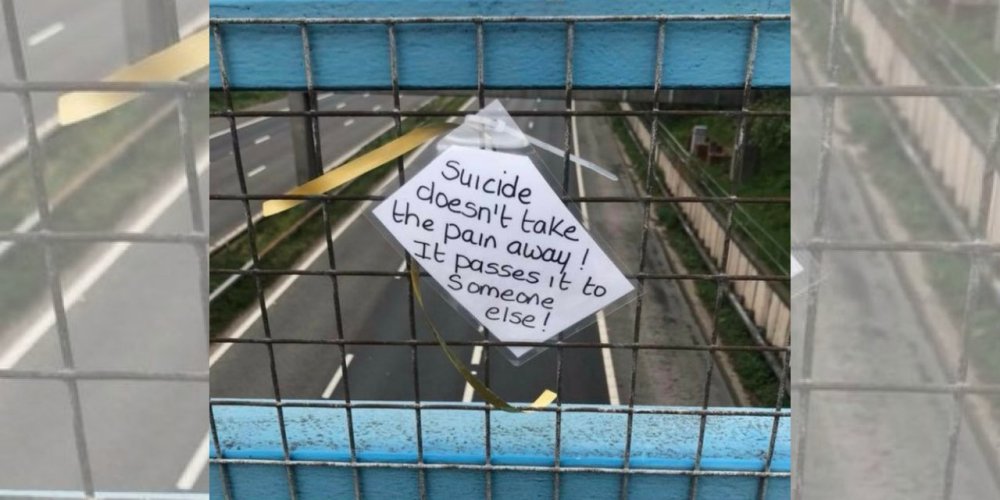
The sign uses guilt and shame to stop someone from jumping from this bridge. Instead of understanding and empathy it offers judgment. Suggesting that the pain of bystanders is more important than the pain of the sufferer is untrue and deeply devaluing, and it exacerbates the ache and isolation of the one suffering. Perhaps the message intends to redirect the jumper to another solution, but it doesn’t offer one, so it comes off sounding like “You must keep suffering so I don’t have to.” Suicide is the last, desperate solution to other failed fixes. Jiselle was in counseling and on meds and still felt too awful to live.
The real question is not, “Does she love others enough?” (as though her burden was not already too heavy) but “Have we loved her enough?” Why is the pain “passed on” at death? Perhaps the bridge meme should read, “Pass some of your pain to us now, so you won’t have to end it here” or “Shared pain prevents suicide” (posted in the church bulletin board instead of the overpass railing). May we embrace one another’s pain and offer to share the suffering rather than scapegoating the one who has run out of all hope.

 Janathan Grace Reflections
Sensitively said Jonathan. Oh how true that emotional pain can be more devastating than physical pain! Terry Powell
Thanks Terry for your encouragement
Thank you for putting these thoughts out there to take seed in as many other minds and hearts as possible.
love you
Mardi
Love you too