Author Archive
 Kimberly and I had a tiff yesterday on our way home from the screening of a documentary at Lynchburg College. In the middle of the film I had left to use the bathroom, and when I returned they were concluding a segment on Ruth Gruber’s role in bringing WWII refugees to America. So in the car afterwards I said, “Tell me about the refugees.” Kimberly responded, “Well, Ruth was in Alaska–” I interrupted, “I was there for the part about Alaska, what happened in Europe?” She started over, “I was telling you that. Ruth was in Alaska working with soldiers. She was sent there under the auspices of the U. S. Government–” I broke in again, showing irritation, “I was there for the segment on Alaska. Tell me about the refugees.” She told me and then grew quiet, upset by my sharpness.
 I was raised on impatience. I’m not sure why my family was so anxious to get to the point. We were in a hurry about everything, and when someone seemed to be dragging their feet, we poked them to pick up the pace. None of us took this personally since efficiency was a shared family value–if I were going too slowly, I expected a shove. Whether getting dressed, sweeping the kitchen, learning to bike, or figuring out the road map, we allowed no one to dally. Efficiency and patience are not bosom buddies. Kimberly, however, was raised to value being considerate of others– if you feel frustrated, keep it to yourself and let the other person take the time they need.
 In other words, to keep the group together, I want the plodders to speed up and Kimberly wants the brisk to slow down. Conversely, I feel it is rude when others hold back my progress, and Kimberly feels it is rude when others push her to go quicker. On the highway, I react to dawdlers in the fast lane and Kimberly reacts to tailgaters in the slow lane… okay, I admit it, I react to everyone. I say we “feel” it is rude because I’m talking about our emotional reaction to someone else. I may feel disrespect even when the other person intends none, and my feelings are affected far more by early family values than by present-day interactions.
Just now I have laid it all out even-handedly, but I don’t find Scripture so balanced. Patience is a huge emphasis in the Bible, and efficiency is… well… um… there must be a verse here somewhere. I know my father, a preacher, would categorize it under “stewardship,” but examples of wise use of resources in Scripture are focused almost exclusively on money and possessions. I am hard put to find time-efficiency as a biblical recommendation. God’s scales of morality seem to be stacked heavily on the side of waiting. I don’t mean to suggest that slowness or inefficiency is a virtue–it can certainly create real problems–but I think our emphasis on it comes less from our faith and more from our culture’s priorities. So I’m learning the value of patience. Of course, 50 years of my ingrained habit is not going to change overnight, so Kimberly will have to learn patience as well.

PATIENCE IS SELF-REWARDING
 “Is it God’s voice I hear in my heart or my own voice mimicking God? How can I tell the difference?” I asked Kimberly tonight as we stared at the candle flames. It was more a doubt than a question. “Even if it IS God talking to me, I may hear it all wrong, just like I do with you,” I continued. God’s voice may be in my head, but it is hardly the only voice there. In fact, as a boy I assumed dad was God’s mouthpiece. I still have trouble telling apart their voices inside me, not because they sound so much alike, but because the mix-up was so long standing. Over the years I have internalized more inflections–preachers, authors, teachers, Christians. So who’s talking now? I am learning to distrust those messages that do not harmonize with grace. God’s heart-songs are always the cadence of love–even if it is a hard scrabble love.
 When I have a friend with me, it colors all that I do, how I do it, and how I feel about it. If he is critical by nature, I will be cautious and inhibited, tense and doubtful. If my daily companion is God, what kind of God is he? If my hours are spent with a God who is focused on fixing my flaws, I will live out of fear and shame. I will be worse off for all my spiritual intent. It is crucial for me that the God I chat with over the dishes and in my car is the God of all grace. It is not only his presence I need, but his compassionate presence. I have enough harsh voices in my brain without adding Sinai to the cacophony. “Perfect love casts out fear.” May we all drink from that stream of redemption.
 Most evenings before supper Kimberly and I light some candles, listen to a word of grace, and invite God into conversation with us. Tonight I told him frankly I don’t know how to include him in the quagmire of my life. All through the day I talk to him and wait on him, but hear no answers for my doubts, feel no healing for my pain, see no clarity for my path, find no energy for my tasks. When I bring God my suffering and weakness and lostness, why do I find no comfort or strength or direction? Why does he leave me sunken in misery? Faith grows haggard without tokens of hope.
 I wrote that paragraph last night and sat thinking for a long time. If God is not in my life to fix me, then why is he here? Somehow, all my theology seems to circle back to relationship… where it should start in the first place. It took me years to learn this with Kimberly–what we both need from the other in our brokenness is compassionate presence, not problem-solving. But God is different from Kimberly–she can’t fix me but he can. He knows exactly what I need and how to provide it. So why doesn’t he?! oh… maybe he does… maybe what I truly need is his compassionate presence.
This is so counter-intuitive for me. If he loves me, doesn’t he want to remove my pain? If he can heal me and doesn’t, is he not callous and unloving? Imagine a doctor with wonderful bedside manners who refuses to cure his suffering patient. And perhaps here is the answer to my riddle. When I treat God as my doctor, I forget he is my friend, my dearest friend who holds my broken heart in his tender hands. My focus locks on my disease instead of our friendship.
I woke up this morning with a nameless dread which slowly distilled into a sense of the pointlessness of my life, and a fear that nothing will change. What did I do this week? I stained the wooden borders around our yard, but in a couple of years I will have to do it again… and to what end? I exercise, clean, shop, cook… a meaningless round of repetition. I enjoy my job in the library, but what difference does it make in the world? Well, it provides me a salary so that I can repair appliances, buy groceries, pay bills… and then do it all over again. When will I find real purpose and direction for my life, something meaningful? As I lay in bed, the thoughts of last night drifted into my mind. So instead of asking God for a fix, I simply shared with him my anxiety. In the end, what if the great purpose of my life is not something, but Someone?

 Kimberly woke me at 2 a.m. on Thanksgiving morning. She felt uneasy, restless, and her heart was racing. I couldn’t find the pulse at her wrist, so I tried her neck–boomboomboomboom–the staccato thumping of a quarter-mile sprinter, probably 200 beats a minute. That scared me. We were at her aunt’s home and I had no idea where the hospital was… I didn’t even know our address. “Should we go to the ER?” I asked. She said, “We can’t afford it, we don’t have insurance.” I quickly answered, “That doesn’t matter.” She responded, “I don’t want to sit there for hours in the waiting room. By the time we see a doctor, I will have no symptoms to check. Let’s look it up on the internet.”
WebMD called it “Supraventricular Tachycardia”– her heart’s electrical system was misfiring–and we should go to the emergency room if it “persisted”–how long is that?! Her veins had been drumming for 10 minutes, but she had none of the listed signs of heart failure, so we kept reading. It offered some home fixes–cough, gag, or shove her face in ice water to shock her pump steady. She tried some dainty coughs, afraid of waking up others. I told her to cough hard as I kept my finger on her jugular. Within minutes the beating slowed.
So, tell me… what are you grateful for this Thanksgiving?
Matthew 1:4 And Nahshon fathered Salmon.
The name Salmon appears only once in the Old Testament, at the end of Ruth in a four-verse genealogy. (He appears one other time as Salma in a mirror genealogy of Chronicles).

In the town of Bethlehem, Salmon’s son Boaz plays supporting actor in the romance play Ruth. As a historical introduction to Ruth, the book of Judges tells of the steep moral decline in Israel, ending with a 3-day civil war in which tens of thousands of Israelis are killed. Bethlehem was at the epicenter of this huge national crisis for it all began with one of their own daughters being brutally gang-raped and dismembered. Without a timeline we do not know whether Salmon was a soldier in this battle, but he certainly struggled against the corruption that engulfed his country.
Salmon lived in the days of the Judges, and that book finishes ominously, “In those days there was no king in Israel; everyone did what was right in his own eyes.” But springing up from this maelstrom of evil is Ruth, a book of hope, whose last verse reads: “To Boaz was born Obed, and to Obed, Jesse, and to Jesse was born David.” That is to say, King David, forefather of the promised Messiah. Yet Salmon had no glimpse of this hope. He died in the night that swallowed his nation.
In spite of this, Salmon (according to Matthew’s genealogy) was in the center of the world’s great channel of redemption. Without knowing it, he was the father from whom the Christ was to be born. His life and history and progeny were surrounded by God’s richest outpouring of grace, the giving of His very Self to the world. How might this realization have lit up his darkness with hope, his trials with patience, his life with purpose? And amazingly, we are each in that very place of Salmon… in a far better place, actually.

We are not simply in a long line of succession through whom God’s grace will eventually come, but we are today channels of God’s grace to the world. The Messiah has come. He is here. If Christ is in us, then He is shining out from us to the world, despite how troubled and confused and pointless our lives may seem or how foreboding the shadows. I am his candlestick, and it is mine to burn, however feebly. It is His to shine that light where He sees fit, and He always makes the best use of every flicker. I am His vital partner in this bedraggled world’s salvation.
 No arguments with my last Ayn Rand post, with my “selfish” assertion that I should care for my own needs before I care for the needs of others? My primary moral concern is myself, according to Rand, and I agree with her. I am ultimately responsible (before God) for my own soul, and it is immoral for me to make a choice that undermines my spiritual well-being, even if someone else might apparently benefit by that action. I must not sacrifice truth or goodness, purity or faith, love or integrity for any cause, however good, because the end never justifies the means. I must not be false to myself in order to benefit another. No good ever comes from choosing against myself.
But what about a mother sacrificing herself for her children or a husband for his wife? Is there no place for self-sacrifice? I think I can best approach this question by considering personal gains and losses. We all suffer losses in this life–not only those forced on us by circumstances, but those we choose for ourselves, for our own benefit. I choose to lose income for a more fulfilling job, I choose to curtail freedom for the joys of marriage, I choose to forgo speaking my mind for the sake of peace. In other words, I sacrifice the good for the better; the lesser for the greater, and ultimately, I am ready to sacrifice everything, even my physical life, for that which is fundamental to who I am–my heart and soul.
I think the term “self-sacrifice” is prone to misunderstanding in this regard. I must never sacrifice my true self for anyone or anything. I may often choose to suffer a loss for the benefit of myself or others, even great loss in extreme circumstances, but I cannot undermine my soul for the sake of anyone. It would be immoral and ungodly.

IS THERE ANY LEFT FOR ME?
Many would agree with this theoretically, but in practice I think we regularly, though unintentionally, trade away our soul little bits at a time. Instead of telling a friend that I need some quiet time, I keep talking on the phone. Instead of taking a refreshing vacation, I spend the week helping a family member move. Instead of taking a stand for myself at work, I yield once more to the boss’s insistence. I don’t tell my spouse what I really think; I wear scuffed shoes to save money; I let the kids choose the radio station. All of these choices seem godly, and they may be… unless they are slowly grinding down my soul, quenching my life, tripping up my dance with God.
I am learning to listen to my heart when it tells me what I truly need, and if I need it, then it is my moral obligation to meet that need to the best of my ability. Others will push me to compromise myself and will make me responsible for meeting their wants and needs. They are in essence making me their savior, but that role belongs to One alone. If they truly need something, it is God’s responsibility to meet that need, whether or not he uses me. Grace is the breath of life, and I must put on my airline oxygen mask before helping my child with his or we will both succumb. 

 Ayn Rand’s philosophy is simple: the purpose of humans is to live fully as humans, pain and pleasure direct us towards life or death, and we must choose life. I find myself agreeing with her. “Choose life!” God tells Israel repeatedly through Moses. Surely life lived to the fullest is God’s design for us, and misery or joy seem to be fairly reliable indicators of what benefits or harms us. But some caution niggles in the back of our brains: if we avoid pain and pursue pleasure, are we not hedonists?
Rand decries hedonism: “When… the gratification of any and all desires is taken as an ethical goal… men have no choice but to hate, fear and fight one another, because their desires and their interests will necessarily clash. If ‘desire’ is the ethical standard, then one man’s desire to produce and another man’s desire to rob him have equal ethical validity…. If so, then man’s only choice is to rob or be robbed, to destroy or be destroyed, to sacrifice others to any desire of his own or to sacrifice himself to any desire of others; then man’s only ethical alternative is to be a sadist or a masochist. The moral cannibalism of all hedonist and altruist doctrines lies in the premise that the happiness of one man necessitates the injury of another.” Hedonism and altruism are alike in this: one person’s well-being must be sacrificed for the sake of another’s.

Rand Is a Rationalist
“The Objectivist ethics,” Rand explains, “holds that human good does not require human sacrifices and cannot be achieved by the sacrifice of anyone to anyone. It holds that the rational interests of men do not clash.” She sees a benevolent world in which every person can find genuine, full happiness regardless of the actions of others. I’m not sure how an atheist such as Rand can be so optimistic, but if the God of all grace rules the world, hope is an inescapable, logical conclusion. A theist might read her statement “the spiritual or life-giving interests of men do not clash.” If God is committed to what is best for me, then I fulfill his will by living out this truth. God must see to it that the choices I make in pursuing what is best for me do not undermine what is best for another.
*Rand is an individualist, so we must still refine her thoughts with the Biblical truths of community and interdependence.
The Giving Tree (for those who don’t know) is a children’s book that tells the simple love story of a boy and his tree. As the boy grows, he loses interest in the tree except as it can benefit him, so the loving tree slowly gives itself away a little at a time to the boy–apples to sell, branches for a house, until finally…
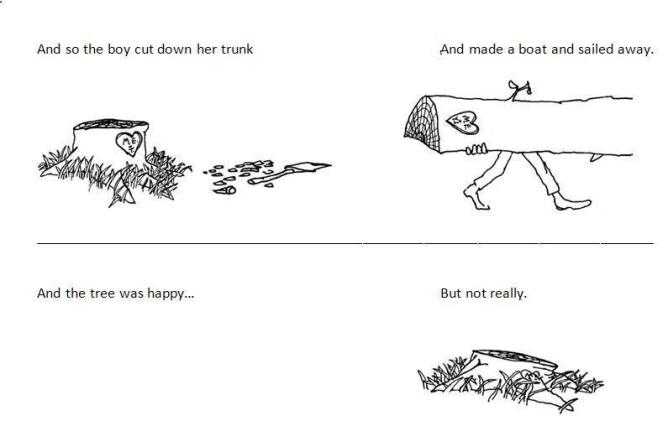
Many see in Shel Silverstein’s book an example of unlimited, sacrificial love. I see a brilliant example of co-dependence. Is it a virtue to harm myself in order to help others?
A year or two ago I read a quote from Ayn Rand’s book “The Virtue of Selfishness,” and was intrigued by her siding with selfishness against altruism as our ethical necessity, our moral calling. (She did not distinguish between selfishness and self-care, which is a complex contrast to untangle.) Here is an example of her perspective, which rings true to a lot of my own life experience:
Altruism declares that any action taken for the benefit of others is good, and any action taken for one’s own benefit [i.e. selfishness] is evil…. Observe what this beneficiary-criterion of morality does to a man’s life. The first thing he learns is that morality is his enemy: he has nothing to gain from it, he can only lose; self-inflicted loss, self-inflicted pain and the gray, debilitating pall of an incomprehensible duty is all that he can expect. He may hope that others might occasionally sacrifice themselves for his benefit, as he grudgingly sacrifices himself for theirs, but he knows that the relationship will bring mutual resentment, not pleasure—and that, morally, their pursuit of values will be like an exchange of unwanted, unchosen Christmas presents, which neither is morally permitted to buy for himself…. If you wonder about the reasons behind the ugly mixture of cynicism and guilt in which most men spend their lives, these are the reasons: cynicism, because they neither practice nor accept the altruist morality—guilt, because they dare not reject it.
I had that guilt of never doing enough for others, but instead of cynicism I practiced and accepted the altruistic morality of denying my own needs (because the needs of others always trumped mine). This conviction that my own needs did not matter left me with a sense of worthlessness. Is selfishness evil? Is it always virtuous to give? I’d like to explore in a few blogs some of Ayn Rand’s views.
 In July I stopped posting because I was depressed (over my failing lawn enterprise). In August I kept silent because I was no longer depressed (with my fall job returning) and had no interest in poking my emotions. Let sleeping dogs lie… they need their rest. Now that I’ve had my breather, I’m waking up to the world again, renewing my personal search for the real and true, but I’m going at a more leisurely pace. I think I’ve been in much too big a hurry to grow up. I need to learn to relax into time.






 Janathan Grace Reflections