Me: So we read together [Kimberly and I]. Rohr said that the only way we can connect with what is outside of us is if there is some correspondence inside us. So God planted all his goodness in us in unique ways. We are not originally evil. Evil is an accretion. I always thought good was something to acquire and impose on my bad self, but this idea invites us to embrace all the goodness within us and foster its growth. It is not about bringing the good in from outside, but finding resonance within us to that good. So what do you think about that?
God: Yes, creation, all of creation, reflects me. How could it not if it sprang from me? I made you. I made you good. I made you to show my goodness in your own unique way. That goodness in you can never be killed, but is eternally beyond your ability to destroy. It is the diamond that might be covered in mud or rock or ocean, but is still a beauty beyond expression. Were I to write down all the unique good that is in you, it would be larger than the encyclopedia… it would take a lifetime to read. Eternity will be spent discovering and growing all the beauty within you. I want you to see your own beauty as much as you see the beauty of nature, of dogs, of all that you take joy in. I want you to see your beauty as much as I see your beauty.
Me: I wish I could too! The barnacles that block my good from expressing itself also block my view of my good. I see the barnacles and think they are a reflection of the true me. I also see all that I am designed to express and realize how far I have to go, how immature I am.
God: But I hope you understand that your growth in beauty is something that will unfold through all of eternity. There is this false sense that “mature” is some stage that everyone should aim for and eventually “arrive” and that immature is somehow inadequate or something to get passed. Imagine a sapling being upset that it is not a tree. Growth is just a continual process that never ends, and varies dramatically for many reasons (note the rings on a tree!), and the growth of one cannot be compared to the growth of another. A sapling in the desert will take a very long time to grow. Softwood grows fast, but hardwood is stronger, and cactus is resilient, and … everyone is unique and beautiful in their own way. When you use future beauty to shame present beauty, the whole concept of unfolding beauty is turned on its head.
ME: More mornings than before are like this morning, I seem to wake to an unhappiness and talking to you while lying in bed does not seem to get me to a better space, so here I am again, completely unmotivated and unable to enjoy the morning, which is unfortunate. I find myself touched by some FB posts or pictures, but I don’t really know what to do with that. Perhaps coming here to sit with you about it would help. I so need to connect to my true self and the good of life. There is so much good to lean into even in the worst of times. Wendell Berry and Mary Oliver invite me into nature in this way. Nature is a lifeline to good because it has prevailed through all and will continue to do so because life is irrepressible regardless of the evil humanity does to itself and the world. It is a bigger story like You and eternity (but more easily accessible sometimes). Connecting to what is true in others through poetry, music, and art can help also. Too often the good feels like little pockets or bubbles that are immersed in the greater reality of the bad. After all, if good were greater, we would make constant progress as humanity when instead we seem to simply repeat cycles of self-destructiveness with recovery, and I’m not even sure the recovery comes from goodness. It may just be a counter force that is merely a lesser evil. The world is ruled by force so that our goodness does not shape the context, but is within the darker context. It influences the context, naturally, and keeps it from becoming even darker, but power always controls, and perhaps that is what Jesus came to teach us—that goodness shines clearer in the contrasting darkness and is strengthened within us by that challenge. “The kingdom of God is within.” Perhaps I am measuring the wrong thing, the context or container instead of the life within, just as the earth is a speck in the dark, lifeless universe and yet the earth is the center of what matters. But when I start to think of my response as the key instead of the dark situation, I see how defective my responses are. Do I have more light in me than darkness—darkness of fear, ignorance, reactivity, self-loathing? I am healing, but the journey is long and I have trouble seeing that the importance lies in the direction rather than the attainment. I should also take note that the context heavily impacts the inner life. It is always “uphill both ways.” The surrounding darkness is full of traps, obstacles, vortexes, deceptions and the like. The good in me is tangled and complex. But then I remember that grace is key not only as the target but also as the means. Grace above all, especially towards myself. I stumble often, but this does not define me. Grace defines me. If I succeed in giving myself grace, true, deep grace, I am living from the good into the good.
GOD: I’m so glad you finally landed back in grace! That is the whole of good. There is no true virtue except it springs from grace and grace heals all. Darkness that ends in grace is transformed, the wrong into good, and virtue that is outside of grace is a deceptive undoing of the good. Grace is all. This is my heart and to live in grace is to live in me. Of course it is a powerful and rich grace, not the cheap imitation that minimizes the impact of the darkness–but no darkness is beyond redemption, which turns it into a source of light. That is the real purpose of shame as it awakens you to the harm and invites you into the only remedy, which is grace, not greater effort. I love how you keep growing in this and coming back to it. The fact that you make your way back here clearly shows that it is at heart what you ground your life in, however distracted you may become at times. This dance between you and me is wonderful, joining our hearts in the one bond that holds against all, which is grace. I welcome you back here! So glad to see you here again! You are a joy to me!
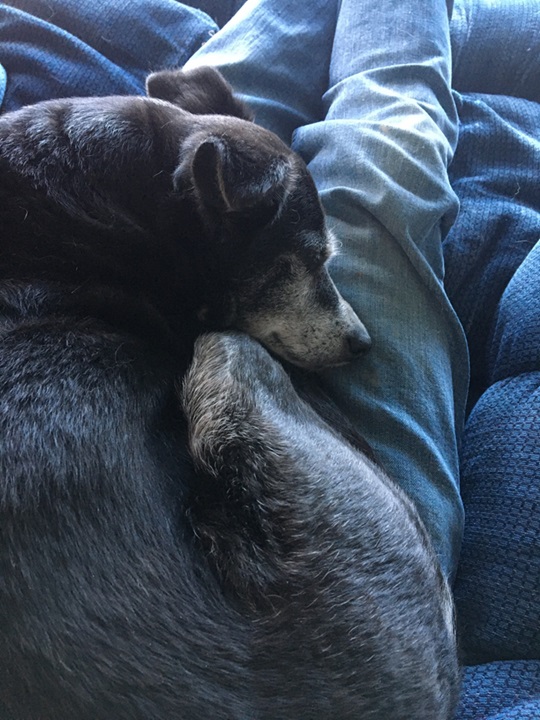
ME: Here we are half way through May. I slept well as my body was catching up on the previous night’s short sleep. I woke up in a better frame of mind also and the sun is shining. I wanted to touch base before I did billing (which is 2 days late on my schedule). I feel apprehension, partly because the billing is “late,” partly because I am not sure about insurance codes for my clients, but also a vague anxiety that often hovers around me… ah, Mitts just jumped up in my lap… that helps!
Maybe the anxiety arises from fear of not doing enough or getting overwhelmed. From that angle, it feels like maybe trusting you to care for me might be an answer. That has always been hard for me because I was taught that I have to “be responsible” and do my part or things won’t work out, and that flop will be my fault. I was taught that you are “not going to do for me what I can do for myself.” But I can never be assured that I am doing all I can because I was always “encouraged” how to do everything better. It was never quite good enough and could always be improved. I so want to just relax into trusting you fully. Please help me with that because I really struggle.
GOD: I hate that your dad had such a weak grip on my grace that he undercut your own faith in me. I hate to see you suffer like this, but I understand why you would. How could you not fear your own inadequacy and my insufficient grace after his influence on your soft, sensitive heart. I just want to keep sitting with you in genuineness so that we can slowly get to know one another and trust one another more deeply. It’s a lot to overcome! I am always sitting here waiting for you with my heart full of love. It is impossible for you to get it all right, and demanding that of yourself is torture. It’s tragic that my grace feels to you so dependent on you getting it right. If anything my grace flows bigger when you get it wrong. That’s the whole point of grace! It’s for those who screw up! You can’t come short of my love. My love is always deeper than that, infinitely deeper. Some of your stumbles might limit our bond, and that is sad to me because I miss you and because it hurts you, but that could never limit my love. And when you get it “wrong” as you suppose, my love grows even bigger, I care more for you because of the difficulty and hurt this brings you, I want to pull you even closer to myself. Mitts is the symbol of my love for you.
ME: I want to just embrace the moment, but I still feel anxious.
GOD: Of course you do! How could you not! I’m so sorry that you have to go through this. I’m here to talk when you need me. I love you!
I continue here sharing some of my interactions with God
5/22/24 ME: So I was more relaxed this morning, lying in bed for a bit before getting up and starting the morning reading Facebook…. I can see also how relaxing can be “artificial” when it is disconnection or distraction rather than soul refreshing, but being too intentional and making relaxation a task is also problematic. Even evaluating relaxation too closely is likely to turn it towards duty and away from joy or peace: “Am I really relaxing in a beneficial way?”… maybe the better question is “Does this really feel good?” which focuses on my wellbeing not the target outcome. Any input here God?
GOD: I trust you more than you trust yourself. You really work to be honest with yourself and lean into healthy living, which is great. Healthy living, like healthy eating, is not finding the exact right proportion, but living in freedom while generally leaning toward what seems good. It is not a science or mathematical equation, but an experimental, intuitive dance with yourself… and with me—I like to watch you, whether you notice me or not, and also to join you (again, whether you notice me or not). Just lean and notice, that’s all. Don’t stress over “getting it right,” there is no “right.” It’s an improvisational dance! When you think about it, that’s kind of what “flow” means—sometimes in the middle of the churning current, sometimes eddying near the bank. You are not responsible for the flow. I am the river. Your part is more play than work for sure.
ME: Okay, but it often doesn’t feel like play and I can feel a reluctance to trust you on this, like maybe it’s too good to be true.
GOD: I know it’s hard for you. For two-thirds of your life you were deeply formed into a drudge-worker or more like a slave. How terrible that you saw me as a slave-master! What deeply corrupting teaching that was! I wish you could believe that all I want is to hang out with you, talk, be friends, enjoy one another, watch you express your beauty in the world. You really are beautiful just as you are! You are my delight apart from anything you do or don’t do. Come sit with me on this swing and just enjoy being together!
ME: Thank you. I so need to be reminded of what is so basic and simple and what is the only thing that matters—that you are with me and I am with you. My worry of getting the dance steps “wrong” lessened a bit as you shared your heart with me. Let me be “wrong” as long as I’m wrong with you. Help me trust that you will keep the dance going. I even feel a little joy sneaking in… to think that I am dancing with the God of the universe!
I deeply believe the love of God for me, and following Kimberly’s suggestion, I started an interactive journal with God last month as I share honestly with the Creator and write down the responses I hear in return. It has been a very rich blessing. This was my first entry of what I heard God speak to me:
Who made dogs to have such intense joy in their owners? Who made them to bond so deeply that even a few minutes separation is cause for dancing delight at the owners return? I just molded my heart for you into a creative four-legged expression so that you could see me reflected in my creation. You are my joy! I watch you with delight as you sleep as any mother of a newborn, and my heart jumps when you awake, longing for you to find the good in the day that hides like little Easter eggs all around. I ache with you with every fear and burden you face. I feel more pained by your pain than even you feel. I agonize with you and long for the day when I can take it all away. I hate that your healing and growth requires so much suffering. I know you are doing your best even if you doubt and judge yourself. And really there is no “best,” no perfect response to life, no path that is better than all other paths. It is like an art gallery that can be explored at any pace in any direction. Each path has its own experiences that offer its goodness and pain. I wish you could worry less and trust more, but that cannot be “fixed” any more than spring can skip to fall without passing through summer. It is a long, twisting journey and I only hope you will see me walking it with you by your side.
I was raised in an environment of revivalism. My grandfather taught a spirituality called “the victorious Christian life” which asserted that a Christian could surrender so fully to God that they would stop sinning. He died well before I was born, but my father carried on that legacy, shaping all of my childhood environment through his presidency at the Christian college campus where we lived as well as the all-summer camp and private high school we attended. My father, who was more aware of his shortcomings, could not live up to his father’s standards and trimmed the spiritual expectations down to match his own sense of moral accomplishment: living without intentional sinning. He continued to call it “the victorious Christian life” and constantly challenged others to recommitment to this higher level at his college and summer conference center (similar spiritualities were labled “higher life,” “deeper life,” and “Spirit-filled living”) His reimagined theology commonly resulted in followers either doubting often their status as a victorious Christian or downplaying their failures as unintentional (so it didn’t “count,” and they did not lose their status or need a life recommitment). Dad had various ways to label a failure as unintentional. So if he were wrongfully angry, he marked it unintentional until he recognized it as sinful, then he could choose to stop being angry and keep the status of “victorious Christian.” He could snap at his children unintentionally (“in the heat of the moment”), but then “come to himself” and make it right and so not lose his standing as a victorious Christian. Lack of self-awareness in this framework became subconsciously a bonus rather than a flaw. Making right choices was naturally core to this theology as was the laser focus on right behavior rather than the underlying causes over which one had little direct control.
My father was quite limited in his self-reflection, both by temperament and by choice–I expect that was necessary for maintaining his sense of spiritual success. However, I was born with a reflective temperament. I had no means of escaping deep self-awareness. Knowing all that went on below the surface, I had no way to separate “intentional” from “unintentional.” When I was angry, I was fully aware from the start that I was angry. Respecting my own feelings would have required me to regularly choose for myself, which was called “selfishness.” I therefore had to learn to ignore, minimize and override my feelings, to basically learn to reject and hate who I was. God who created my feelings judged me for having those feelings–fear was a lack of faith, sadness was ingratitude, anger had to be “righteous.” This was terribly dis-integrating for me, but with many years of intense effort, I finally pulled it off, successfully outrunning my shame… until it finally caught up with me. The fake god who shamed me overplayed his hand, crushing me, and so drove me into the arms of the God of all grace. I finally realized that “growing in grace” was not about meeting higher standards, but about embracing unmerited love.
But one’s childhood is not so easily outgrown. I know this from the judgments that still claw at my heart after 25 years of opening myself to grace. Naturally my temperament (what the old Greeks would call melancholy) inclines me towards this. It is a long journey of learning to foster the unique beauty that springs from this DNA, to embrace what troubles me until it rises into the glory of its creation. I wish us all hope on this difficult, rewarding journey and may whatever spirituality you embrace be a sail and not an anchor.
Recently our beloved dog Mazie refused to eat for two days. Kimberly needed to talk about arrangements for her death because Mazie is old and has health issues. I tried to feed Mazie breakfast, and when she turned away again, I started crying heavily. She has been a precious part of our life our whole marriage. This is the third time we thought we were losing her, though she pulled through once again. How will I bear it when she is gone? The next day I wrote the following reflection.

Death came knocking yesterday.
He did not stay.
just tapped twice and peered inside,
because he is concerned for me
and does not want to shock me
when he comes for his appointment.
He wanted to get acquainted,
to let me know he is in the neighborhood.
He is much more gentle than I feared
and more understanding.
He does not want to shove me suddenly
into the dark river unexpectedly
but hopes I will hear his reassurance
that I will not drown,
and that life itself is richer and fuller
when I remember that all blossoms die,
and in their passing leave behind
their rich fragrance
while making room for new life to spring up.
Living awake to certain loss
widens my heart, breaks it free
of its defensive, guarded posture,
helps me breathe in deeply
the goodness of today so its fragrance
in its passing lingers full in my heart,
blessing it and opening it
to the hope of good to come.
I later rewrote the poem in metered rhyme, but I like the rawness of the original. Here is the edit

Stark death came knocking yesterday.
He just tapped twice and did not stay
But gently smiled in real concern
That coming suddenly would turn
My heart to ash and crush all good.
So being in the neighborhood
He wished to get acquainted now,
Prepare me for his scheduled blow,
As not to double pain with shock
And slash before I’d taken stock.
He’s much more gentle than I feared,
And moved with understanding cared
That I not unexpectedly
Be swept away so tragically.
He hoped I’d see his real intent
To help me be more confident
That life itself is richer by
Remembering that all blossoms die,
And in their passing leave behind
Their fullest fragrance in my mind
while furrowing new life to bring,
from torn up soil fresh buds will spring.
If I can live awake to loss,
Expand my heart, and breaking toss
away its guarded, armored stance,
It helps me breathe in deep and long
The good today before its gone.
The fragrance as it slips away
Fills up my heart, opens its way
To hope for all the good to come.
The good that’s passed is always home.
All my life my mind has secretly been constructing an autobiography, pulling together all the tangled pieces of my past and turning it into a coherent storyline that defines me. Sadly, I am not kind to my protagonist. My mind narrates the time I joined with neighborhood kids in grade school to call our friend Bobby “Roto-rooter,” laughing at how mad it made him, and I wince with sadness and shame. I recall scolding my dearly loved collie Taiho, who had done nothing wrong, just to see the cute look of remorse on his face, and it seems so mean. The older I got, the worse I did, and in my retelling, the good that I did weighs lightly against the heaviness of my perceived failures. I become my story’s villain, a cautionary tale.
Most novelists are kinder to their protagonist. As I read, I find myself hoping good for the main character, even if she is a scold or he is a criminal. I am sad when she loses her best friend or when he ends up under a bridge in the rain. I am sympathetic to their failures and losses, understanding of their vices, and whispering to warn them against harmful choices. Just show me their humanity, and my heart is all in for them. What would it be like if one of these writers told my story? If they showed the good generously and the faults compassionately and made the reader love me like a dear friend? Would I be able to accept such a telling of my story or would it feel undeserved, even untrue like the overindulgent words of a doting mother?
Just yesterday it occurred to me that I do have a flawless Biographer of my story who writes with the kindest, most gracious heart ever known, a retelling of my life that is perfect and trustworthy in a way my own memory and judgment could never be. Imagine if my life were told from the perspective of boundless love–every failure told from pure sympathy, every wrongdoing wrapped in understanding, every flaw traced with caring fingers. What if the Author of my story, while clearly seeing my shortcomings, was my cheerleader who found deep joy in who I am in every moment of my life. What if Love defined me? That is the story I long for. I believe, help my unbelief.
I’m often plagued by insecurities, inadequacies about work, relationships, income, decisions, indecisions, and forgetting to put the wet laundry in the dryer. I feel like I’m at the bottom of a rugby pile on. I think I’d be okay if there were no people–no one to impress or hurt or misunderstand or fear. Hermits must be the happiest folks on earth… except the people they carry around inside their heads. Many think well of me, but that’s no reassurance. Their approvals are light as air–they’re nice, but they don’t decrease the heavy weight of judgments (imagined or real). If you do everything right in a surgery, but make one mistake, you screwed up. You don’t get points for the positives. Success is what ought to happen, so there are no accolades except for super-human efforts. I can’t beat the game by having more wins than losses because the losses always blot out the wins.
The worst is when I feel I’ve hurt someone, whether I’m guilty or not. Even their forgiveness does not relieve my self-judgment if they are still in pain… in fact, their kindness can make me feel worse still. So feeling bad about their hurt as well as my guilt makes it twice as hard, and I feel guilt even if my motives were good and my effort strong. I could have done better–I know this is true because I look back and see it. I can point out each misstep. I should have known, should have expected, should have listened, should have should have should have. I need to stop shoulding all over myself… yes, I should stop that!
My father tried to save us children from this stinging shame of not being good enough by giving lots of advice for improvement. He was just trying to help us be better… always better. He wasn’t harsh or mean about it, but he was relentless. So I learned from childhood that if things go badly, it was my fault for not thinking or planning or performing better. The only smidgeon of relief was to figure out how to make sure I didn’t screw up again. Failure feels terrible and any means to escape it feels intensely important, and our strategy was to try harder.
The only other way to relieve my sense of awfulness was to blame someone else. I learned as a kid that someone is always to blame for a failure, because if no one is to blame, it can’t be fixed. and fixing it is an urgent necessity. We had the wrong address… whose fault was it? The bill was paid late, who was to blame? If the fault was someone else’s, it relieved my shame. It was then my duty to make the guilty one see their fault and take ownership so we didn’t have to face this shame again. How well I remember the hard-faced disappointment of my father who was waiting for me to express the intensity of my shame through hanging head and muted words with a promise to never repeat the failure again. Even then he expressed coldness and distance for some time, perhaps to let the full weight of my failing settle into my determined commitment to never repeat that wrong. It felt like forgiveness was earned by self-abasement. This particular memory, common enough, came from my sneak-reading a book in class the teacher had told me to put away and who called my father to complain even though I had apologized to her.
In my dad’s dedicated campaign of betterness, the key ingredient missing was grace. In my family, grace was the leniency offered the weak. You did as much as you could, and if you truly were unable, grace was offered… somewhat grudgingly. It was basically pity… a suspicious pity, concerned that you were “taking advantage” of grace, pretending to be unable to do something you were quite capable of doing. By its very nature, pity is demeaning, which is the opposite of grace, thinking badly of someone because of their limitations. This pity was grudging because if I couldn’t pull my weight, he had to pull it. If mom couldn’t remember, he gave her suggestions for remembering, but in the end, he had to remember for her. If I did it wrong, he corrected me repeatedly, and then he had to do it for me. It didn’t really matter how big or small the matter was because a failure is still a failure, and often the failure was simply doing it too slowly. The impatience at someone’s shortcomings always proved that “grace” was not really grace.
This week as I reflected on this deeply hurtful upbringing, the reason for my sense of inadequacy became clear to me once again. Of course I struggle with this! How could I not find myself in this continual battle against the deeply engrained views and values of my childhood? It is like my mother tongue–if I speak, it is in English. Heck, I even think in English and feel in English. “Just Do It Better” was more deeply taught than colors and shapes and I learned it before I learned the alphabet. I am on a slow and staggered journey away from this land of betterment into a land of unconditional acceptance where love is no longer a reward for beauty but a nurturer of beauty. Love comes first. Always. I am fully embraced with all my shortcomings.
I can’t seem to catch my breath for all the running. We made a crazy sudden decision in August 2017 to move across country in one month so I could start school. I drove my truck from the Atlantic to the Pacific, then slept in it for two months as I started working part time and studying fulltime for a Master’s in counseling.
Mid-semester I flew back and drove Kimberly and all our belongings 15 hours a day as I banged out a research paper in the hotel rooms each night. The sprint did not slow as I pushed to get through my studies as quickly as possible and begin my internship, 3000 hours of counseling to earn my license so that I could get a real job before our savings were all gone. When our rent went up dramatically, we realized we needed to buy a house, a very involved process for someone with 4 income streams as I was working at Home Depot part time, working for two counseling organizations, and running my own counseling business. We could only afford a fixer-upper in this market, so immediately after buying the house this spring, all my free time has been consumed with fixer-upping.
I keep waiting for things to settle down so that I can get back to a normal routine, including blogging, but I have realized in the last couple of weeks that things may never slow down. Perhaps this is my final dash to the end of life and I must simply make time now for things I value. I hope to be more present here going forward.





 Janathan Grace Reflections