Archive for the ‘thoughts’ Category
I love mystery in arts and entertainment, but I don’t want it following me into the parking lot and hitching a ride home. If insight is a blessing, mystery is a curse. If knowledge is power, mystery is paralysis. What possible good can it bring? Of course, there was that little incident over the tree of the knowledge of good and evil that ended rather badly. Apparently some knowledge and control is better left in God’s hands. But it’s scary to be left in the dark. It feels like it’s my fault, as though God is put out with me and won’t turn on the light, not as though he’s doing it out of love and support. I’m really struggling to trust God with my unresolved ignorance and confusion. Mystery has never been part of my spiritual tool chest. Gerald May explains why:
When we were children, most of us were good friends with mystery. The world was full of it and we loved it. Then as we grew older, we slowly accepted the indoctrination that mystery exists only to be solved. For many of us, mystery became an adversary; unknowing became a weakness. The contemplative spiritual life is an ongoing reversal of this adjustment. It is a slow and sometimes painful process of becoming “as little children” again, in which we first make friends with mystery and finally fall in love again with it. And in that love we find an ever increasing freedom to be who we really are in an identity that is continually emerging and never defined. We are freed to join the dance of life in fullness without having a clue about what the steps are.
We’re just getting reacquainted. It’s going to take a lot more time before mystery is a friend, especially a trusted friend.
 As I said in my last post, I am stuck with God. When Jesus got weird on his disciples (John 6), many of them left. He asked his twelve, “Will you leave too?” and Peter answered, “Where else can we go?” Yes. Exactly. We’re in the middle of the ocean, freezing cold, living on bread, squatting on steel decks and the captain of the boat says, “Feel free to leave.” And where would that be? Trust me, we are not staying because we like it here. St. Teresa of Avila once complained to God, “If this is the way you treat your friends, it’s no wonder you have so few!”
As I ended my last post, this story in John came to mind, and I felt bad for not having Peter’s good attitude. He answered Jesus, “Lord, to whom shall we go, you have the words of eternal life.” I heard Peter saying, “You’ve got it all–peace, joy, fulfillment. Why would we leave? We like it here.” I was confusing ‘eternal life’ with ‘the good life’… spiritually speaking, of course–the delights of fellowship with God. What was I thinking? You want encouragement of the Biblical kind? Acts 14 tells us that the apostle Paul was “strengthening the souls of the disciples, encouraging them to continue in the faith,” –what was his supportive message?– “and saying, ‘Through many tribulations we must enter the kingdom of God.’” What ever happened to “If you’re happy and you know it clap your hands”?

Jesus’ message was loony: “Unless you eat the flesh of the Son of Man and drink His blood, you have no life.” These are the “words of eternal life” to Peter? Everyone was stumped, and many left Jesus over this cannibal homily–“If we understand what he is saying, it’s a problem… and if we don’t understand what he is saying, it’s a problem.” Simon Peter, for all his flowery speech, was just as baffled. Had he known Jesus spoke of his own sacrificial death, Peter would have corrected the Son of God himself. For Peter, this was the one thing the “words of eternal life” could not possibly mean–the cross.
I think in all his fog, Impetuous Pete spoke the truth after all. There is nowhere else to go because these are the words of eternal life, even if it leads through more pain and perplexity than other roads. Those who stayed with Jesus after this sermon did so in confusion, not clarity, but they found him worth trusting right through the dark. Even Peter finally followed him to his own crucifixion. That is the one serious problem with resurrection–you have to die to get there.

 I am clinging to Christmas past: playing Christmas music, plugging in the tree, snacking on holiday food and drink. My neat wife likes to box up the season quick, but I’ve talked her into observing the 12 days of Christmas, not because I’m liturgically inclined, but because I’m trying to hold at bay the cheerless, cold, dark march of winter days. Our second advent theme this year was celebration, and all our decorations and colored lights inside and out speak of good cheer, pushing back the bleakness beyond.
 The first Christmas was a true celebration, the Savior had been born and his whole life of healing and redemption lay ahead of him. His birth was the great crack in space and time through which God poured in. It changed everything. But our little christmases change nothing. We pause to celebrate for a few weeks and then go back to life as usual; our sugar high dumps us on the doorstep of New Years with our purses a good bit thinner and our paunches a good bit thicker. Our celebrations leave us worse off, our only defense the remorse of resolutions to do better in the next 12 months.
As I say goodbye to extended family, vacation, wrapped gifts, boxes of chocolate, TV specials and Christmas carols and return to the mundane of alarm clocks, office memos, bologna sandwiches, and the monthly mortgage, how can I keep alive the magic of Christmas? If there is any real magic in Christmas and not just pretend magic, it must be that God himself is with me–Immanuel–and my ongoing celebration, not simply of his memory from 2000 years ago, but of his daily presence. Any suggestions for how a celebration of that might look?
The bright-faced children (and adults) whose lives were snuffed out in Newtown look out at me from the screen as their talents and personalities and families are profiled. It makes me cry. It is not just the sadness of this one event, but the tragedy of the whole history of the world that washes over me. Even as I write this and you read this, folks all over the world are being mutilated, raped, burned alive, enslaved, beaten, starved; they are being traumatized, rejected, hated, abandoned. As my wife says, “Why did God think this was a good idea?”
Whatever clever answers we give theologically, our daily reality is inescapable–we live in a malicious, dangerous world and we are not safe from harm. Faith-filled followers of God are raped, blinded, stoned alive; some lose family and friends, a good reputation, mental health, productive ministry, even a sense of God’s presence all through no fault of their own. It is a scary world, and that makes me cling all the more tightly to every bit of control I can leverage.
The more I control, the safer I feel. I create a safe theology of a loving God who would allow no harm to his children… and 20 kindergarteners are massacred. Suddenly, my theology cracks and fissures. If I cannot predict what love will do, how can I trust it… how can I even understand it? God himself no longer feels safe. The cross in my past and the heaven in my future counterbalance these doubts but do not resolve them. A gap remains between the theology of a loving God and the reality of a terrible world, and it cannot be bridged rationally. The ‘why’ is never fully answered. An honest faith is much more strenuous than I ever realized.
I recognize this dynamic in my marriage. My wife loves me at a fundamental level, and I trust this love when I smack against painful and scary tensions, conflicts, and misunderstandings in our relationship. We eventually sort it out, we are both better for it, and our relationship, love, and commitment are deepened. In the middle of the fight, I can easily doubt her love, but it is not a fundamental doubt–I do not question our marriage. We have been through so many things together without breaking apart that I trust the relationship even when my feelings are in full retreat. A strong relationship is not one without doubts, but one that endures the doubts.
My first feeling was horror, quickly followed by outrage, and then a creeping sense of helplessness: horror for how many and how young the victims; outrage for the unprovoked, extreme violence; and helplessness because it was inexplicable and unpredictable. As a red-blooded, American male with an overblown sense of responsibility, my powerlessness is the most frightening of these emotions, so I try to get passed it as quickly as possible (though I would not have admitted this even to me most of my life). The way I protect myself from horror is to let my outrage stir me to resolve, to make sure such a terrible thing never happens again. In other words, the quickest way for me to escape those wretched feelings is to jump passed them into problem-solving mode.
My gut response to natural disasters or unavoidable accidents is quite different, much simpler and cleaner. I move easily into grief and solidarity with everyone since we are all in it together. There is nothing to examine and correct. I am responsible for nothing, and can simply feel. This acceptance is typical in fatalistic cultures, even for calamities that are preventable, but that seems like a defeatist attitude to us Americans.
As a nation carved out of the frontier by pioneers, we are very gifted at overcoming adversity with our “can do” spirit. We are independent, pragmatic, self-confident, and creative… so much so that we see everything in the light of problem-solution. We are able therefore to use action to largely override any feelings that crop up. In fact, feelings themselves are often seen as part of the problem that needs fixing. We tend to deal with insecurities by taming the situation. We are a nation of controllers. We take charge of ourselves, others, and our environment.
Within hours of the Newtown massacre, some of us were demanding solutions: better school security, more gun control, better ways to identify and fix those with emotional issues (or just as vigorously rejecting these ideas). “We can stop these killings; we can fix this,” we told one another. No. We can’t. We can limit violence in various ways, but we really are not in control of what happens on this old earth. The most we can do is influence it for the better. Malicious, unprovoked, random violence is an inescapable part of our broken world, and embracing our sense of vulnerability and fear might be a good place for us to start.
I am a particular kind of controller. I gain a sense of security by figuring things out. I am at my most vulnerable when I am confused or stymied. I often “resolve” my feelings of powerlessness by sorting, categorizing, and explaining the situation–intellectual escapism. (I guess this blog is exhibit A.) When I am lost in the maze of life, I fall easily into depression. But choosing a sense of helplessness rather than avoiding it can be my way into grace.
So in my next blog I will get out of my head and into my feelings.
 “Is it God’s voice I hear in my heart or my own voice mimicking God? How can I tell the difference?” I asked Kimberly tonight as we stared at the candle flames. It was more a doubt than a question. “Even if it IS God talking to me, I may hear it all wrong, just like I do with you,” I continued. God’s voice may be in my head, but it is hardly the only voice there. In fact, as a boy I assumed dad was God’s mouthpiece. I still have trouble telling apart their voices inside me, not because they sound so much alike, but because the mix-up was so long standing. Over the years I have internalized more inflections–preachers, authors, teachers, Christians. So who’s talking now? I am learning to distrust those messages that do not harmonize with grace. God’s heart-songs are always the cadence of love–even if it is a hard scrabble love.
 When I have a friend with me, it colors all that I do, how I do it, and how I feel about it. If he is critical by nature, I will be cautious and inhibited, tense and doubtful. If my daily companion is God, what kind of God is he? If my hours are spent with a God who is focused on fixing my flaws, I will live out of fear and shame. I will be worse off for all my spiritual intent. It is crucial for me that the God I chat with over the dishes and in my car is the God of all grace. It is not only his presence I need, but his compassionate presence. I have enough harsh voices in my brain without adding Sinai to the cacophony. “Perfect love casts out fear.” May we all drink from that stream of redemption.
 Most evenings before supper Kimberly and I light some candles, listen to a word of grace, and invite God into conversation with us. Tonight I told him frankly I don’t know how to include him in the quagmire of my life. All through the day I talk to him and wait on him, but hear no answers for my doubts, feel no healing for my pain, see no clarity for my path, find no energy for my tasks. When I bring God my suffering and weakness and lostness, why do I find no comfort or strength or direction? Why does he leave me sunken in misery? Faith grows haggard without tokens of hope.
 I wrote that paragraph last night and sat thinking for a long time. If God is not in my life to fix me, then why is he here? Somehow, all my theology seems to circle back to relationship… where it should start in the first place. It took me years to learn this with Kimberly–what we both need from the other in our brokenness is compassionate presence, not problem-solving. But God is different from Kimberly–she can’t fix me but he can. He knows exactly what I need and how to provide it. So why doesn’t he?! oh… maybe he does… maybe what I truly need is his compassionate presence.
This is so counter-intuitive for me. If he loves me, doesn’t he want to remove my pain? If he can heal me and doesn’t, is he not callous and unloving? Imagine a doctor with wonderful bedside manners who refuses to cure his suffering patient. And perhaps here is the answer to my riddle. When I treat God as my doctor, I forget he is my friend, my dearest friend who holds my broken heart in his tender hands. My focus locks on my disease instead of our friendship.
I woke up this morning with a nameless dread which slowly distilled into a sense of the pointlessness of my life, and a fear that nothing will change. What did I do this week? I stained the wooden borders around our yard, but in a couple of years I will have to do it again… and to what end? I exercise, clean, shop, cook… a meaningless round of repetition. I enjoy my job in the library, but what difference does it make in the world? Well, it provides me a salary so that I can repair appliances, buy groceries, pay bills… and then do it all over again. When will I find real purpose and direction for my life, something meaningful? As I lay in bed, the thoughts of last night drifted into my mind. So instead of asking God for a fix, I simply shared with him my anxiety. In the end, what if the great purpose of my life is not something, but Someone?

 No arguments with my last Ayn Rand post, with my “selfish” assertion that I should care for my own needs before I care for the needs of others? My primary moral concern is myself, according to Rand, and I agree with her. I am ultimately responsible (before God) for my own soul, and it is immoral for me to make a choice that undermines my spiritual well-being, even if someone else might apparently benefit by that action. I must not sacrifice truth or goodness, purity or faith, love or integrity for any cause, however good, because the end never justifies the means. I must not be false to myself in order to benefit another. No good ever comes from choosing against myself.
But what about a mother sacrificing herself for her children or a husband for his wife? Is there no place for self-sacrifice? I think I can best approach this question by considering personal gains and losses. We all suffer losses in this life–not only those forced on us by circumstances, but those we choose for ourselves, for our own benefit. I choose to lose income for a more fulfilling job, I choose to curtail freedom for the joys of marriage, I choose to forgo speaking my mind for the sake of peace. In other words, I sacrifice the good for the better; the lesser for the greater, and ultimately, I am ready to sacrifice everything, even my physical life, for that which is fundamental to who I am–my heart and soul.
I think the term “self-sacrifice” is prone to misunderstanding in this regard. I must never sacrifice my true self for anyone or anything. I may often choose to suffer a loss for the benefit of myself or others, even great loss in extreme circumstances, but I cannot undermine my soul for the sake of anyone. It would be immoral and ungodly.

IS THERE ANY LEFT FOR ME?
Many would agree with this theoretically, but in practice I think we regularly, though unintentionally, trade away our soul little bits at a time. Instead of telling a friend that I need some quiet time, I keep talking on the phone. Instead of taking a refreshing vacation, I spend the week helping a family member move. Instead of taking a stand for myself at work, I yield once more to the boss’s insistence. I don’t tell my spouse what I really think; I wear scuffed shoes to save money; I let the kids choose the radio station. All of these choices seem godly, and they may be… unless they are slowly grinding down my soul, quenching my life, tripping up my dance with God.
I am learning to listen to my heart when it tells me what I truly need, and if I need it, then it is my moral obligation to meet that need to the best of my ability. Others will push me to compromise myself and will make me responsible for meeting their wants and needs. They are in essence making me their savior, but that role belongs to One alone. If they truly need something, it is God’s responsibility to meet that need, whether or not he uses me. Grace is the breath of life, and I must put on my airline oxygen mask before helping my child with his or we will both succumb. 
 Ayn Rand’s philosophy is simple: the purpose of humans is to live fully as humans, pain and pleasure direct us towards life or death, and we must choose life. I find myself agreeing with her. “Choose life!” God tells Israel repeatedly through Moses. Surely life lived to the fullest is God’s design for us, and misery or joy seem to be fairly reliable indicators of what benefits or harms us. But some caution niggles in the back of our brains: if we avoid pain and pursue pleasure, are we not hedonists?
Rand decries hedonism: “When… the gratification of any and all desires is taken as an ethical goal… men have no choice but to hate, fear and fight one another, because their desires and their interests will necessarily clash. If ‘desire’ is the ethical standard, then one man’s desire to produce and another man’s desire to rob him have equal ethical validity…. If so, then man’s only choice is to rob or be robbed, to destroy or be destroyed, to sacrifice others to any desire of his own or to sacrifice himself to any desire of others; then man’s only ethical alternative is to be a sadist or a masochist. The moral cannibalism of all hedonist and altruist doctrines lies in the premise that the happiness of one man necessitates the injury of another.” Hedonism and altruism are alike in this: one person’s well-being must be sacrificed for the sake of another’s.

Rand Is a Rationalist
“The Objectivist ethics,” Rand explains, “holds that human good does not require human sacrifices and cannot be achieved by the sacrifice of anyone to anyone. It holds that the rational interests of men do not clash.” She sees a benevolent world in which every person can find genuine, full happiness regardless of the actions of others. I’m not sure how an atheist such as Rand can be so optimistic, but if the God of all grace rules the world, hope is an inescapable, logical conclusion. A theist might read her statement “the spiritual or life-giving interests of men do not clash.” If God is committed to what is best for me, then I fulfill his will by living out this truth. God must see to it that the choices I make in pursuing what is best for me do not undermine what is best for another.
*Rand is an individualist, so we must still refine her thoughts with the Biblical truths of community and interdependence.
The Giving Tree (for those who don’t know) is a children’s book that tells the simple love story of a boy and his tree. As the boy grows, he loses interest in the tree except as it can benefit him, so the loving tree slowly gives itself away a little at a time to the boy–apples to sell, branches for a house, until finally…
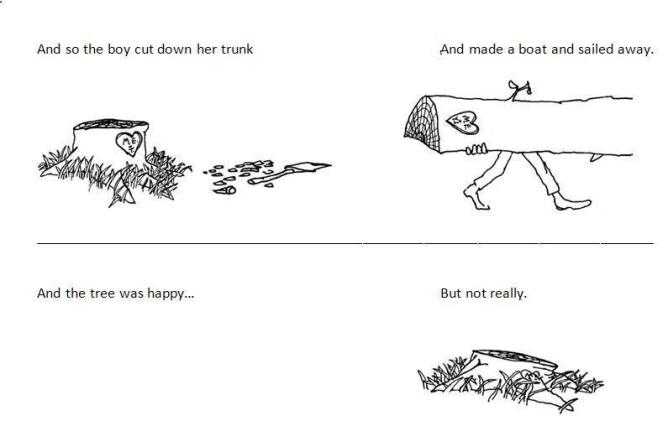
Many see in Shel Silverstein’s book an example of unlimited, sacrificial love. I see a brilliant example of co-dependence. Is it a virtue to harm myself in order to help others?
A year or two ago I read a quote from Ayn Rand’s book “The Virtue of Selfishness,” and was intrigued by her siding with selfishness against altruism as our ethical necessity, our moral calling. (She did not distinguish between selfishness and self-care, which is a complex contrast to untangle.) Here is an example of her perspective, which rings true to a lot of my own life experience:
Altruism declares that any action taken for the benefit of others is good, and any action taken for one’s own benefit [i.e. selfishness] is evil…. Observe what this beneficiary-criterion of morality does to a man’s life. The first thing he learns is that morality is his enemy: he has nothing to gain from it, he can only lose; self-inflicted loss, self-inflicted pain and the gray, debilitating pall of an incomprehensible duty is all that he can expect. He may hope that others might occasionally sacrifice themselves for his benefit, as he grudgingly sacrifices himself for theirs, but he knows that the relationship will bring mutual resentment, not pleasure—and that, morally, their pursuit of values will be like an exchange of unwanted, unchosen Christmas presents, which neither is morally permitted to buy for himself…. If you wonder about the reasons behind the ugly mixture of cynicism and guilt in which most men spend their lives, these are the reasons: cynicism, because they neither practice nor accept the altruist morality—guilt, because they dare not reject it.
I had that guilt of never doing enough for others, but instead of cynicism I practiced and accepted the altruistic morality of denying my own needs (because the needs of others always trumped mine). This conviction that my own needs did not matter left me with a sense of worthlessness. Is selfishness evil? Is it always virtuous to give? I’d like to explore in a few blogs some of Ayn Rand’s views.






 Janathan Grace Reflections