Archive for the ‘Growth’ Tag
 Usually when I am absent from this blog for a while it indicates that I’m fighting to keep my head above the water. For the last several weeks, melancholy has been dragging down my spirit. I think I am beginning to understand the cycle. Many folks suppose that depression comes from current external circumstances. Certainly there are trigger situations that fire up an emotion, but if the emotion is more than brief and reactive, if it hangs on for some time, then something else is at work. The feelings were awakened by the situation, but they are being powered by old, deep wounds of the heart. A pinprick will make little effect on a flat balloon; it is the balloon packed with the tension of air pressure which the needle will explode. The power is from the balloon, not from the needle. My melancholy comes from within, not from without. It is my soul purging the muck from within.

The balloon analogy would suggest that all melancholy is from a single source, a single wound, but I have discovered countless wounds in my own soul, a multilayered mosaic of pain. It is a web of entanglements, and I can only work on a bit of it at a time. Thankfully, life seems to bring these to my attention consecutively, activating the same emotional struggle repeatedly and so giving me plenty of opportunity to work through the issue involved before moving on to the next concern. I say “life” because it is the stimulating events that activate the feelings, but I am realizing now it is my own soul that directs the progress. I cannot reach the feelings below and behind until I have unpacked the ones above and in front of them. My issues seem to come in layers, and a fear cannot be identified (for instance) until the anger or defensiveness covering it has been understood and worked through.
Unfortunately, I can’t figure out the basis of my current melancholy. It has been very disheartening. But even as I write, I am realizing a pattern. When a new emotionally charged issue crops up, I cannot sort it out easily. It has been silenced for so long that it takes time for it to develop a clear voice… or I could say that because the sound is new, my soul does not recognize the language yet. The melancholy feels so repetitive, the same old misery cropping up again, stuck in an endless repeat cycle.
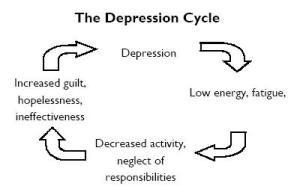
But the truth is quite different–as I work through each issue, it really does slowly heal and the next wave of depression arises from a different wound that also needs the healing touch of grace. Perhaps I will never reach the end of this progressive redemption, in which case my depression will be life-long, but it is a great encouragement to know that I am on a path of hope and healing and not trapped in an inescapable morass.
That thought gives me the patience and hope to deal with my present depression. It is not my failure or stupidity that blocks me from quickly identifying the source of my depression, and it is not a meaningless melancholy, suffering without purpose or benefit. My soul is doing its vital work, and it will just take time to come to more clarity and resolution. I have hope again. Thanks for being there to listen!
Matthew 1:2
“To Abraham was born Isaac.”
 Those five words are packed with dramatic history. The first seed in the family tree of salvation was barren. I think I would have written it, “To Abraham…. was……. born…………….Isaac. Abram had reached the end of a century with no son by his wife. He is known as the Father of faith, the Father of the nation of Israel. His very name meant father, from the Hebrew Ab, and if this were not enough, God renamed him Abraham, father of a multitude! No wonder he and Sarah laughed, though it was a bitter chuckle I’m sure.
God does not set his watch by the earth’s revolutions. He is unhurried, sometimes maddeningly slow. “Patience” is one of the major Old Testament virtues, and it is not primarily an exhortation to longsuffering with our fellow men, but with our God! That is why it is often used as a synonym for faith. We usually think of faith as the courage  to confront great odds, when in fact, it refers more often to doing nothing at all, to simply waiting on God to act. For most of us the second takes far more faith than the first, and far longer faith. It is not God who is impatient with our progress, but we who are impatient with His. We cry, “How long, O Lord?!” and he says, “Trust Me. Wait.” Especially in our hurried day, slow is a 4-letter word. I wonder if we have lost our peace because it couldn’t keep up with our quick pace.
This is a wonderful word of grace to those of us who fear that God is disappointed, tapping his foot in impatience till we get it right. It is the direction we are going rather than the length of our stride which keeps us in step with God. He is not waiting for us to catch up, running after him with our little legs. He is here for the relationship, not for the performance. He wants the journey to be full rather than the destination to be reached quickly. Slow is a word rich with peace, wisdom, and power.

Matthew 1:1 The record of the genealogy of Jesus the Messiah the son of David, the son of Abraham:
 Both Abraham and David understood God’s plan as universal rather than solely Jewish (as the calling of each clearly states). Therefore, this is the history, salvation history, of the world, not just of one small nation. Both men are seen here primarily as avenues of salvation rather than centers of political control. Jesus, being the denouement, becomes the lens of interpretation for all of history. He gives to both Abraham and David their historical and spiritual meaning, so, as the first verse states, this family tree is about Jesus, not just (for example) a rehearsing of Jewish history. The history of the world (and of Israel) can only be understood by seeing all through the person and work of Jesus. He is the defining point of history.
Even though the focus is entirely on Jesus, it is not “the record of Jesus,” unconnected to history, as though God let the world wander on its own and then finally sent a Savior. The whole history is part of a closely laid plan from the beginning of time, the beginning of man and his fall, the beginning of Israel. It is the record of the genealogy of Jesus. History—factual events that really occurred—is fundamental to the Christian faith. Existentialism, much as I like it, tries to de-contextualize Jesus and personal faith, but faith must always be firmly rooted in our reality and past. Theology, as much as each individual life, cannot begin in the middle in dismissal of the past.

IF ONLY
We are not controlled by our past, but we are at every point a direct outgrowth of our past (though every present moment is an opportunity for re-directing our future history). Every step of a journey takes you to a very specific location. You can change direction at any point, even radically, but you cannot change the previous steps taken which have brought you to this place. If you have walked to Central Park, you cannot take your next step from Times Square, you can only take your next step in that direction. Even the greatest redirection in life, spiritual regeneration, does not suddenly change your personality, biology, total sum of a lifetime of thoughts, family and friends, skills and talents, likes and dislikes, or even your character. It gives the power to change in ways never before possible, and it begins to change everything, but we all start that journey with the first step.
It is because every present moment is so weighted by our past that it takes a lifetime and more to be restored to the persons we are meant to be. You cannot wake up tomorrow and live as though you had no past or precedent… even if you had amnesia. Who you are is a continuous flow, not disconnected states of being. Some truths can have profound impact on the flow of our lives, but being transformed by a given truth is a process. This is very frustrating for many of us. It all seems to take so long, especially when the embedded lies are still wounding us and our relationships. But this forces us to fall back on grace for ourselves as well as for one another. The quality of our relationships is not determined by our goodness (thankfully), or even our maturity, but by grace to us, in us, through us. And the source of this grace is Jesus who is just as much a part of our life’s history as he was of Jewish history.

 Usually when I am absent from this blog for a while it indicates that I’m fighting to keep my head above the water. For the last several weeks, melancholy has been dragging down my spirit. I think I am beginning to understand the cycle. Many folks suppose that depression comes from current external circumstances. Certainly there are trigger situations that fire up an emotion, but if the emotion is more than brief and reactive, if it hangs on for some time, then something else is at work. The feelings were awakened by the situation, but they are being powered by old, deep wounds of the heart. A pinprick will make little effect on a flat balloon; it is the balloon packed with the tension of air pressure which the needle will explode. The power is from the balloon, not from the needle. My melancholy comes from within, not from without. It is my soul purging the muck from within.





 Janathan Grace Reflections