Archive for the ‘love’ Tag
I have been encouraged a great deal in reading one of my favorite 17th century theologians, Thomas Traherne, and want to give you a taste of his thoughts on friendship, especially regarding friendship with God. (I’ve modernized spelling and a couple words)
[Friendship is] kindness of behavior, a thorough and clear communication of souls, a secure reliance upon each others fidelity, a perfect discovery of all our thoughts, intentions, and [feelings], an ardent willingness to impart lives and estate for the benefit of our friend, the reposing of all our secrets in each others bosoms, to do all services, and suffer all afflictions, for each others sakes, to prefer the concerns of our friend upon all occasions above our own….
The greatest secret in its nature is, the mutual agreement of souls and spirits, the delight which either takes in the other, the honor and esteem they give and receive, the approbation and love of each others dispositions, the sense and admiration of each others virtues, the continual desire of being always together, peculiar ecstasy, which the beauty of either occasions in the other, when of all other treasures in the world their persons are the greatest to one another. Either is the proper element and [consolation] of the others soul. Their bosoms are the mutual receptacles and temples of each others accomplishments, whereinto they are received in all their desert, and have justice done to every degree and perfection in their nature; their hearts are thrones where they are exalted, and magnified, and live at ease, are honored [and extolled].
–though I often fall short, I want to dedicate these aspirations to Kimberly

“To love at all is to be vulnerable. Love anything, and your heart will certainly be wrung and possibly be broken. If you want to make sure of keeping it intact, you must give your heart to no one, not even to an animal. Wrap it carefully round with hobbies and little luxuries; avoid all entanglements; lock it up safe in the casket or coffin of your selfishness. But in that casket—safe, dark, motionless, airless—it will change. It will not be broken; it will become unbreakable, impenetrable, irredeemable. The alternative to tragedy, or at least to the risk of tragedy, is damnation. The only place outside Heaven where you can be perfectly safe from all the dangers and perturbations of love is Hell.” C. S. Lewis

Forgiveness 4: Seeking Understanding

When I get whacked by the blunt end of a relationship, I first need to assess the bruising and salve it with compassion. From this haven of acceptance and support, I can draw enough grace to respond in a healthier way to the bruiser. But before forgiveness is even an option, I need to piece the story together: why did he act that way? Easy forgiveness brushes aside this opportunity of better understanding. What are his heart sores and life hurdles? How did he see and experience our social fumble? We also need a better grasp of the relationship. Every interpersonal dynamic is involved here: truth-seeking, communication, perception, relational history, roles, expectations, and a hundred other facets. Forgiveness is only part of this complex relational feng shui, so if it is my only consideration, I turn a vivid social mosaic into a black/white toggle switch of blame.


Quick forgiveness looks so gracious, and long discussion seems so dramatic. Both of us may want a quick fix, and perhaps it’s the right choice for now, but we should remember that this tables the issue, it doesn’t resolve it. The same conflict will pop up again and again until we sort it out. Deferring until later may feel better in the short run, and may be a necessary strategic move, but it does not enrich our bond. And slowly over time little resentments will build up like barnacles on a boat or relational callouses will form to deaden the pain and with it the vibrant connection.
So I begin to unfold the map of who he is. I’m not looking for evidence to accuse him. I simply want to understand him, see things from his perspective. Since resolution requires mutuality, I share with him in turn my struggles, without implying fault. Just as my own heart hides when I am gruff and suspicious with it, he cannot be honest and forthcoming about his genuine feelings and thoughts if I don’t invite him with gentleness and love. I can accept him without approving of or excusing his behavior. He is precious regardless of what he does or doesn’t do. I want to know what he feels about our scrape and why he feels this way. If he is dismissive or defensive as I probe, then he’s not at a safe place with me. He may not even feel safe with himself because of the shaming voices in his head. When he closes the gate on this part of our relationship, I must honor it—I cannot force him to share. In response, I may also need to stake down a boundary marker to protect my heart. Perhaps a better time will come if I stay open and gracious.

DO YOU SPEAK RABBIT?
If we can break through into deeper mutual insight, we will then want to reflect also on our relationship. This will spark memories of past conflicts, a rich resource to ponder if we don’t use it as ammunition but as sutures. Why do we react to one another in this way in these situations? What are we feeling and thinking? Do we respond to others in similar ways? Why or why not? What patterns does this reveal about our interactions? Since honesty and openness depend on our sense of safety, the one issue we overlook at this point is blame. It may be that neither of us is guilty or both are guilty or that the problem lies in a completely different direction. But once we are sharing, the issue of fault and forgiveness often becomes moot.
Forgiveness II: Other options
My friendships are sprinkled with boredom and surprise, tinged with ambivalence and enthusiasm, stuffed with doubts and hopes, fears and triumphs. They wander through gardening and coffee and politics, with rants and laughs and confusion. Relationships are so rich and complex and rewarding. And they are painful. That’s the part we’d like to cut out like a tumor. We commonly assume that pain in friendship is a bad thing, a sign that something has gone wrong, a malignancy. It certainly feels bad, and so we naturally want to avoid it or resolve it as quickly as possible. I know I do. Berly quietly mentions my lateness or messiness and it feels like a bee sting. My emotions jump, swatting and dodging to protect the softer parts of my soul, sometimes with clenched words, sometimes in the silent safety of my mind, working out feverishly a plan to escape future critiques.

In spite of my fears and doubts, I’ve come to realize that the hard patches in our togetherness are quite often the most vital for our well-being and richest for our relationship. They uncover something important about me, about her, and about us. They open the way to deeper understanding, connection, and love, greater trust and security with one another. But this path requires the courage to face into the storm and work through the feelings together, not find ways to side-step the mess or slap up quick fixes.
Pain in relationships can come from so many sources–differences of perspective, personality, priorities, or preferences, unavoidable circumstances and pressures, misunderstandings, bad timing, sensitivity, stupidity. Notice that none of these things are culpable offenses, not even stupidity, so forgiveness is not the answer. Close neighbors to forgiveness come into play—patience, humility, acceptance, and benefit of the doubt when the behavior is irritating or problematic or inconvenient to us. But I think forgiveness uniquely addresses the issue of wrongdoing. There is a big difference between excusing or making room for someone’s behavior and forgiving them.

Forgiveness is only relevant when someone is to blame, and such a turn must be taken with care since that exit for dealing with relational pain bypasses other options, perhaps better options. For instance, if the major problem is miscommunication, we prefer seeking clarity rather than blame, at least in our calmer moments.
When one of us feels hurt, it’s best to slow down, breathe, get some emotional space, and try to sort through the feelings, seeking mutual understanding. This is far easier if we can leave aside blame for the moment. A rush to judgment sets one against the other, obscures the truth, and slows progress personally and relationally. I know how hard it is for me to move in a healthy direction when I feel defensive. In the end, if one of us needs to choose a better course of action (repent), why not start from a place of insight and love rather than coercion and shame? In our marriage, when seeking understanding is the goal instead of deciding fault, we find that forgiveness plays a much smaller role.

Kimberly and I have had rough weather for the last few months, not only in our individual souls, but in the soul of our marriage. We have wanted to sort it all out and have tried, but we’re still baffled, unable to do anything but cling to our seats as we ride out the turbulence. In spite of the conflicts that keep popping up, I want her to know that she is precious to me, and sometimes words of appreciation ring truer when we overhear them, so let me share with my friends here the treasure she is to me.
She is gentle. She is accepting. She is courageous. She is true and genuine. She is self-reflective and in touch with her soul as few people are. She is determined and tough in spite of setbacks. She is vulnerable and open. She naturally believes the best of others, and stands up for the underdog. She is empathetic and understanding. She is a great listener. She is wise and insightful and talks for hours about deep things. She is welcoming of the weak and broken and marginalized. She is responsible and capable. She calls out the best in others by being okay with their faults and foibles and valuing them for who they are, not what they do or fail to do. She is a woman of grace, even when it hurts her. She shares her true self with others even when they have crushed her spirit, but she is also good at keeping healthy boundaries. She never gives up on herself or on others.
She accepts me as I am and makes room for my weaknesses, encouraging me to support myself even when it is hard on her. She has an incredible commitment to personal growth and wholeness, and though she started out far behind others in her childhood environment, she has far surpassed most others in becoming her true self. She welcomes all of who I am, even the broken parts, and loves me as I am, and so she has taught me to love myself. In other words, she is for me the truest experience of the gospel with skin on. When my insecurities and weaknesses break out against her, she does not retaliate, but hangs on through the tensions until we work it out.
She is not perfect, and I wouldn’t want her to be (how intimidating would that be!). She has her own hangups, insecurities, and weaknesses. But we have discovered that the deepest and truest bonds come through our frailties more than our strengths. I’ve never met anyone like her, and we do life together in extraordinary fashion… even our stumbles seem to add something beautiful to the rhythm of the dance. We’re still figuring out the steps to this new rumba, and we often as not step on each other’s feet, but we’ll keep swinging till we get it down. It is in the hard times that love proves its character. Ours is a tough love.
 Kimberly woke me at 2 a.m. on Thanksgiving morning. She felt uneasy, restless, and her heart was racing. I couldn’t find the pulse at her wrist, so I tried her neck–boomboomboomboom–the staccato thumping of a quarter-mile sprinter, probably 200 beats a minute. That scared me. We were at her aunt’s home and I had no idea where the hospital was… I didn’t even know our address. “Should we go to the ER?” I asked. She said, “We can’t afford it, we don’t have insurance.” I quickly answered, “That doesn’t matter.” She responded, “I don’t want to sit there for hours in the waiting room. By the time we see a doctor, I will have no symptoms to check. Let’s look it up on the internet.”
WebMD called it “Supraventricular Tachycardia”– her heart’s electrical system was misfiring–and we should go to the emergency room if it “persisted”–how long is that?! Her veins had been drumming for 10 minutes, but she had none of the listed signs of heart failure, so we kept reading. It offered some home fixes–cough, gag, or shove her face in ice water to shock her pump steady. She tried some dainty coughs, afraid of waking up others. I told her to cough hard as I kept my finger on her jugular. Within minutes the beating slowed.
So, tell me… what are you grateful for this Thanksgiving?
The Giving Tree (for those who don’t know) is a children’s book that tells the simple love story of a boy and his tree. As the boy grows, he loses interest in the tree except as it can benefit him, so the loving tree slowly gives itself away a little at a time to the boy–apples to sell, branches for a house, until finally…
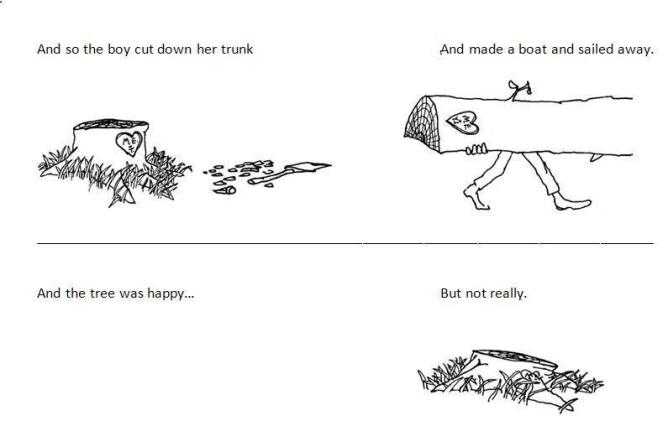
Many see in Shel Silverstein’s book an example of unlimited, sacrificial love. I see a brilliant example of co-dependence. Is it a virtue to harm myself in order to help others?
A year or two ago I read a quote from Ayn Rand’s book “The Virtue of Selfishness,” and was intrigued by her siding with selfishness against altruism as our ethical necessity, our moral calling. (She did not distinguish between selfishness and self-care, which is a complex contrast to untangle.) Here is an example of her perspective, which rings true to a lot of my own life experience:
Altruism declares that any action taken for the benefit of others is good, and any action taken for one’s own benefit [i.e. selfishness] is evil…. Observe what this beneficiary-criterion of morality does to a man’s life. The first thing he learns is that morality is his enemy: he has nothing to gain from it, he can only lose; self-inflicted loss, self-inflicted pain and the gray, debilitating pall of an incomprehensible duty is all that he can expect. He may hope that others might occasionally sacrifice themselves for his benefit, as he grudgingly sacrifices himself for theirs, but he knows that the relationship will bring mutual resentment, not pleasure—and that, morally, their pursuit of values will be like an exchange of unwanted, unchosen Christmas presents, which neither is morally permitted to buy for himself…. If you wonder about the reasons behind the ugly mixture of cynicism and guilt in which most men spend their lives, these are the reasons: cynicism, because they neither practice nor accept the altruist morality—guilt, because they dare not reject it.
I had that guilt of never doing enough for others, but instead of cynicism I practiced and accepted the altruistic morality of denying my own needs (because the needs of others always trumped mine). This conviction that my own needs did not matter left me with a sense of worthlessness. Is selfishness evil? Is it always virtuous to give? I’d like to explore in a few blogs some of Ayn Rand’s views.
I’m glad I finally realized the truth stated here by Parker Palmer: “Let Your Life Speak.” His description could be the retelling of my pre-grace life.
Like many middle-class Americans, especially those who are white and male, I was raised in a subculture that insisted I could do anything I wanted to do, be anything I wanted to be, if I were willing to make the effort. The message was that both the universe and I were without limits, given enough energy and commitment on my part. God made things that way, and all I had to do was to get with the program.
My troubles began, of course, when I started to slam into my limitations, especially in the form of failure. I can still touch the shame I felt when, in the summer before I started graduate school at Berkeley, I experienced my first serious comeuppance: I was fired from my research assistantship in sociology.
Having been a golden boy through grade school, high school, and college, I was devastated by this sudden turn of fate. Not only was my source of summer income gone, but my entire graduate career seemed in jeopardy, the professor I had come to Berkeley to study with was the director of the project from which I had been fired. My sense of identity, and my concept of the universe, crumbled around my feet for the first, but not last time. What had happened to my limitless self in a limitless world?
The culture I was raised in suggested an answer: I had not worked hard enough at my job to keep it, let alone succeed…. But that truth does not go deep enough…. I was fired because that job had little or nothing to do with who I am, with my true nature and gifts, with what I care and do not care about….
Neither that job nor any job like it was in the cards for me, given the hand I was dealt at birth. That may sound like sinfully fatalistic thinking or, worse, a self-serving excuse. But I believe it embodies a simple, healthy, and life-giving truth about vocation. Each of us arrives here with a nature, which means both limits and potentials. We can learn as much about our nature by running into our limits as by experiencing our potentials.
Despite the American myth, I cannot be or do whatever I desire–a truism, to be sure, but a truism we often defy. Our created natures make us like organisms in an ecosystem: there are some roles and relationships in which we thrive and others in which we wither and die….
If I try to be or do something noble that has nothing to do with who I am, I may look good to others and to myself for a while. But the fact that I am exceeding my limits will eventually have consequences. I will distort myself, the other, and our relationship–and may end up doing more damage than if I had never set out to do this particular “good.”
When I give something I do not possess, I give a false and dangerous gift, a gift that looks like love but is, in reality loveless–a gift given more from need to prove myself than from the other’s need to be cared for. One sign that I am violating my own nature in the name of nobility is a condition called burnout.
 Yesterday Kimberly was reading to me from Anne Morrow Lindbergh’s “Gift from the Sea,” a breeze of calm and insight from the ocean by way of the author’s soul. Anne spoke of the slow drift between spouses and the need to restore the purity and simplicity of the first wave of love. Berly and I are coming up on our fifth anniversary (May 10), and neither of us want to return to those early days of our relationship. Folks remember the romance, the excitement, the uncomplicated acceptance of one another, the overlooking of each other’s faults and feel sad that those intense feelings and sense of inseparability are gone.
Kimberly and I feel sad rather for a culture that believes romance is the fullest expression of relationship. We would never want to trade what we have now for what we had then. It was pure and simple then because it was so superficial. We spent many hours every week for two years sharing openly with one another about the things closest to our hearts, so we knew one another fairly well at a basic level before we married, but knowing the basic truths about someone is so far short of really knowing them and connecting with their heart, which is why the first year of marriage is often so hard. I know it was for us.
 Like marriage, a sailboat on her maiden voyage looks sleek and beautiful, there are no rents or dings, and she slices effortlessly through the water. But it is only after years of riding with her through the storms, risking life and fortune, and recalling the story of every rattle and dent that the captain knows his boat as no one else ever will, and the bond is deep and fierce. As we share life with mutual understanding and love, the original beauty and delight I found in Berly fills with meaning and substance. For me, every line of her face is an etching of her soul. The roots of our hearts grow ever deeper and more entwined. To pull us apart now would rend our vitals.
 The law is good, as Paul says, and it has several beneficial uses. One use is to teach us what God is like, and provide insight on how we might be like him. Of course, all of Scripture (not just the commands) is designed to help us in this way whether history, teaching, prophecy, or the like. For those who want to be intimate with God and be shaped into his beautiful likeness, it doesn’t really matter whether a biblical teaching is grammatically in the command form. The only question is whether it will help me grow personally and relationally.
The word “should” has close links with law, and it carries several connotations. First, it suggests an evaluative role. It is telling us what would be a good or better course of action. This may have no moral connotations, such as: “You should try Ben and Jerry’s New York Fudge Chunk.” Second, and closely connected to the first, is an implication of pressure to act in a certain way. We could place it on a continuum to demonstrate this: Can—–Should—-Must. Again, this need not be concerned with morality: “You must try this app!” The third connotation of should, like the word law, is one of potential personal judgment. Even if this regards simply a choice of wrenches, the person who fails to do what he should is faulted. Something is wrong with him. He is defective or weak or stupid or belligerant. Finally, because it is poised to judge, should appeals to a particular motivation. It is not a positive motivation (as the first two connotations might be); it does not attract by the beauty or benefit or health of the choice. It rather motivates by the fear and shame of being bad, unacceptable, dis-graced.
I do not want to live my life being motivated by fear and shame. I want to be motivated by God’s love for me and my echo of love for him and others, in other words, grace. Sometimes the should of law is necessary to shape external behavior to curb the harm a person may do to herself or others, but as long as the individual is acting from fear or shame, it is only her behavior which is affected. Her heart is not growing in grace. It may even be shrinking. I think the primary judgment role of law and should is to help us recognize our real inadequacies and faults, not in order to shape our behavior but to awaken us to the gospel. Some folks think grace has no power to motivate, but I have found it incredibly powerful… that must wait for another post.








 Janathan Grace Reflections