Archive for the ‘shame’ Tag
I have always been a highly disciplined person. This has been unfortunate from so many angles. It has made me arrogant and judgmental towards those with less “will-power” or commitment. It has made me focus excessively on behavior and choice and see them as the foundations for goodness rather than its fruit. It has made me self-abusive, both in driving myself past any reasonable limits, resulting in self harm, and in condemning myself for my shortcomings (because of the unbridgeable gap between highly disciplined and perfectly disciplined). Like all coping mechanisms, it played to my natural strengths and inclinations and offered me protection from the fears that snarled and snapped inside, but like a protection racket it kept me permanently bound to those same fears.
So here is the wretched conundrum of every coping mechanism: the very thing that protects us blocks us from a real resolution. We cannot give up suddenly and entirely on our coping mechanisms or we will be unable to cope, trampled by our fears and dragged away from the grace that comes to save us. Except for miracles–and by definition those happen rarely–we must grow into grace, beginning with small steps. We speak of a “leap of faith,” but that is best seen as a change in direction rather than a sudden and complete transformation of our psyche. We make a deliberate commitment to a new vision, a new allegiance, a new God of grace instead of the old god of legalism, but learning to live out that commitment is a long, slow process, full of missteps, confusion, and doubt–ask any newlyweds… or oldy-weds. Trust is a tree that matures from a sapling, not a full-grown log dropped at our feet.
Coping mechanisms are both necessary and limiting, helpful and ensnaring. They cannot be shaken off in one go, cold-turkey, like one might give up alcohol or drugs, because they sustain us in a vital way. The struggle for health is more aptly compared to an eating disorder, since we all must eat daily, so the solution cannot lie in abandonment (which seems much simpler and easier to me), but in rehabilitation. That is, I cannot simply chuck discipline, since some discipline is necessary for life and growth. I can certainly moderate self-discipline, but that does not resolve the root of the problem, which is not the amount of the discipline, but its role and purpose. “Why?” is the all important question to snag our inner gremlins. “Why is self-discipline so important to me?” Because it is the gauge by which I measure my worth, it is my source of validation. As long as I do the right thing, I think, I am in good standing with God… which is the quintessence of legalism.
I’ve been at this for years, rethinking my knee-jerk criticisms of the “lazy and irresponsible” and trying to be a little more “lazy and irresponsible” myself as a means of practicing grace towards others and myself. I’ve worked hard for over a decade to recognize my real reasons for doing good and avoiding evil and to realign those with the gracious God I serve. I’ve been focused on this, disciplined. Oh, snap! Yes, it’s true, I can even drive myself to grace or shame my lack of it, trying to force grace to grow but ending up frustrated and impatient, which helps neither me nor my relationships. Old habits die hard, and often rise up in new guises. But I recognize it, take apart my viewpoint and reorganize it. Wash, rinse, repeat. By God’s grace I am not who I once was, and by God’s grace I will not be who I am now.
“I’m sorry for being impatient with you Sunday night,” I told Forest, one of my student workers, as he sat down at the circulation desk. “You were doing your best, and that is all I can ask of anyone.” I am not a patient man, with myself or with others. I “came by it honestly” as my mother would say since Dad was highly committed to efficiency and raised us on the double: if it’s worth doing, it’s worth doing quicker. “What took you so long?” was cliched into the moral soundscape of our lives, a diagnostic metronome to gauge our pace in life. I never earned my efficiency badge, so it became an obsession of sorts as I chased after the qualifying time that kept eluding me. Life was a race and I was losing, but instead of quitting, I just ran harder.
My hopped up need for hustle exalts efficiency over more Scriptural values like patience, and even when I demote it, it still mucks up the works by prodding me to bark at consequences instead of intentions. That is, if you get in my way, I’ll get hot whether it’s your fault or not. Forest is diligent, but learns slowly. Impatience (if ever legitimate) must burn at his negligence, not at his learning curve, over which he has little control. Scolding a slow person for being slow is abusive, and the first step down that harmful path is expecting too much of others… which usually springs from demanding too much of myself.
So the cure, ironically enough, begins with grace towards myself, even about my abusive impatience towards others. I cannot in any healthy way scold myself into virtue. Being patient with myself is not at all the same as excusing myself or minimizing my fault. Rather, it is fully admitting my faults, but seeking a cure in God’s greater grace rather than my greater effort. Divine grace is key not only because it forgives me, but because it creates a whole context of grace, a circle big enough for all our failings, mine and Forest’s both. Excuses, far from being an expression of grace, are a rejection of it. They are a claim to need no grace since no wrong has been done–I only need your understanding, not your forgiveness. Excusing myself closes the door to grace just as surely as loathing myself. Self-justification and self-condemnation are both blockades to grace–in the first I am too good for grace and in the second I am too bad for it, but both express a legalistic worldview. and trying to validate them by calling them “righteousness” and “contrition” respectively will not change their antagonism to grace.
I scolded Forest shortly before we closed Sunday, and I was already feeling guilty by the time I walked out the door. I wrestled with it on the way home, refusing to play the devil’s song of shame in my head, but embracing my failings and the grace I needed to relieve my shame. Instead of spending the two days till his next shift beating myself–a common habit of mine that is so personally and relationally destructive–I settled into the relief of God’s all-encompassing grace, and when I apologized to Forest on Tuesday, it was not from a shame-induced defensiveness or groveling, but as a fellow recipient of grace. We both fail, we both need grace. May we all learn to grace ourselves and one another more freely.
I hit a deer yesterday morning as I drove home from work at 2:30 a.m. I often see deer the last half mile, sometimes just twin dots as their eyes reflect my highbeams while their bodies blend into the terrain. They are skittish, at times plunging into the road from the safety of the field, so I watch for them. But this one leaped out of the dark when I was going 50 mph, landing a few feet from my bumper. I’d have been heartsick to injure it, but it was killed instantly, so instead the slime of shame started gumming up my soul over the cost of fixing the car. Kimberly has often warned me to be careful, but I’d seen no deer in two weeks so my mind had drifted to other things. Would I have seen it, could I have avoided it, if I’d been alert?
In driving safety, Berly’s got me beat. She is more careful and aware in life, while I am more fearless and ruminative or if you prefer more reckless and scatter-brained. All personality traits have their benefits and detriments, and Berly’s make her better behind the wheel. They also make her more stressed and tired behind the wheel, so ironically I, the dangerous one, do most of the driving. There usually is a trade-off somewhere in the plus and minus categories of our personal characteristics. We often suppose there is some golden mean to seek–a perfect balance of caution and risk, of intensity and tranquility, of talking and listening–shave off the bumps to fill in the holes and end up with the perfect personality. Except those convexes and concaves are what make us each unique individuals with unique contributions. Our patterns of light and shadow shape our beauty, and our mix of strengths and weaknesses bond us in relationship.
Of course, I want to shore up my weaknesses as best I can; I want to become safer in traffic. But I must measure that against my own abilities and gifts, not my wife’s. She will always be better on the road, and that is okay… that has to be okay. Her safe driving must not be the basis for critiquing and shaming my erratic driving. In the first few years of our marriage, I was a strong defensive driver… meaning I was strongly defensive about my driving, a toxic mix of pride and shame towards any complaint. But I have slowly owned my faults and am now grateful for her backseat driving. She used to silently stomp invisible brakes on her passenger floor, but now she cries out, “That’s a stop sign!” or “That car is turning!” Team driving like team living brings out the best from both of us, but it requires mutual trust and respect built from honest interaction about our vulnerabilities and caches of shame.
 “What do you do?” is the lead-off question when you’re introduced: first your name, then job title, because in this society our work defines us, and our productivity determines our worth. I spent most of my life desperately chasing success to prove my value, and my failure drove me into despair. So for more than a decade I have been reorienting myself, trying to settle into a worth independent of accomplishment. It has been painful and frightening and crushingly hard, but God gave me no choice, thwarting my every attempt at meaningful work. And I think I have finally come to the point that I’m okay with that. He can impact this world through me or not as He thinks best.
Over the last dozen years my ambitions have dropped from saving the world as a missionary to saving a city as a pastor to saving an organization as a social worker to…. putting library books in call number order. Still I was trying to eke out some sense of personal usefulness from my job. When I was furloughed every Christmas and summer break, my depression deepened because I didn’t even have that thumb tack on which to hang my value as a human being–my existence was pointless. Like a drowning man clutching at flotsam, I would gasp in relief when work started back.
Yesterday my forced holiday ended, but for the first time in four years I was not flailing for some scrap of self respect from a dead-end job. I am grateful for work, I enjoy my colleagues, and I prefer a set schedule, but I no longer feel worthless when I’m jobless. I seem to have finally crossed a watershed in emotional freedom from this lifelong compulsion to find purpose in work. This is huge for me. This has been my most fundamental personal issue, and I’m sure it still has plenty of kick left, but its emotional grip has been loosened. The arc of this healing has been so gradual that I didn’t even realize it was a benchmark until I wrote this paragraph, and as I read it back to my wife just now, I got all choked up.

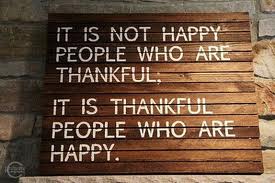
As Christian fads go, “30 days of thanks” seems to have some potential for good. If you’ve missed it, it’s the practice of giving thanks for something each day of November (often posted on social media). Hopefully it makes us all happier. Gratitude is seen in church as well as in our society at large as a foundation stone of mental health. On a TED talk last week the positive psychology guru Shawn Achor listed thanksgiving as his first choice to improve life’s outlook: find 3 things daily for which to be grateful. On the surface, I think this is a good idea. On the surface. But like most things, the real story is under the surface.

My first question is about motivation, which can sour so many good practices. I remember as a child being ordered to write thank-you notes for gifts I hated. It did not improve my life’s outlook! Legislating gratitude spoils it. But following cultural norms, my parents shamed my “ungrateful attitude” as a child… and it seemed to fix my attitude, but it damaged my spirit. In compliance, I trained myself to “feel” grateful, not as a natural response of delight, but as a way to avoid shame. On the surface, it’s hard to tell the difference, but natural gratitude gives life and forced gratitude suffocates life and relationships. Based on how I react to ungrateful people, I’d say I need more of the natural kind. When I choose thanksgiving as a “discipline,” my spiritual growth may only be in pride or resentment.

But even if my motivation is healthy, I can still misuse thankfulness. Both pop psychology and pop Christianity suppose we can fix hard events and feelings with positive thinking (often labeled “faith”). On the surface, that might be a good idea. On the surface. That is to say, if the bad feelings are superficial, then I can easily “shake it off” with some uplifting thoughts. But for anything deeper, positive thinking will only mask the problem, like taking ibuprofen for a ruptured appendix. The real solution for difficult feelings is to recognize and accept them in a spirit of compassion, try to understand them and find a means to truly support the needs that my soul is expressing. Using thankfulness to resolve significant pain just minimizes and belittles our true feelings and fosters false lives and relationships.
If you are lonely, for instance, not just this particular evening, but in life generally, you cannot rectify it by reminding yourself of all the people who love you and so talk yourself into being okay. If you are hurt by rejection, by loss, by trauma, you cannot find healing by “counter-balancing” it with happy thoughts or smothering it with praise music. Massages are nice, but they don’t cure ear infections. Paul tells us in Romans to “weep with those who weep,” not “cheer up those who weep.” Some of us need to learn to weep for ourselves in compassion. I never use thanksgiving to shout down my feelings. Joy is most truly experienced when I genuinely embrace my sorrows. So any takers for “30 days of pain”?

I’ve been missing here for a month, not from depression or busyness or low energy as in the past, but from fence sitting.

Not by choice. I’m too weak to jump out of the yard and do anything useful–I’ve glanced at projects countless times, even started some, only to realize they would drain my soul. in the other direction, the emotional gravity dragging me back down hasn’t found a grip as long as I’ve kept my shaky equilibrium. I’m in a holding pattern on a narrow platform, and I sense that it is my task to wait and gather strength.
 This is not easy for me. My internal voices are always shouting for me to get busy, and ignoring them has always led me into a place of shame. They drove me into more and more Christian service until it broke me. When I discovered the potholes this pounded into my soul, I thought I had turned onto the road to recovery, but the voices just switched goals, whipping me towards personal development, “figure out NOW what is holding you back and FIX it!” I feel ashamed for not healing faster. Patience with myself is rarely an item in stock.
I have lived all my life on the principle that rest must be earned. After all, God worked six days and rested on the seventh. I thought the Sabbath was simply a concession to our weaknesses: “Okay, you’ve worked hard enough, so now you get to rest.” In fact, there was no command to work six days… that was simply a necessity for survival and advancement. The duty, the order, the commandment (one of the Big Ten), was not to stay busy, but to stop busy. The Sabbath is not a reward for working all week. The reward for working all week is the material benefits we reap. The Sabbath was certainly a blessing, but it was a command, not a reward. It had its own justification and importance quite independent of the other six.
The Fourth Commandment was also not a prohibition (“thou shalt not work”) but a prescription: “Remember the Sabbath to keep it Holy.” It offered positive power and creative purpose for our lives, the one day to focus care on our spirits instead of our bodies (for food, shelter, etc.). If anything, it was not the work week that justified the Sabbath, but the Sabbath that justified and gave meaning to the work week. I was raised on the “Protestant Work Ethic,” but what I really need is a strong dose of the “Protestant Rest Ethic.” The first has often pulled me from faith in God to dependence on myself, but the second forces me back to faith… and though it is shaky and insecure, it is a faith I am committed to.
Matthew 1:5 Salmon was the father of Boaz by Rahab.
 In America, our job defines us. It is the first, most important identifier when we’re introduced, “Good to meet you. So what do you do?” Sometimes it’s even tacked on like a surname: Joe the Plumber or Bob the Accountant. With one word we label, categorize, and define someone from the moment we meet them. Just imagine if your meaning as a person was distilled into the name Karen the Harlot. You are suddenly no longer a person, but a commodity, and the worst sort of commodity, associated with all that is unclean, cheap, and dark. When someone hears “prostitute,” they do not think of giggling children, fresh-squeezed orange juice, and butterfly kisses. Rahab was part of a cursed race of uncircumcised philistines and she was known as Rahab the Harlot. Then God came.
In the gospels, Jesus was a trash-magnet. The discards of society were drawn to him like the starving to a feast of love. They found in him the acceptance and respect and embrace they never knew. Like father, like son they say, and the God of Israel was the Father of all widows and orphans, the poor and lost. He saw in Rahab what no one else saw, and said of her “I want her in the royal line as mother to my Son.” The beauty in all of us originates always with God, and it is our faith, not our goodness, that opens the door to his glory. Those least able to “make a name for themselves” are the ones most welcoming of grace. “Blessed are the poor in spirit, for theirs is the kingdom heaven.”

RECYCLED RAGS
2,000 years after her first appearance, we find Rahab again. Her past has not been air-brushed away–she is still “Rahab the Harlot”–because grace does not re-write our past; it transforms that twisted frame into an instrument of glory. She is now immortalized in the Hebrews 11 Hall of Faith as a model for us all to follow. God embraces a pagan prostitute simply because she opened her arms to him by faith. God does not ask us to patch together the shredded pieces that make up our lives, but asks us to trust him with those tattered remnants. He makes all things beautiful, all things placed in his hands.
This 3 minute video is a remarkable parable of grace
Matthew 1:4 Ram fathered Amminadab and Amminadab fathered Nahshon
Wouldn’t it be great to be Billy Graham’s brother? I’m not so sure. How would you be introduced at parties? Whose exploits would your children talk about around the dinner table? In public, whose reputation would you be most concerned to protect? CNN, Time, NBC would all contact you… with only questions about Billy. Imagine your whole life and personhood defined by someone else.
Amminadab knew that feeling. His name appears nine times before the gospel of Matthew, in four separate books of the Bible, and we know nothing about him. But we know about his son Nahshon. Even in the middle of a genealogical listing, the registrar pauses to trumpet Nahshon: “Ram was the father of Amminadab, Amminadab was the father of Nahshon, the leader of the people of Judah.” The only reason Amminadab’s name crops up at all is to note his relationship to Nahshon… except for his first appearance, when he is footnoted as the father-in-law of Aaron, the high priest of Israel.
We all live in someone else’s shadow that is cast by the spotlight on their better performance in cooking or speaking, patience or punctuality. As I do life with others, it is naturally hard to feel good about myself, hard to avoid competing with Jennifer’s achievements, hard to resist comparing Jason’s friendliness to my own. But when our culture also constantly rates us against our fellow, noting how we fall short, it becomes nearly impossible. I can either sign up for this game where I must be a winner (in everything) to feel adequate, or I can opt out and be labeled a loser. That is, I can constantly chase after the adequacy that is just beyond my grasp or I can give up in despair and accept my own worthlessness… or I can stumble into grace.
When you consider Amminadab, Nahshon, Aaron and Moses in the light of their descendant at the culmination of Matthew’s genealogy, they all rank shoulder to shoulder. We all stand equally shadowed by Jesus’ glory. But here the simile breaks down, for Jesus does not diminish us by his greatness, but transforms us by it. We stand not in his shadow, but in his glory, and this comes not as the borrowed, vicarious glory of a famous relative, but in his fulfilling in us all he designed us to be. Jesus being all he is makes me all I am and can be. May we be such life-givers to one another.
 Kimberly and I have started reading a book on “Sabbath” each Sunday morning. It suddenly occurred to me today that we are called to follow not only God’s example of rest, but his example of spending 6 days in creativity, like him expressing who we are to the world (for our gifts are simply an outflow of the unique creation each of us is). If we could discover and have the courage to be our true selves before the world, offering it what we have rather than what we do not have, the world would be marvelous. If we could only value each one for who she truly is and what her being means to my life and the life of the world as a whole. If we could only live in a spirit of curiosity and receptivity for (and therefore blessing from) the uniqueness of each.

D.I.Y FACELIFT
Instead, we live out of who we are not, pushed into acting in ways for which we were not created, living a lie. We hide our shame with pretenses and cover-ups, unable to encourage others to be themselves (and delighting in it) because of the fear out of which we live. We find the uniqueness of others to be threatening, confusing, irritating, dividing, and so we push for them to conform to our ways of thinking and doing and being. It is unsafe for any of us to be himself, since being rejected for our essence is the ultimate disgrace. Sadly such shame disables and distorts God’s own creation as he designed each to be, with both our limitations and our abilities. May we all learn to welcome and relish the beauty of differences.
Kimberly and I were visiting her relatives in Arkansas for a week, and some days after that, my laptop died. It is much easier for me to pick up my laptop as I sit on the sofa and begin to compose, but now I must come into our office and sit at a desk to compose, and it takes away the spontaneity and ease (and requires coordination with my wife). So I’ve been missing. Kimberly read to me this morning from a book written by the father of a boy with disabilities. He quoted a poem by Wendell Berry that I appreciated and so will share here:
You will be walking some night
in the comfortable dark of your yard
and suddenly a great light will shine
round about you, and behind you
will be a wall you never saw before.
It will be clear to you suddenly
that you were about to escape,
and that you are guilty; you misread
the complex instructions, you are not
a member, you lost your card
or never had one. And you will know
that they have been there all along,
their eyes on your letters and books,
their hands in your pockets,
their ears wired to your bed.
Though you have done nothing shameful,
they will want you to be ashamed.
They will want you to kneel and weep
and say you should have been like them.
And once you say you are ashamed,
reading the page they hold out to you,
then such light as you have made
in your history will leave you.
They will no longer need to pursue you.
You will pursue them, begging forgiveness.
They will not forgive you.
There is no power against them.
It is only candor that is aloof from them,
only an inward clarity, unashamed,
that they cannot reach. Be ready.
When their light has picked you out
and their questions are asked, say to them,
“I am not ashamed.” A sure horizon
will come around you. The heron will begin his evening flight from the hilltop.














 Janathan Grace Reflections