Archive for the ‘Sorrow’ Tag
Naomi Shihab Nye – 1952-
Before you know what kindness really is
you must lose things,
feel the future dissolve in a moment
like salt in a weakened broth.
What you held in your hand,
what you counted and carefully saved,
all this must go so you know
how desolate the landscape can be
between the regions of kindness.
How you ride and ride
thinking the bus will never stop,
the passengers eating maize and chicken
will stare out the window forever.
Before you learn the tender gravity of kindness
you must travel where the Indian in a white poncho
lies dead by the side of the road.
You must see how this could be you,
how he too was someone
who journeyed through the night with plans
and the simple breath that kept him alive.
Before you know kindness as the deepest thing inside,
you must know sorrow as the other deepest thing.
You must wake up with sorrow.
You must speak to it till your voice
catches the thread of all sorrows
and you see the size of the cloth.
Then it is only kindness that makes sense anymore,
only kindness that ties your shoes
and sends you out into the day to gaze at bread,
only kindness that raises its head
from the crowd of the world to say
It is I you have been looking for,
and then goes with you everywhere
like a shadow or a friend.
“I wrote [this poem] down, but I honestly felt as if it were a female voice speaking in the air across a plaza in Popayán, Colombia. And my husband and I were on our honeymoon. We had just gotten married one week before, here in Texas, and we had this plan to travel in South America for three months. And at the end of our first week, we were robbed of everything. And someone else who was on the bus with us was killed. And he’s the Indian in the poem. And it was quite a shake-up of an experience.
“And what do you do now? We didn’t have passports. We didn’t have money. We didn’t have anything. What should we do first? Where do we go? Who do we talk to? And a man came up to us on the street and was simply kind and just looked at us; I guess could see our disarray in our faces and just asked us in Spanish, “What happened to you?” And we tried to tell him, and he listened to us, and he looked so sad. And he said, “I’m very sorry. I’m very, very sorry that happened,” in Spanish. And he went on, and then we went to this little plaza, and I sat down, and all I had was the notebook in my back pocket, and pencil. And my husband was going to hitchhike off to Cali, a larger city, to see about getting traveler’s checks reinstated.”
Eleven years ago on a forested mountain covered with treacherous ice, sparkling like slivers of glass in the sun, Kimberly said “Yes!” to me. I slipped on her finger a ring that we designed together, two light blue opals, the color of her eyes, surrounding a teardrop diamond. My wedding ring was a simple circle of beaten gold, showing the rough marks of the hammer blows that shaped it.
Our stories have always been forged by pain and sorrow, and we were embracing this together, the sadness and the beauty. It is the seeping wounds of cut limbs bound together that creates the miracle of grafting, the agony and glory of each coursing through the veins of the other. It is not just slow healing that we find, but a hybrid bouquet that far surpasses the beauty of either flowering branch on its own.
How perfect that our 11-year engagement anniversary should combine Valentine’s day and Ash Wednesday. How apropos that I inadvertently wore black pants and a red shirt yesterday to school where I had my one class called “Spirit and Trauma.” I came home to a living room full of lit candles, and Kimberly and I shared with one another our struggles and hopes, inviting God to pour in his grace.
Beginning with advent, our motto has been “find the beauty,” and for this season of Lent we have refined it to, “find the beauty in lament.” This week we will remember the goodness that has come to our marriage through our brokenness. “There is a crack in everything. That’s where the light gets in.” Our deep, genuine, close connection is the bond of shared sorrows through stumbling love. This week we will name each facet of that unique beauty of brokenness to one another.
I got choked up when a friend posted this John Milton poem to my page, a poem written as he was losing his eyesight. It so perfectly reflects my own present struggle that it resonated deeply with me in a way it never had before.
When I consider how my light is spent
Ere half my days in this dark world and wide,
And that one talent which is death to hide
Lodg’d with me useless, though my soul more bent
To serve therewith my Maker, and present
My true account, lest he returning chide;
“Doth God exact day-labour, light denied?”
I fondly ask. But Patience to prevent
That murmur, soon replies: “God doth not need
Either man’s work or his own gifts; who best
Bear his mild yoke, they serve him best. His state
Is kingly. Thousands at his bidding speed
And post o’er land and ocean without rest:
They also serve who only stand and wait.”
Dec. 9 Is It Me or Christmas That’s Broken?
Did I seem morose in yesterday’s post? I found it soothing. When I trust God’s acceptance of me, mess and all, it gives me a sense of release, of lightness, even sometimes joy. This evening Kimberly and I lit some scented candles, turned off the lights, and celebrated Christmas by meditating on the words so reflective of our experience:
 And ye, beneath life’s crushing load,
whose forms are bending low,
who toil along the climbing way
with painful steps and slow
Look now, for glad and golden hours
Come swiftly on the wing;
O rest beside the weary road,
and hear the angels sing!
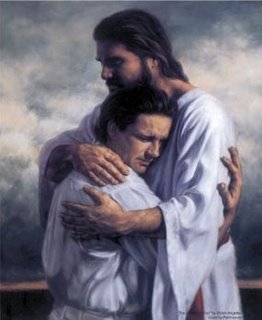
I was suddenly struck by the appropriateness of our experience and feelings in this season. It was to such as us that Jesus came. He came to “preach the gospel to the poor.” In December our whole society rises up to call the cheerful blessed. I feel out of place. It is the biggest holiday of the whole year, filled with happiness and laughter and peppy greetings to random strangers. “Holiday” is a linguistic child of “Holy day,” but it is the prodigal son that hollowed out his father’s meaning and ended up with all the froth and little of the substance. Berly and I listened to a popular Youtube rendition of “It Came Upon a Midnight, Clear,” but it had elided this middle verse. No one wants to hear about life’s crushing load at Christmas! No one but Jesus. That’s exactly what He came to hear… and to heal. Although the healing hope of this chorus is the next life (according to verse 3). Today’s joy then, muted as it may be, does not flow from our present success and comfort for “in this world you will have tribulation,” a promise of Jesus we’d like to leave unclaimed under the tree. The birth of Mary’s child rather opens the door for us into a world to come where all tears will be wiped away, and that is our hope, our future hope. Relief for my pain does not come here and now, but comfort comes into my pain because Jesus sees it and is moved by it, and his heart bleeds with mine. He does not need me to be cheerful, even on His birthday! Tonight that verse clenched my heart till the tears came in realization of a loving Savior who sees and knows and embraces me in my misery.


 Janathan Grace Reflections