Author Archive
 I am Irish from 4 generations back, and my great-grandfather apparently lived out that legacy with a liquor bottle. My grandfather was converted, and I guess he tossed everything out from the old country, good and bad, because we heard nothing more about his father in our family histories. Our illustrious past started with grandpa, and what lay before was best forgotten. By my generation, we were starched so red-white-and-blue that I discovered my green ancestry by accident, from a passing comment. When I was a boy, March 17th had no more significance than the 16th.
 New beginnings are rich with potential as Kimberly and I can attest in changing our surname, in my case from McQuilkin to Grace, but the past cannot be sliced off like so much dead weight. It’s roots are permanently entwined in who we are till death do us part–it’s part of our physical and spiritual and mental DNA. Recognizing that, I kept my middle name Kent. I often wonder how much of that early delinquent heritage has seeped down through our family line, even more powerfully because of our refusal to acknowledge it. In facing the shadows of our past, reaction is as false a step as acquiescence. I also wonder how much good we have missed by that same act of mental divorce. How might we have been enlightened and enriched by a past which has now faded beyond recovery?
I woke up this morning with spare change on the clock to get to church on time, but my soul was out of sorts, so I lay still, sensing its pulse instead of pushing myself out of bed. For the last decade I’ve honed the skill of listening to my feelings without judging them, but I’m only gradually learning to then respond with compassion, a crucial second step. Since I spent most of my life judging my feelings and driving them out with shame–calling them stupid or weak or petty–it was a giant step for me to learn to accept them as legitimate and meaningful, and it took years of stiff work.
That tenacious acceptance opened a huge cache of information about myself, a way to sort through my junk and set the furniture back on its feet. But with my cognitive bent, I’m slow on intuition, a key conduit to feelings. I often get stuck in my head, my thoughts going in circles like bugs around a rim, emotionally trapped, unable to move forward until I understand it.
I failed to realize that understanding someone and embracing him are quite distinct, and I don’t need to diagnose him in order to love him. Empathy can be profoundly healing even without an emotional biopsy. When I focus on fixing a “problem,” I default to analytics, but I can’t support the feelings when I treat them as the problem, a roadblock instead of a signpost. A hug is often better than a flow chart, not just for my wife, but surprisingly for me, the thinker.
When I’m busy dissecting feelings, I can forget compassion, especially for myself. Love seems a distraction from analyzing and engineering a solution… unless love IS the solution. “1+2 = love” does not make sense because feelings cannot be reduced to equations or formulas. But if love is not the answer, then perhaps I’m asking the wrong question, and if I’m not ending up at compassion, then I’m really off track. How would it shape my experience of life if I lived for love, not just for others, but for myself?
I know how to be a good friend to others: to listen, love, be gentle and patient, kind and thoughtful. But I don’t treat myself that way. I bully myself. I push and prod, roll my eyes, belittle pain, ignore my needs, devalue my efforts. I’m a really bad friend to myself.
So this morning I lay in bed, fully present to God and myself, ignoring the clock, being patient and gentle and sympathetic to my struggles like a good friend should. I took a feel-good shower instead of skipping it and rushing to church, and I discovered that being a better friend to myself made me a better friend to those I met. I’ve found a new buddy, and I think I’m going to really like him.
I’m on furlough over spring break and it’s been difficult. A fixed schedule helps my depression–simple requirements at set times take much less energy to commence. That easy on-ramp is a big plus for me because my psychological crud poisons initiative, so whatever keeps my wheels turning, even slowly, keeps me alive. When my schedule is wide open, just making decisions increases my load. How much energy do I have? How much energy will it take? What is priority? How will Kimberly feel? How long can I put it off before it breaks or blocks up the works or breeds flies? Procrastination is a serious survival strategy.
I could rouse myself to do something invigorating if I were sure of a pick-me-up, but more often than not I put in the work and get nothing out of it but tired. When I use up the little energy I have and find myself no better off, I feel hopeless and helpless and powerless. And the more I try and fail, the more lost I feel, till I give up in despair.
But against my resistance, a little hope sneaks back in, maybe because I can’t live without it or maybe because it never fully leaves in spite of our countless beatings. It grimaces and drags me back into the ring to get pummeled again by life. Apparently I have a masochistic addiction to hope, like battered person syndrome. Emotional resilience against my better judgment. Is it a blessing or curse?
Yesterday I applied for a groundskeeper position at Lynchburg College because it’s a full-time job and my current library position is part-time… and I enjoy yard work… and I’ve been thinking about starting an M.A. in counseling (free credits with full time work). Then I took Mazie for a walk as my agitation slowly crescendoed over my creaking joints, “What the blankety-blank am I doing?! My body can’t stand up under all that physical labor,” I griped as I limped along with a leg that’s been bothering me for… well… on and off for over a year. “Why the blankety-blank are you going to study counseling? One more degree to stack against the other useless ones after you discover you don’t like the work?” This was just the latest on a life piled high with dead-end schemes, so I walked faster to drive out my perturbation… which just made my calf hurt more.
I was a couple miles down the trail, and as I’d left behind the other strollers, I was emboldened to turn my muttering into short, loud exclamations of woe. Then I started singing a spontaneous dirge. “I hate life on this wretched earth; full of misery, without mirth. What the heck were you thinking, God? This is worse than a filthy clod.” Hey, don’t criticize, I had to make up each line on the spot in 4/4 time. I would tell you the chorus, but it was a pounding four-letter word, and some of my readers might be offended. I swept other unfortunates into my lyrics, singing for all of us, and that curved around to lines of empathy for them and my wish to be supportive of them in their struggles. And finally I came full circle to seeing God as understanding and empathizing, as being one of the wounded rather than the wounder. That’s not a typical Christian approach: cursing my way back to faith. But then, I’m not very typical.
Following the great literary tradition of Dr. Seuss, someone coined the phrase “Fake it till you make it,” meaning that if you can’t do something good from the heart, do it without the heart until the heart catches up. If you hate someone, smile and be nice anyway. If you are frightened, affect a bold, unflinching attitude. If you are upset, act as though you are calm. Fake it.
Pretense never appealed to me. I take the honest approach. If I hate someone or think he’s stupid, I let him know it, scowl at him across four lanes of traffic or shake my head in pity. There’s a reason I don’t have any Jesus bumper stickers on my car–it would be false advertising. “Receive Jesus and you can be just like me” has some major shortcomings as a marketing strategy. To be honest (I’ll try to stick with that), I’ve noticed that when I force a smile through clenched teeth, and he smiles back, good happens, a sliver of peace accidentally slips down into my heart and relaxes my jaw.
Or not. When I try to stuff the bad feelings and force myself to be virtuous, it doesn’t work so well. I wrestle down my aggravation over this lane-hogging driver… and the one who dilly-dallied till I missed the green light… and this guy who parked so crooked I can’t pull in, and each time I push down the bubbling anger, it comes back up hotter. Putting a lid on it can make things boil over.
So which is it–does it help or hurt to act good when I don’t feel good? Why does positive behavior sometimes pull my reluctant heart along and at other times trip it up?
For me, it depends on the impetus. When I choose to do good in a way that seems to devalue and override my feelings, it turns radioactive. When I give grace to others by denying it to myself, it poisons me. In fact, I don’t think it’s real grace. Picture grace as electricity–I am the cable, and God is the generator, and when I cut myself off from grace, I also cut off those who receive it from me. Being only the wire, I can’t crank grace out on my own, especially not from legalism (which is the impetus if I am moved purely by obligation). Or to say it without wires and sparks: I cannot shame and fight my feelings and then hope to be accepting and generous towards others.
Here is how it plays out for me in two traffic scenarios. First, under law. I try to clamp down on my irritation by “shoulding” on myself, forcing down my feelings. Legalism makes me very conscientious as a driver–I don’t tail-gate, I let others merge in front of me (one car only, thank you), I don’t hold people up at traffic lights as I text on my phone. I work hard at it because my self-worth is tested daily, and I have to pass every section, even the driving part, to get my human license re-validated. If God’s keeping a scorecard, I can’t afford to make mistakes, and If I can’t have excuses, neither can you. It’s a tense way to be a driver… and a husband… and an employee… and a neighbor… and a human.
Grace only has room to flow in when I change the game from whack-a-mole to save-a-mole. I decide to accept myself and others with our mistakes instead of trying to beat out the faults till we deserve acceptance. Instead of saying in my head, I drive right, so you must drive right, I say, I make mistakes, so you may make mistakes. Now this is not a new equation of fairness on a different standard as though I am saying I will allow you as many mistakes as I allow myself, but if you cross the limit, I’ll whack you. Grace is unlimited. It is no longer based on fairness. Whatever I need I get and whatever you need you get.
But what if it goes past mistakes into meanness–she is deliberately unkind. Then grace takes the form of forgiveness, and since I need a lot of that too, I want forgiveness to be woven into the ambiance of grace in my relational world. I’m not suggesting a world without boundaries, leaving us defenseless. But walls are not weapons, so personal boundaries are not a conflict with grace, but a concession to our limitations. In fact, boundaries are a form of grace to myself, providing support for my weaknesses and security for my fears, and only then will I have the resources to offer grace to others, even to trolls, who are no less deserving. None of us have merit badges–that’s why we need grace.
I just feel like touching base tonight with readers who follow my tortuous journey. Thank you for sticking with me, coming here to read and sometimes interact. It would feel very lonely to share my heart and struggles if no one were reading. I especially want to thank those of you who comment: to hear that my words are meaningful and encouraging to you is a trickle of grace and hope into my heart. Because of my depression, my active relational circle is very small, so I have almost nowhere else to make a positive impact on the world, to feel my life matters to anyone but my wife and dog. I just want you all to know that you matter to me, and that is not a small thing. Thank You.

Beautiful, Solemn, Peaceful, but Lonely

Some of my flaws are more fundamental than others, more pervasive and enmeshed, more demanding and persistent, more hidden and stubborn, like my deep rooted legalism. If I voiced my intentions, I would say I’m a recovering legalist, but my progress seems so glacial that that might be unfairly congratulatory, like a daily drinker claiming to be a recovering alcoholic. As I think about it more, I really have improved a great deal over the years, but all that thrust has not lifted me above its gravitational drag. Legalism remains my default in so many situations, a judgmental sinkhole out of which I must crawl, talking down my critical reaction to others. Trying to be gracious is a very long way from actually being gracious.
My soul is resistant to giving grace because it makes me feel so vulnerable. In a disagreement, if I can dismiss them as being stupid or unbiblical or biased, then I don’t have to give any weight to their idea, which threatens my own perspective, a perspective around which I have built a safe world for myself. If I label them untrustworthy, I can justify my suspicions of them and guard my heart against their potential betrayal. If I mark them as selfish, I can depend wholly on myself… for fear they will refuse my request for help and so prove I am not worth helping. It threatens me at my core. As C. S. Lewis wrote, “To love at all is to be vulnerable. Love anything, and your heart will certainly be wrung and possibly be broken. If you want to make sure of keeping it intact, you must give your heart to no one, not even to an animal.” A closed heart is a safe heart. Thinking generously of others, trusting them, and opening my heart to them is dangerous. Giving grace opens me up to assault from every quarter.
 Living in a world full of potential aggressors is frightening and lonely, so I am drawn to nice people, safe people, people like my wife. They have helped me slowly build trust, creep towards vulnerability, discover genuine connection. Once I develop a close relationship, I find that grace flows naturally… until I feel threatened. That is when my grace muscle is stretched as I claim grace firmly enough to support myself and then extend it to the one challenging me. Berly has been the perfect companion for this journey into fear and grace.
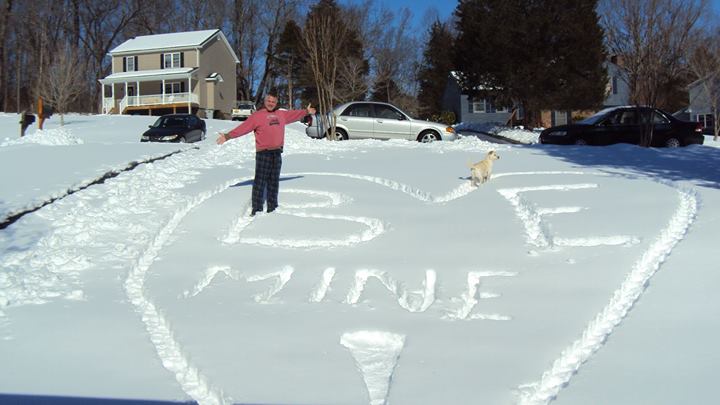
On Valentine’s Day while Kimberly was at the doctor’s, I stomped my heart out on our front lawn to surprise her.
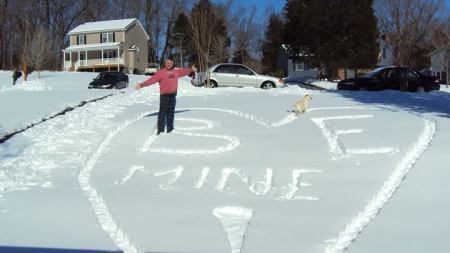
It was spontaneous, with little forethought, because I love my wife and want to express it, but when I am bowed down with depression, my energy is used up on today’s survival, not tomorrow’s plans. This is how depression often plays out in a committed relationship–with what little energy we have, we give, and we appreciate the gift, however small. It may look meager and haphazard, and to be honest, sometimes it feels that way, but in a cold world with thin blankets what we need most is a close friend.
The substructure of our relationship is good, very good, but the frills are often missing. Far from being a problem, this is a sign of our marriage’s strength. Many couples count on the frills to smooth over their stresses. To mollify an angry outburst, he brings home a bouquet or she whips up a banquet instead of sorting through their feelings with empathy and honesty. They’ve tried that and it doesn’t work. They begin with “Let me be honest,” and it goes downhill from there. So they opt for the smooth-over. But when frills become the primary language of love, flubbing it can threaten the relationship.
Depression strips Kimberly and me of many of these emotional bonuses, so we cannot use them as a substitute for the honest, hard work of sorting out our differing views, feelings, and thoughts. Of necessity we learn to make room for one another’s weaknesses and limitations, trust one another’s hearts, accept one another’s efforts. Without frills to fall back on, our relationship becomes deeply grounded, and our small offerings of love become far more meaningful.
The first thing Kimberly saw each morning as she left for work last week was the heart I stamped out in the snow. And for her it was not just a romantic gesture, but a symbol for what beats behind the image, a heart she knows intimately and feels safe in because she courageously shares her true self and is embraced for who she is. Hallmark and Whitman’s can never compete with that.
I was a 45-year-old bachelor when I started dating Kimberly, and my friends, assuming I was girl-dumb, insisted I romance her with flowers, fancy chocolates, and fru-fru gifts… take her to see a chick-flick… say “I love you.” I smiled and nodded to placate their eagerness, but I knew they were wrong. For starters, Berly prefers cheap chocolate and is ambivalent about gifts. They might have known “women,” but I knew Berly. The problem with our romance pop-culture, and much of the marriage enrichment industry, even many Christian seminars and books, are the notions that all women are alike, that men cannot understand them, and therefore that husbands should simply learn some basic rules for marriage maintenance. Men regularly come home from a weekend retreat with a checklist to follow: kiss your wife goodbye when you leave for work, tell her you love her, have a weekly date night, and for goodness sake drop the toilet seat after peeing. And those are the better men, the ones who are really trying.
It’s a deep sadness that our most intimate relationships are held together with stock routines because we’re convinced we can’t understand each other. The gender gap might as well be an intergalactic separation, after all, women are from Venus and men are from Mars… and we’re apparently lost in space. It’s certainly a nice gesture to take a quiz on our five love languages and task oneself (say) with giving three daily encouragements to a spouse, but how much does that help in understanding one another deeply and thoroughly, which is what the relationship truly needs. It is almost as though we’ve given up on real relationship (vulnerable sharing, open listening, trusting, understanding, accepting, valuing, empathizing) and reduced love to what we do for one another.
Mutual understanding between the sexes is not easy or quick. It takes a lot of time and energy, not to mention fear and pain, and perhaps for that reason our culture has largely abandoned the effort as hopeless. “It has not been tried and found wanting; it has been found difficult and not tried” (as Chesterton said of true Christianity). But nice words and kind behavior can never substitute for the gritty, real work of heart connection. The first is comfortable and functional, like a pair of old shoes, the last is revolutionary.
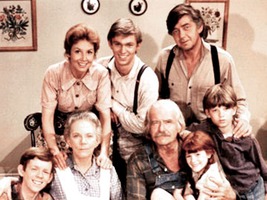 I’m sitting here listening to instrumental hymns on Pandora. It transports me back to a childhood full of the good feelings of an uncomplicated world, truth distilled into a plain, straightforward way of life agreed on by everyone, at least everyone who was right. All of us knew what was good and bad–and who was good and bad. There was no confusion or doubt, no questions or tangles to sort out, but as simple as The Waltons or The Sugar Creek Gang, a Christian book series about boys who always did the right thing (or paid dearly for failing).
Spiritual progress was like apprenticing to a trade. The models were showcased, especially parents, so we all knew what the finished product should look like, and the tools were laid out (Bible reading, prayer, church) so we knew how to get there. It was simply a matter of perfecting the skills, getting better and better at using these methods and plans to reach that end. The answers were all given, we just had to memorize them and put them to practice like a multiplication table.
As children we were shielded from any real danger, but as we grew older we were trained in beating back the onslaught of the world. We were supplied with all the reasons why those who disagreed with us were wrong, and we were constantly warned not to listen to liberal and secular views, except as a means to spot the weaknesses to refute. We were on the side of God. What else mattered? As long as we stayed in the circle of safety it felt secure, we belonged, and nothing ahead could bring us down.
That contentment of security and simplicity warms my heart to recall and re-feel. Except it’s like the nostalgia I feel from watching The Waltons–I never lived in a wood-frame house outside a small town with dirt roads and plain, country neighbors, so that sense of loss is for a past I never had. I do have genuine and positive childhood memories, but they have been sanitized, split off from the fear and guilt and shame I lived with for failing to meet family standards. The questions and confusion and inner turmoil I faced as an adult did not come from the incursions of a secular perspective, but from the inherent dissonance in my heart of the worldview in which I was raised.
There was much good in my childhood home and much good in my parents, but their prefab worldview did not work for me. I tried hard to make it fit, like the lad David trying on Saul’s armor, but it hurt and hobbled instead of helping me. In some sense I think this is everyone’s story because we all differ in some profound ways from our parents, and so we must find the path that works best for ourselves. For some of us, blazing a new trail is so scary and hard that we start our own journey much too late in life. I struggled through my adolescent independence at forty.
Perhaps our longing for a past we lost but never really had is homesickness for a past we really did have, but older than memory, a past where we walked hand-in-hand with God in an unspoiled world. Perhaps that yearning was planted in us as a whispered promise to pull us on till we see the face of God once again. So let me remember the good ol’ days with fondness and stoke the hope that helps me lift each tired leg on this long journey home.


 I am Irish from 4 generations back, and my great-grandfather apparently lived out that legacy with a liquor bottle. My grandfather was converted, and I guess he tossed everything out from the old country, good and bad, because we heard nothing more about his father in our family histories. Our illustrious past started with grandpa, and what lay before was best forgotten. By my generation, we were starched so red-white-and-blue that I discovered my green ancestry by accident, from a passing comment. When I was a boy, March 17th had no more significance than the 16th.
 New beginnings are rich with potential as Kimberly and I can attest in changing our surname, in my case from McQuilkin to Grace, but the past cannot be sliced off like so much dead weight. It’s roots are permanently entwined in who we are till death do us part–it’s part of our physical and spiritual and mental DNA. Recognizing that, I kept my middle name Kent. I often wonder how much of that early delinquent heritage has seeped down through our family line, even more powerfully because of our refusal to acknowledge it. In facing the shadows of our past, reaction is as false a step as acquiescence. I also wonder how much good we have missed by that same act of mental divorce. How might we have been enlightened and enriched by a past which has now faded beyond recovery?


 Janathan Grace Reflections