Author Archive
Kimberly and I are enjoying a sci-fi series called “Haven.” Last night they ended the show with a short dialogue I thought was profound. Chris is hugely popular, and he uses his popularity to manipulate others, though he knows he is not being his genuine self in doing so. He can only be himself when he is with Audrey, his “love” interest.
Chris: I want to be with you Audrey. I need to be with you.
Audrey: You once told me, ‘I want you because you’re you.’ Wanting me and needing me are two different things. I can’t be the person that keeps you you. You have to do that on your own. You’d eventually start resenting me for it.

THAT WAY!
God often uses us as his channels of grace, and we can support others in their efforts to heal and grow. But if we take responsibility for their change, it will prevent them from truly growing. They lack the courage or desire or understanding to move forward, and eventually they will resent us for obstructing their default path. We must all choose for ourselves the path of life and growth and the pace we take on the journey, and then others may support our will rather than substituting for it.
I’ve discovered that all the support in the world is of no use to me if I cannot receive it. No amount of compliments or empathy or affection can heal my heart unless I am somehow able to open to it. But opening to love makes me vulnerable… I can be hurt much more deeply by those I trust (and all humans fail). Kimberly and I have each discovered that unless we can find a means to value ourselves, external validation will make little impact. Grace knocks at our door but is also on the inside encouraging us to open. Grace is on the giving side, but also on the receiving side, supporting us with the courage and faith to accept. But we must acquiesce, for grace forces itself on no one.
This was my written prayer over not missing, but just delaying my morning visit with God. Welcome to a world where grace is in short supply. (Notice the date, this was well before I awakened to full grace.)
07/07/97
Lord, forgive me for failing to spend time with you this morning. I was caught up once again in doing other things, working on the day’s tasks instead of spending time with you. Lord my heart is so prone to wander and so quick to forget and turn aside. Oh, God make me sensitive to hear your voice. To crush the voice of my flesh crying out so loudly all day and all night. Let me learn to die to that voice. To live only to you. To take my pleasure only in giving you pleasure. To cast out all darkness, however pretty, from my heart like it is the entrance of Satan into my heart, for it is. Who can tell where the end of evil is once it enters the heart–for even after repentance and forgiveness it continues its evil work in me and in others, sending out wave after wave of evil from that one initial act. What fools we are to think we can measure our own sins. If we added all the evil up which comes from one sin alone, we would find it the mother of countless and terrible demons roaming the earth to devour all good.
We confess a sin quickly, spoken and forgotten. We said an unkind word to a brother. Out of discouragement from that word, he fails to be grateful to his wife’s special meal. She responds by withdrawing into silence and her daughter feels rejected. Because she is in her mood, she forgets to make lunch for her son. At the first growth of sin it has multiplied into two lives. The daughter goes to school, and her attitude affects 5 girls. The son doesn’t have a lunch, and gets angry as a result, and because of a quarrel, loses a friend who turns against Christianity as a result. All through his life he affects hundreds of people with his hatred of Christianity. That sin we confessed and forget that night grows into a terrible monster. Evil, like energy, never dies, but rather grows and breeds.
A story from NPR:
Last year, my young son played T-ball…. Needless to say, I was delighted when Dylan wanted to play…. Now on the other team there was a girl I will call Tracy. Tracy came each week, I know, since my son’s team always played her team. She was not very good. She had coke-bottle glasses and hearing aids on each ear. She ran in a loping, carefree way, with one leg pulling after the other, one arm windmilling wildly in the air.
Everyone in the beachers cheered for her, regardless of what team their progeny played for. In all the games I saw, she never hit the ball, not even close. It sat there on the tee waiting to be hit and it never was.

STRIKE... 13?
Sometimes, after ten or eleven swings, Tracy hit the tee (in T-ball, the ball sits on a plastic tee, waiting for the batter to hit the ball, which happens once every three batters). The ball would fall off the tee and sit on the ground six inches in front of home plate. “Run! Run!” yelled Tracy’s coach, and Tracy would lope off to first, clutching the bat in both arms, smiling. Someone usually woke up and ran her down with the ball before she reached first.
Everyone applauded.

WOW! Look at This BUG!
The last game of the season, Tracy came up, and through some fluke, or simply in a nod toward the law of averages, she creamed the ball. She smoked it right up the middle, through the legs of 17 players. Kids dodged as it went by or looked absentmindedly at it as it rolled unstopped, seemingly gaining in speed, hopping over second base, heading into center field. And once it reached there, there was no one to stop it. Have I told you that there are no outfielders in T-ball? There are for three minutes in the beginning of every inning, but then they move into the infield to be closer to the action, or, at least, to their friends.
Tracy hit the ball and stood at home, delighted. “Run!” yelled her coach. “Run!” All the parents, all of us, we stood and screamed, “Run, Tracy, run, run!” Tracy turned and smiled at us, and then, happy to please, galumphed off to first. The first base coach waved his arms ’round and ’round when Tracy stopped at first. “Keep going, Tracy, keep going! Go!” Happy to please, she headed to second. By the time she was halfway to second, seven members of the opposition had reached the ball and were passing it among themselves. It’s a rule in T-ball–everyone on the defending team has to touch every ball.
 The ball began to make its long and circuitous route toward home plate, passing from one side of the field to the other. Tracy headed to third. Adults fell out of the bleachers. “Go, Tracy, Go!” Tracy reached third and stopped, but the parents were very close to her now and she got the message. Her coach stood at home plate calling her as the ball passed over the first basemen’s head and landed in the fileding team’s empty dugout. “Come on, Tracy! Come on, baby! Get a home run!”
Tracy started for home, and then it happened. During the pandemonium, no one had noticed the twelve-year-old geriatric mutt that had lazily stettled itself down in front of the bleachers five feet from the third-base line. As Tracy rounded third, the dog, awakened by the screaming, sat up and wagged its tail at Tracy as she headed down the line. The tongue hung out, mouth pulled back in an unmistakable canine smile, and Tracy stopped, tight there. Halfway home, thirty feet from a legitimate home run.
 She looked at the dog. Her coach called, “Come on, Tracy! Come on home!” He went to his knees behind the plate, pleading. The crowd cheered, “Go, Tracy, go! Go, Tracy, go!” She looked at all the adults, at her own parents shrieking and catching it all on video. She looked at the dog. The dog wagged its tail. She looked at her coach. She looked at home. She looked at the dog. Everything went to slow motion. She went for the dog! It was a moment of complete, stunned silence. And then, perhaps, not as loud, but deeper, longer, more hearfelt, we all applauded as Tracy fell to her knees to hug the dog. Two roads diverged on the third-base line. Tracy went for the dog.
Two roads diverged in this little girl’s life. One is the road of rules and expectations, the other is the road of love. The roads of our lives are much the same. Will we go for the safe, predictable road of rules and expectations? Or will we go for the One we love…?
Yaconelli: Wild Abandon (quoting a story by Bill Harley on NPRs “All Things Considered”)
This is where my story gets hard and healing, frightening and amazing. First the mess. My needs displayed themselves in a hundred ways that were threatening to Kimberly and her needs. For instance,  I have often used anger and blame to protect myself from looming danger, but Kimberly was raised by a mother who screamed and shouted, so when I honestly expressed my feelings, her alarm tripped.
Early in our dating we sat for lunch in a restaurant booth in Arlington, Virginia where I was living. The man in the booth behind us, apparently a construction foreman, was carrying on a loud conversation on his two-way radio. I muttered to Kimberly how rude this was, which she feared he could overhear, and then I swiveled around and gave him a “dirty look” hoping to shame him quiet. When I turned back around, she was visibly shaken and said she did not know whether she could stay in relationship with someone with anger issues. So began the saga of conflicting needs in the area of self-defense, specifically anger.
The machinations of the mind are complicated, so unless this is your experience, you may not understand the root of my anger. Anger is the result of feeling disrespected, having my boundaries crossed. As I grew up, my sense of worth grew dependent on the value others placed on me. If they seemed to devalue me, I was threatened at my core. There are many ways folks can protect themselves from this, and one of mine was anger and blame. When the crew chief raised his voice, I felt disrespected, and in my insecurity, I reacted to protect myself against this threat.

Is This Going to Work?
From childhood, Kimberly has taken the opposite approach of protecting herself by accommodating every one so that she is liked. When threatened, I bared my teeth and Kimberly wagged her tail. She was quite successful in acting in such a way that no one would ever get angry with her. Underneath was her terror of rage and denial of her own anger. Both of us were living out of fears that we did not recognize, incompatible anxieties, each person’s defense mechanism triggering the other’s fear. I thought I needed a mate who would be okay with my anger and Kimberly thought she needed a mate that never got angry. This did not look like a match made in heaven!
But what we wanted was not what we needed. Let me put it plainly–we each wanted to marry someone who would help us escape our deepest fears. Our coping mechanisms were not “working” (protecting us from pain), so we wanted a spouse that would reinforce our defenses, not so we could face our underlying issues, but so we could avoid them successfully. We were both blessed to have a very supportive and accepting relationship… except when it wasn’t. She was not trying to expose my denial (the anger that hid my fear), but in simply being herself with me, and I with her, the truth was forced to come out, and it was very painful. After all, there were quite good reasons why we developed these protective patterns early in life. Let me relate a very common interchange
 Me: “That jerk just cut me off and then slowed down to turn into Sheetz. That’s really considerate!” My insecurity is shouting at me that I have been disrespected. I don’t realize that I feel threatened and fearful because my anger jumps in so quickly to protect me and blame the other driver. I think my aggravation is his fault.
Kimberly: “Maybe he was running low on gas and saw the gas station at the last minute.” Kimberly feels her fear rising at my heat, and she jumps in to protect the person I am attacking. I feel unsupported and shamed.
Me: “He could have easily slowed down and pulled in behind me.” My coping mechanism is being threatened. If you take away my anger, I have no protection from being devalued. I still don’t realize that my true, underlying feeling that needs addressing is fear.
Kimberly: “Maybe he didn’t have time to think of that.” I feel the legitimacy of her argument. I really should not be mad. I begin to feel shame for my temper instead of sympathy, which would give me the safety to look deeper into the roots of my fear. I shame my anger away, closing the one door to my true heart’s need, and I no longer feel safe sharing my feelings with Kimberly.
Me: “Whatever!” an irritated dismissal. Kimberly senses my disapproval of her responses. She is deeply hurt by my unspoken criticism that she is not supportive and caring, that she is not enough. I am challenging her one shelter against shame, her remarkable ability to be supportive and empathic. Her solution for the world’s problems is “Life is so hard, let’s all just get along.” To feel safe, she needs me to be nice to everyone, especially her.
This dynamic played out scores of times. We were committed to honesty in sharing our feelings and in accepting one another “as is,” and this characterized our relationship, so we grew more trusting and secure with each other. The problems came when our needs conflicted, when supporting her meant denying my own needs. But our commitment to love and understanding in the other parts of our lives slowly began to soften these areas of conflict. Kimberly moved from “your anger is bad” to “your anger is hard for me” to “your anger is understandable” to “I see how your anger is a vital protection.” I moved from “you are not enough” to “I feel hurt by you” to “I see why anger is a problem for you” to “wow, you have every reason to fight anger.” This was only possible by understanding ourselves and one another better. We had to face into our fears and trust one another to listen, understand, and accept us. We often failed. It was messy.

OKAY, LET'S TAKE THIS SLOW

PAIN
Before I share how Kimberly and I grew in our wonderful, painful, scary and supportive relationship, I need to give some context regarding our perspective on coping mechanisms.
All of us are wounded because we are born into a broken world with broken people and broken relationships. In order to survive emotionally we develop methods for protecting ourselves. These include the happy face, the sad face, the angry face, the cute face to hold off the dis-grace of others. We use control, manipulation, confrontation, and every other form of avoidance (procrastination, withdrawal, acquiescence, drugs). The list goes on. We use these methods unwittingly, settling into a pattern that works best for each. Many children would be emotionally destroyed if they found no means to cope.
I was at one time convinced that coping strategies were evil because they shielded us from the truth and taught us to live a lie. They do shield us from the truth, but this is not necessarily an evil. As Jack would say, “You can’t handle the truth!” or in Jesus’ words, “I have much more to say to you, more than you can now bear.” Our coping mechanisms act as crutches, and if we see them as such, we can slowly mend and get back on our feet. The problem comes when we either deny the injury and pretend we have no crutch or stop going to physical therapy because it is too painful and decide we’ll just sign up for a disability pension. I used to try talking people out of their coping mechanisms, kick their crutches out from under them so to speak, until I realized how powerfully beneficial these protective shields are.
 My major coping mechanism for feeling better about myself is trying harder. I thought I was practicing discipline, obedience, godliness, but increased effort was really my means to block a sense of shame and unworthiness. I only discovered this truth because my method of coping didn’t “work” sufficiently–I still felt too much like a failure. The more energy I used to escape my negative feelings, the more I realized it wasn’t working, that I could never make it work.
Once I realized that this was a coping mechanism, I tried to “overcome” it. It was a lie that I had to cast out… only it had stopped deceiving me once I recognized it for what it was. When I realized it was a crutch, I could use it as a crutch. For instance, I feel inordinately bad about failing to meet expectations (the inordinate part is a major clue). When I did not recognize this as a coping strategy, it controlled me subconsciously. Now that I realize it is a crutch, I am tempted to throw it down, but the problem is not so much my behavior (trying harder) but the reason behind it–working to earn my worth.

The Dark Hand of Shame
So my second temptation is to maintain my hard effort while changing the underlying thought patterns, but the effort itself supports the wrong mindset. I am running late for a meeting, and as I drive I tell myself, “It’s okay. Everyone is sometimes late. Calm down,” but all the while I am driving like Jehu. I find that I can’t maintain the same level of diligence without operating out of a sense of urgency, a drivenness that comes from my insecurities. The more I try to give myself a break, the less I meet expectations, and the worse I feel about me. These voices of condemnation have indoctrinated me and shaped my feelings, and barring a miracle, it will take a long process of reorienting my perspective. In the meantime I do not have the emotional resources to simply stop all effort to meet others’ expectations and hold back the resulting flood of shame. I would be overwhelmed by the voices against me feeding my shame. My coping mechanism allows for my frayed emotions to be soothed as I slowly push into my fear and break free.
So I take baby steps, put a little weight on the foot. I put in a little less effort while working to offload the shame that I would normally feel, turning a little more towards grace. I share with others my fears so that their power is reduced. I find gracious people to support my faltering faith. And slowly I find myself growing whole from this deep wound. Healing of long established problems, both physical and emotional, takes a lot of time, gentleness to the injury, support and protection.

ME: YOU GOT A PROBLEM? I GOT A SOLUTION!
I could share many troubles that jumped Kimberly and me because of conflicting needs. One of the most painful and intractable is based on her focus on acceptance and my focus on improvement. Because of our families, personalities, and experiences, we have each fine tuned our coping strategies to survive threats to our emotional well-being: she is a people pleaser and I am a people fixer.

BERLY: I AM HERE FOR YOU
In relationships, she provides emotional support and I provide practical solutions. I am pretty good at empathizing, but that is not my goal. My goal is to help folks find a way forward. Kimberly is encouraged to see folks move forward, but that is incidental since her goal is to “be there” for others. I seek change, she seeks stability; I want action, she wants presence; I need hope, she needs patience.
Naturally, when our coping mechanisms do not “work,” do not protect us, we each feel deeply threatened at our core. You can see where this is going. I feel loved when someone understands my struggle and adjusts to my needs; I feel rejected if my friend does not change. Kimberly feels loved when she is accepted as she is; she feels rejected when her friend asks her to change (i.e. is not okay with her as she is).  The message she regularly heard from me was “You are not enough” and the message I regularly heard from her was “I don’t care about your needs.” Each of us, by trying to defend our needs in relationship to each other, simply hurt the other one more.
If I were to write my real thoughts about these particular differences while dating, I would say, “I want to change for the better, she does not; I seek improvement, she seeks stagnation; I am an optimist, she is a pessimist.” In my younger years I would have pointed out the many Bible verses that support my perspective and shamed the other person into compliance. I am quick to blame, Kimberly is quick to accept, so she probably did not have these thoughts, but she would be justified in thinking, “I accept others, he rejects others; I am patient, he is impatient; I see people as individuals, he sees people as projects.” Thankfully, Kimberly and I respect one another and highly value honesty, understanding and acceptance. I see real benefits in her perspective and see how I fall short in those areas. She sees real good in my strengths and is grateful for it.
However, this does not change decades of reinforced feelings. When these dynamics popped up, it was very painful for both of us. For a long time, her perspective made no sense to me and my perspective made no sense to her. When our needs were not in conflict, we freely expressed our love and acceptance, and so over time we became more trusting of each other. That gave us the emotional space to slowly learn each others’ languages. Most of this happened before marriage, and though our feelings still smarted a great deal, we understood our issues and were committed to working through them. In fact we realized that in an amazing way, even our conflicting emotions were a great benefit to us and our relationship… but more on that later.

Pain Opens the Door to Love
 When I last shared about Kimberly and me, I left an important point untouched. Are there not certain responsibilities that are moral in nature? Is my wife not required to be monogamous? Is it ever right for me to hit her? For the relationship to work (any relationship), do we not need some moral standards on which we can insist, a moral code of conduct?
Let me begin by saying that I believe all intentional acts are moral. Everything we do and how we do it is affected by our faith, love, humility, and the like. Even things we do with no apparent moral content are choices to do this and not something “better.” So perhaps the question is rather: are some moral choices “beyond the pale,” so significant that the relationship cannot simply absorb the behavior and continue on more or less as it was but must be addressed and worked through. To reorient the question in this way, however, moves it from a legal question of right and wrong and rather asks what will hurt or benefit our relationship. Relationship becomes central, and law becomes its servant (as Jesus said).  Instead of saying, “You must stop this because it is against the law,” or even, “You must stop this because it hurts me,” we simply say, “When you do this it hurts me,” because if we force or manipulate them to change, it will undermine the genuineness of our connection. For important relationships, this step is just the beginning of an ongoing discussion and a doorway into deeper mutual and self understanding, acceptance, and trust. That is not to suggest I have no recourse if I am being hurt, but if relationship is primary, the solution does not lie in controlling the other person.
I am ultimately not accountable for their choices, but for my own. I am responsible to see that my own needs are met in a healthy way, whether my friend supports me or not. My needs determine where I draw the boundary line in our relationship, and my friend’s needs determine where he draws the line. If he cannot respect my boundaries, then I will take measures to protect my boundaries because I must respect myself and my needs whether he does or not. This is not a judgment of my friend’s inadequacies or of my inadequacies (as though he doesn’t care enough or I am too needy). We may both be doing the best we can, but not have the capacity to make the relationship work.
 This was the huge distinction between my (former) perspective and Kimberly’s. I thought the only legitimate basis for boundaries was the law. If you lie to me, you are wrong; you must stop it, end of story. If you cheat me, you are wrong and must stop it. If you hurt me, you must stop it. I would use my relationship to blackmail their compliance, communicating with my behavior, “If you want to feel good with me again, you must change.” With this approach, determining who was at fault was fundamental to resolving relational conflict.
Basing such boundaries on my own personal needs was just selfishness. But when Kimberly did, I could very clearly see she was not selfish. She cared very much for my needs, whether she could accomodate them or not, and this confused me. Every selfish person I know subtly or blatantly shows disregard for my needs. Kimberly was saying in essence, “I do not have the emotional resources to care for all my own needs and all yours as well. If any of your needs go unmet, it is very unfortunate, and we will try to find the resources of support you need, but I can only give from what I have. You cannot ask me to go into debt in order to pay off your debt. I cannot ultimately take responsibility for your unmet needs.”
Of course, this was not one straightforward, simple talk we had. We both agonized over the emotional turmoil that sprang from our conflicting needs. Let me give an example that plagued us for years… in the next post.
 “THERE is hardly a word in the religious language, both theological and popular, which is subject to more misunderstandings, distortions and questionable definitions than the word “faith.” It belongs to those terms which need healing before they can be used for the healing of men. Today the term “faith” is more productive of disease than of health. It confuses, misleads, creates alternately skepticism and fanaticism, intellectual resistance and emotional surrender, rejection of genuine religion and subjection to substitutes. Indeed, one is tempted to suggest that the word “faith” should be dropped completely; but desirable as that may be it is hardly possible. A powerful tradition protects it. And there is as yet no substitute expressing the reality to which the term “faith” points. So, for the time being, the only way of dealing with the problem is to try to reinterpret the word and remove the confusing and distorting connotations, some of which are the heritage of centuries.” — Paul Tillich
This interaction occurred several days ago on Facebook with a friend who got a brief response from me after she posted a quote. You can see she is very gracious and open. I have changed the names for privacy’s sake. Our FB interaction is followed by a personal message I wrote to her.
Jennifer: “You either pass on your fears or your faith” to think about…
Janathan: sometimes how I express my faith stirs up your fears and my fears expressed calm your fears. to think about.
Jennifer: good point Kent, still reflecting on your comment. My initial thoughts on the area of fears … sometimes expressing or admitting our fears ‘demystifies’ them, & I can see value in that,.. also hearing others admit their own fears helps me realize i’m not the only one… I think what I appreciate about the above quote is the thought of being able to ‘transform’ a paralyzing fear into a faith action. Rather than being immobilized by fear, moving towards trusting God with it. Fear does not come from Him… whatcha think??

FAITH CAN MAKE YOU SMILE!
Janathan:I think I’m wary of what seems over-simplification to me, assuming solutions when I haven’t taken sufficient time to fully understand the emotional dynamics at work (a definition of “pat” answers). We might say ‘love’ and ‘faith’ are simple, clear, easy to identify… until we start realizing how common misconceptions are, confusing love with lust, possessiveness, admiration, etc. I think we have to agree that all emotions were created by God and of high worth. God created fear in us, and the Bible regularly commands us to fear. My biggest fears tell me something really important about my own woundedness, and if I try to simply control this fear with ‘faith” and not understand my deeper heart issues, I think it causes real personal and relational problems. What is your perspective?
Janathan: On the other hand, one can be equally disrespectful of one’s own feelings by exacerbating them rather than listening to them (though I think conservative Christians tend to err on the former side… as one well-known writer titled a book “Emotions, the Believer’s Greatest Enemy.”
Jennifer: hmmm i don’t like simplistic answers either.. and will often ‘chew’ on a thought for a long time (including your quote 🙂 but at the same time, I’ve had to face some of my biggest fears,… and in the midst of those fears have often found myself unable to do anything else with but transfer them to God. “perfect love casts out all fear” is a concept i don’t fully understand yet it seems to involve trusting the Source of Love to such an extent that we have nothing that’s too big for us to face. The kind of ‘fear’ you refer to,.. i would associate with a respectful fear.. and not an immobilizing fear. appreciate your thoughts..
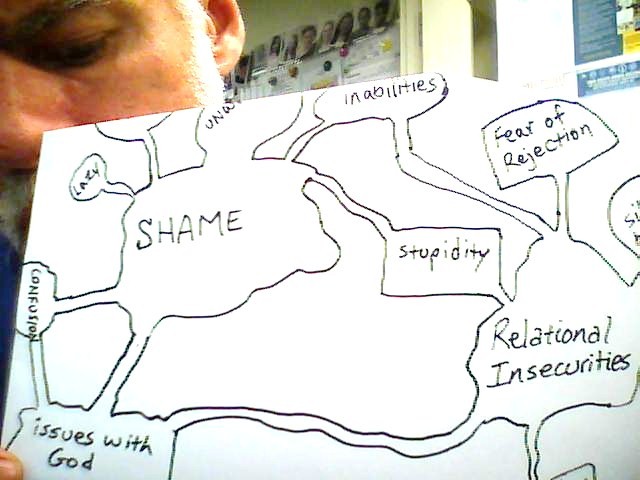
HIDDEN UNDERGROUND
Janathan: I agree, Jennifer, sometimes fears are so intense we have to find a means of calming them before we can begin to understand them. I think there are many ways of doing this, such as adding a safety net or sharing our fears with someone who is safe for us (this is an act of faith as well). I know I have had numerous misconceptions of faith in my past, misconceptions I still struggle with. One of the biggest ones was to use “faith” to shame my feelings, in which case my feelings went underground, seeming to be conquered, but simply adding another layer of distance between myself and my heart.
Jennifer: hmmm good points. I’ve had to work through ‘fear of admitting fears’…. because as I looked back on my life i realized that the fears i ‘verbalized’ (admitted out loud) were exactly the ones that i ended up having to face in reality. 😦 Still working thru that one, but I think one of the lessons I’ve come away with, was that God wanted me to experience His peace even in the midst of my biggest fears (and I did,… for the most part! 🙂 From what I can tell, fear doesn’t GO AWAY.. we just learn to manage it. I’ve prayed endlessly for God to take away my fear of flying.. but it’s still there. What I had to face was my fear of dying instead.. With cancer, I had to face my fear that His plans weren’t good ones (from my perspective),.. but as I look back,.. so much GOOD came from having it.
Beth: Such thought-provoking comments. You’ve both alluded to the idea that fears have a variety of sources. Yes, fear can be emotionally based, but it can also be based on objective facts and truth. Jesus said “… I am the truth…”. Truth is his very essence and thus he also knows all. I’ve learned that I can trust my God more than I can trust myself. We can all be easily manipulated (emotionally) and we can also manipulate others and we can even manipulate ourselves. But God can not be manipulated. Thus I choose to put my trust in Him who is truth, and pray that he gives me the wisdom to discern the source of my fears and take control of all my thoughts. (2 Cor 10:5 “…destroy arguments and every lofty opinion raised against the knowledge of God, and take every thought captive to obey Christ.”)
Jennifer: thanks for your input Beth… i like the verse about ‘taking your thoughts captive’ … i think it fits the discussion. Though I have to admit.. i’m a very practical person… and as much as I understand the ‘exercise’ of doing that,.. i still don’t understand what are the practical, tangible results.? In other words,.. what actually changes in relationship to our fears?
Beth: Making our thoughts “captive and obedient” to Christ is definitely practical, with tangible & transformational results. Emotionally based fears are often reinforced by our thought life. “For God has not given us a spirit of fear, but of power and of love and of a sound mind” (2 Tim 1:7). It seems that fear and faith can not co-exist. Paul repeatedly tells his readers we have real power to control our thought-life, leading to transformational living. “Do not be conformed to this world, but be transformed by the renewal of your mind, that by testing you may discern what is the will of God, what is good and acceptable and perfect.” (Rom 12:2). As we renew/change our thinking, our emotions and behaviour will realign accordingly. When our focus is Christ and his attributes, it will result in our minds being filled with his presence and peace (Phil 4:8-9). Faith and fear do not co-exist.
Kent McQuilkin: Ah, Beth, what a very different view you and I have on emotions and faith!
Jennifer: Will need to reflect on your thoughts Beth… Sometimes it just takes time for a truth/principle to move from my head to my heart,.. and then into action. 🙂 Curious about your view on emotions and faith, Kent. 🙂
Wow, Jennifer, where do I even begin? I understand Beth’s view, I was raised with that view. There are good and bad emotions and we must choose the good and refuse the bad. The good emotions are telling us the truth about the world and God, and the bad emotions are telling us lies. We encourage the good emotions and discourage the bad emotions by thinking the right thoughts about each, often using Scripture as the basis. We talk ourselves out of the bad emotions and into the good ones. This is how faith works to free us from bad emotions–I keep telling myself the truth until I believe it (and truth comes from propositions, not from feelings, which can’t be trusted), and as I slowly believe more, my bad emotions dissolve.
 In a sense I believe and follow this approach for superficial matters. As everyone knows, emotions can be very changeable and fleeting (which makes us reluctant to trust them). If Kimberly does something that slightly irritates me, I throw some “truth” at my feelings (“she also has to forgive me for my irritating behavior” or “she’s just tired”) and let it go. I can do this because I am secure in our relationship—I know she cares deeply for me and respects me and my feelings. It is just an emotional hiccough I feel. However, if the feeling persists, I know it is telling me something I need to hear.
To suppose that emotions are fickle and unreliable because they constantly fluctuate is a serious misunderstanding I think. What I see with my eyes constantly changes—I see a chair, then a table, then you, then my book… does this mean my visual perception is unreliable? On the other hand, if I kept staring at the chair and it turned into a cat and then into a pecan pie, I would have major doubts about my visual perception. Just like my eyes, my emotions are “reading” constantly changing situations, so that to be consistent, they must constantly fluctuate, but when that situation returns, that emotion returns. Emotions are remarkably consistent and reliable measures of how our situations are impacting us. We realize this when we use all our reasoning powers to change our feelings about someone, and one look from them brings those feelings flooding back. In other words, our emotions are telling us something profoundly true and accurate, stubbornly so, though we may misinterpret them easily if we have been raised in a culture that teaches us to doubt them.
I think that is where we get thrown off the track. We assume that our emotions are measuring the facts about the current situation, and this consistently proves false. But that is like blaming the gas gauge for giving the wrong mileage. Our emotions can tell us things about the current situation that our minds cannot (we call it intuition), just like our gas gauge can help us estimate how many miles we have driven. But that is not their purpose. Emotions primarily tell us about our own hearts, not about external situations. This was very hard for me to grasp at first. I thought my anger against a friend measured his guilt. It doesn’t. It simply says something is going on in my heart that I need to figure out. Whether he is guilty or not is a very different issue, related but different.
If my emotions are given to me by God, they are all good and valuable when treated as they were designed. But if I suppose some are bad, then I will refuse to listen to them, perhaps quite effectively drowning out their voice, the voice of truth. I may credit Biblical thinking and faith for this result, but I feel strongly that such an approach ultimately hurts rather than helps me. If anything, I have discovered that faith can do the opposite—it can give me the safety and courage to identify and listen to my unwanted emotions instead of pushing them away. I think that blaming and fixing my emotions is much like using my finger to push the gas gauge needle to “full”.
 It is true that I want to be free of those feelings of fear, anger, sadness (and even joy and peace) that are harmful for me and my relationships, but after failing in a life long effort at using the typical “biblical” approach I described above, I learned that listening to my emotions with compassion and understanding was the only way to discover my true brokenness and needs and take the long term, deep approach for transformation. I put “biblical” in quotes since I find myself now with quite different understandings of verses like “take every thought captive” (ones that do not involve pitting my reasoning against my emotions—wouldn’t it be wonderful if our emotions and intellect could work as partners instead of competitors?)
I’d be interested to hear your thoughts.
Janathan
 At last we come to this. Kimberly and I have needs that conflict–satisfying her need exacerbates mine and vice versa. I could fill a book with examples, literally. Promptness is a high value of mine and we are going to be late, so I am driving fast, but safety is a high value for Kimberly. Whose need gets trumped? She needs to talk and I need to think. She needs a clean car and I need a functional one. She needs us to be more tactful with folks and I need us to be more straightforward. She needs to spend more money and I need to spend less (in certain categories). She may need more together time and I may need more alone time. She’s freezing and I’m burning up.
I was raised to 1) evaluate if this is a true need or just a want 2) if it is just a want (and almost everything was), then sacrifice your desires for the other person 3) if this is not adequately reciprocated and I feel resentment for the “unfairness,” then I hint with my eyes, tone of voice, sighs, coolness, a “joke,” etc. 4) if this does not fix the injustice, then we “talk” about it (which means I tell you in so many words that you are wrong, you apologize and change). This was my understanding of fairness and compromise–in my family we manipulated each other to get the other to meet our needs–and it generally worked, at least for us younger siblings. We made demands of one another, taking responsibility for each others needs instead of taking responsibility for our own. In this environment, personal boundaries were significantly infringed, but the incursions were roughly equivalent, so it was workable. Of course, this only functions in a context where the expectations are set, determined by an authority (our parents). Someone has to settle what is fair if fairness is to be the default standard for behavior. Pushing or choosing for one’s own wants and needs was generally seen as selfish.
I quickly discovered this approach did not work with Kimberly. My system was reciprocation and her system was freely giving with no expectations. She insisted that my expectations did not determine her obligation. If I had a need, it did not mean she had to meet it, because she also had needs and she did not insist that I meet them. She explained the value of healthy boundaries in relationship. She would listen and empathize with my need if I cared to talk about it; she would offer suggestions for how my needs could be met; but if I then pushed her with an “ought,” it would stifle her free love, it would not only wound her, but hurt our relationship, setting it on legalistic grounds rather than on grace. I have needs, my needs are legitimate, she loves me and cares about my needs, but caring about my needs is quite different from caring for my needs. I cannot demand that she neglect herself to serve me (even if I neglected my needs to serve her). My resentment towards her “unfairness” suggested that I was not giving out of love and grace (which expects no reciprocity), but out of a fair-trade agreement.
 She told me to only give to her (or compromise) freely, and if my gift had strings attached, I was not ready to give. In that case, she would look out for her own needs. If I say, “I don’t care where we eat,” “You choose where to dine,” “I’ll go where you want,” and this eventually leads to, “Why don’t we ever eat where I want to go?” then I am being dishonest with her and with myself. We should tell one another plainly what we want, and then look for some solution that provides for both our needs (or at least does not block either of us from meeting our own needs). I have learned to trust Kimberly to give me what she can in a healthy way, and whatever is still lacking I take responsibility for instead of placing on her. She trusts me in the same way.
This set things on a very different footing for me. I always assumed my expectations were justified, were self-evident and obvious. If so, then she should change to meet them. Why did Kimberly disagree? I began questioning whether my expectations were self-evident. I always assumed I “needed” to be on time… the what was given and I only had to resolve the how, how can I get her on my schedule. But suppose punctuality is not a necessity or even of high value. Instead of asking what should be done, I started asking why do I feel this way. Why did I have such a high level of anxiety about lateness? I thought I did this out of care for the other person’s time, but in fact I was operating from a fear of what others would think of me. My value depended on others seeing me as dependable, and punctuality was a big part of that evaluation. I tried to control others’ views of me (and thereby my true worth) by being prompt. My feelings cried out that I needed to be on time, but my true need was rather to feel worthy, and I could only satisfy this need by grounding it in something more firm than others’ opinions. I had to learn to be okay with being sometimes tardy, it is human, and part of finding this path into freedom was allowing myself to actually be late. Kimberly’s need for me to drive slower was an invitation to reconsider my own true need.
This was not a smooth, quick, or comfortable transition, and I still tend to drive with narrower safety margins than makes her comfortable. I am a work in progress (as is she), and what matters to her most is not slower driving, but acceptance and support of her feelings (instead of poking fun at her caution or otherwise suggesting there is something wrong with her view). Amazingly, once I was able to segregate my real needs from my false needs, I realized that my greatest need was what Kimberly was so great at giving–empathy and acceptance of my feelings rather than help avoiding my feelings by “fixing” the situation. If simple compromise works because neither of us feels very strongly about the matter, then we simply adjust for one another because we care. But if either of us feels an ongoing discomfort with this solution, we bring it up for discussion, not to figure out a better solution (and so avoid the true issue), but to uncover the real unmet need that is agitating our feelings.
BTW, Kimberly is a punctual person, she just is not driven to it as I am.









 Janathan Grace Reflections