Archive for the ‘thoughts’ Category
 Kimberly and I have started reading a book on “Sabbath” each Sunday morning. It suddenly occurred to me today that we are called to follow not only God’s example of rest, but his example of spending 6 days in creativity, like him expressing who we are to the world (for our gifts are simply an outflow of the unique creation each of us is). If we could discover and have the courage to be our true selves before the world, offering it what we have rather than what we do not have, the world would be marvelous. If we could only value each one for who she truly is and what her being means to my life and the life of the world as a whole. If we could only live in a spirit of curiosity and receptivity for (and therefore blessing from) the uniqueness of each.

D.I.Y FACELIFT
Instead, we live out of who we are not, pushed into acting in ways for which we were not created, living a lie. We hide our shame with pretenses and cover-ups, unable to encourage others to be themselves (and delighting in it) because of the fear out of which we live. We find the uniqueness of others to be threatening, confusing, irritating, dividing, and so we push for them to conform to our ways of thinking and doing and being. It is unsafe for any of us to be himself, since being rejected for our essence is the ultimate disgrace. Sadly such shame disables and distorts God’s own creation as he designed each to be, with both our limitations and our abilities. May we all learn to welcome and relish the beauty of differences.
I have been listening to my George Winston channel on Pandora this morning. Music has such power to affect my feelings. It can help me connect more deeply with myself and my experiences emotionally, but its influence is so strong it can also hijack my emotions. This can be profoundly disturbing when I want to experience my emotions, but it can be a drug of preference to escape unwanted feelings. Sometimes we need this medication to provide a rest from our life struggles, but it can easily become an addiction, helping us avoid the unhappy truth our hearts are speaking to us, a truth we must work through if we are to heal.
 It is not only music which can be the escape hatch. Many folks use television, sports, hobbies, internet, and even friends for this purpose. Still more dangerously, I can use meditation, spiritual reading, ministry, and church as a powerful narcotic to avoid rather than connect to my soul… so that I not only feel good, but feel right for feeling good. When we pick and choose Bible verses to provide quick, simple solutions to deep heart issues, we may be using the Bible itself as the great escape, “talking” ourselves into different surface feelings and missing the chance to experience fundamental transformation. Often these pat answers we offer one another are simply unconscious reflections of our culture’s values which have shaped our view of Scripture. Instead of using the Bible to reveal and heal our hearts, we can use it to wall off our hearts. I know this was a huge block to my own spiritual growth–(mis)using God’s word against my true self. (more on this later)
 I have been fighting with fear for a month now, and a sense of being overwhelmed. It partly comes from my anxiety of having to survive this summer on my lawn-mowing income (along with my inability to pick up sufficient regular clients) and partly from forgetting (as a result) my 2012 commitment to rest. It has made me think afresh of the Biblical command, not to keep the Sabbath, but to remember to keep the Sabbath. Apparently I’m not alone in having fear and busyness crowd out the vital place of rest for my soul. I notice that, remarkably, I accomplish less, not more, when I neglect the rest my soul needs… the fear and drivenness drain away my energy. This has not always been the case.
 Most of my life I lived by overriding my own needs. I thought I was meeting my soul’s needs by spending hours in prayer, meditation and Bible study, going to church, self-examination and the like. But in fact these were just more activities to which I drove myself. They were not “means of grace,” but means of accomplishment, of spiritual advancement. In those days I measured success by how much I changed the world for the better, not realizing that I was denying with my life the very gospel I preached. It is hard for the fruits of grace to spring from the drivenness of legalism. I was getting more tasks done (being successful) because of my unceasing labor, but grace would have had so much more space to work had I learned to do much less while acting from a spirit of unconditional love (in both receiving it and sharing it).
 My conception of success has changed so drastically since those days. The ghost of ‘failures past’ still haunts me at times. I have not been able to fully shake off those old definitions (mostly because the whole world seems to speak that language), but I realize now that my soul’s health and thereby the health of the hearts around me is my new measure of success. It has little to do with numbers of tasks completed or people fixed. I would rather accomplish one thing a day graciously than a dozen without grace, and because of my unhealthy proclivities, the more I try to fit into the day, the more likely I will shortchange grace. As I grow in grace, I believe I will be able to do more good, but for now I must live within my limits and refuse the shame that shouts at me for doing too little, learning to trust more in God’s grace.
 Usually when I am absent from this blog for a while it indicates that I’m fighting to keep my head above the water. For the last several weeks, melancholy has been dragging down my spirit. I think I am beginning to understand the cycle. Many folks suppose that depression comes from current external circumstances. Certainly there are trigger situations that fire up an emotion, but if the emotion is more than brief and reactive, if it hangs on for some time, then something else is at work. The feelings were awakened by the situation, but they are being powered by old, deep wounds of the heart. A pinprick will make little effect on a flat balloon; it is the balloon packed with the tension of air pressure which the needle will explode. The power is from the balloon, not from the needle. My melancholy comes from within, not from without. It is my soul purging the muck from within.

The balloon analogy would suggest that all melancholy is from a single source, a single wound, but I have discovered countless wounds in my own soul, a multilayered mosaic of pain. It is a web of entanglements, and I can only work on a bit of it at a time. Thankfully, life seems to bring these to my attention consecutively, activating the same emotional struggle repeatedly and so giving me plenty of opportunity to work through the issue involved before moving on to the next concern. I say “life” because it is the stimulating events that activate the feelings, but I am realizing now it is my own soul that directs the progress. I cannot reach the feelings below and behind until I have unpacked the ones above and in front of them. My issues seem to come in layers, and a fear cannot be identified (for instance) until the anger or defensiveness covering it has been understood and worked through.
Unfortunately, I can’t figure out the basis of my current melancholy. It has been very disheartening. But even as I write, I am realizing a pattern. When a new emotionally charged issue crops up, I cannot sort it out easily. It has been silenced for so long that it takes time for it to develop a clear voice… or I could say that because the sound is new, my soul does not recognize the language yet. The melancholy feels so repetitive, the same old misery cropping up again, stuck in an endless repeat cycle.
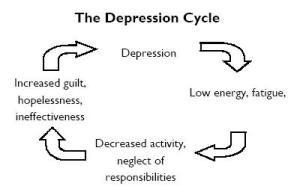
But the truth is quite different–as I work through each issue, it really does slowly heal and the next wave of depression arises from a different wound that also needs the healing touch of grace. Perhaps I will never reach the end of this progressive redemption, in which case my depression will be life-long, but it is a great encouragement to know that I am on a path of hope and healing and not trapped in an inescapable morass.
That thought gives me the patience and hope to deal with my present depression. It is not my failure or stupidity that blocks me from quickly identifying the source of my depression, and it is not a meaningless melancholy, suffering without purpose or benefit. My soul is doing its vital work, and it will just take time to come to more clarity and resolution. I have hope again. Thanks for being there to listen!
This is not a thought topmost on my mind these days… I wrote it some time back. But I thought it was worth sharing.
Many conservative Christians direct their lives by a long list of expectations handed down to them from various sources (family, church, tradition, culture, etc.), many of which purport to be fundamentally grounded in Scripture. I know this is how I spent most of my life, but for me it was the letter that killed the spirit.

I was raised to believe and obey the Bible. At a foundational level were direct and clear commands that seemed to make a lot of practical sense, saving myself and my relationships much grief: don’t lie, don’t cheat, don’t gossip (or in positive terms, be honest, be fair, be kind in what you say about others). It doesn’t take much wisdom to understand the importance and relevance of these commands.
But along with these direct commands, I was taught to identify and live by biblical principles. Here the footing got very unsteady, for who was to say what principles should be applied in this way by this person at this time to this situation? Let me give one general principle, stewardship, focusing on one of its corollaries, efficiency, limited to one resource at my disposal, money. The principle is: spend as little money as possible for the greatest good. The Bible does not say this directly, but we all know this is what it means when it warns us against greed, tells us to be generous instead of self-serving and to be “rich towards God,” etc. I said “we all know,” but some of us struggle with such a simple reduction of many passages to one principle. Even if we agree that a given principle is worth following, we still find the devil in the details–a given application of that principle. Let me list a few quandries:
 1) How do the hundreds of other principles laid out by levels of priority interact with this principle, limiting it, redirecting it, even overriding it? What kind of good should be done (for instance, is it more important to give Bibles or give bread); who will receive this good (for whom am I most responsible); what other resources will be used in the accomplishing of this good (will it be cheap but take “inordinate” time); may I consider my own interests, talents, vision; what positive or negative side effects may come from this expenditure; am I permitted to solicit money or borrow money for this goal; and I could go on for many pages.

Quantity or Quality? Brand or Generic? Organic or Inorganic?
2) How does this principle apply to purchases for myself? What must I buy cheaply, and what may I take into account in deciding (the more expensive laundry soap that smells better, the fine quality suit, attending an ivy league school over a local state college?); what percentage must I give away (based on income, cost of living, family concerns, etc.); who decides and how does one decide what is lavish, normal, or frugal living; how much latitude (freedom) do I have; do my feelings matter in any way in making a decision.
 3) What role do love and grace play? Using this principle of financial efficiency, the disciples criticized the woman who anointed Jesus’ feet with expensive perfume instead of giving to the poor, and they were rebuked. It would seem the heart of the matter is the heart matters most, more than the behavioral choices we make, and that we need a level of freedom and faith to live out of grace rather than law. (I packed way too much into that sentence.) As Augustine said, “Love God, and do what you want,” or as Paul said, “Love is the fulfilling of the law.”
 Yesterday Kimberly was reading to me from Anne Morrow Lindbergh’s “Gift from the Sea,” a breeze of calm and insight from the ocean by way of the author’s soul. Anne spoke of the slow drift between spouses and the need to restore the purity and simplicity of the first wave of love. Berly and I are coming up on our fifth anniversary (May 10), and neither of us want to return to those early days of our relationship. Folks remember the romance, the excitement, the uncomplicated acceptance of one another, the overlooking of each other’s faults and feel sad that those intense feelings and sense of inseparability are gone.
Kimberly and I feel sad rather for a culture that believes romance is the fullest expression of relationship. We would never want to trade what we have now for what we had then. It was pure and simple then because it was so superficial. We spent many hours every week for two years sharing openly with one another about the things closest to our hearts, so we knew one another fairly well at a basic level before we married, but knowing the basic truths about someone is so far short of really knowing them and connecting with their heart, which is why the first year of marriage is often so hard. I know it was for us.
 Like marriage, a sailboat on her maiden voyage looks sleek and beautiful, there are no rents or dings, and she slices effortlessly through the water. But it is only after years of riding with her through the storms, risking life and fortune, and recalling the story of every rattle and dent that the captain knows his boat as no one else ever will, and the bond is deep and fierce. As we share life with mutual understanding and love, the original beauty and delight I found in Berly fills with meaning and substance. For me, every line of her face is an etching of her soul. The roots of our hearts grow ever deeper and more entwined. To pull us apart now would rend our vitals.
 Perhaps those who are concerned about my emphasis on grace are worried that I may encourage irresponsibility. Some folks seem inclined to let things slide, choose the easy way, care too little for the concerns of others. We think they need a “kick in the pants.” I use “seem” to describe them because we really don’t know the issues they are struggling with, the energy, insight, support they do or do not have and so forth. The closer I am to them, and the more perceptive I am at understanding others deeply, the more clearly I may be able to see what is at work inside them, but if they are clueless about themselves, I can easily be misled. It is common to confuse fear, shame, depression, fatigue and the like with laziness, and the last thing such folks need is a kick.
As I see it, those who are truly irresponsible create two problems, and these can be profound depending on the level of their negligence. The first is what it does to them, and the second is what it does to others (and their relationships). When  we say that these folks “take advantage of grace,” I think we mean that grace allows them to be irresponsible (does not force them to be responsible). But when they choose this course, they are retreating from grace rather than embracing it, and the result, far from being to their happiness, is to their unhappiness. They do not “get away” with it because sin always has its natural consequences–sin is always a harmful choice, to the ones acting as well as to everyone whom they touch (that’s why God warns us against it). Grace can only bring redemption to such a situation if it is embraced, and this can only be done by faith, which is to say the slackers now see things God’s way. Given this vantage point, I think we would pity the irresponsible, and if we have some role to play in their lives and are motivated by love, we may wish to warn them from this folly and invite them back to grace.
The second problem with the neglectful is their impact on others and their relationships, and this is where many feel grace is inadequate and the law must be applied. What do we mean by “law” and “grace” in this context. Is there something one does that the other does not? If law is about restriction and grace is about freedom, then our call to apply law is to bring force to bear, either the force of a guilty conscience (say, by rebuking him) or the force of retribution or punishment (say, by taking his keys). But why do we think these actions are connected to law and disconnected from grace? Is it not possible for grace to stir the conscience or give a wake-up call of negative consequences? To my mind, the whole distinction lies in what motivation prompts the act.
 It seems to me that I turn to the obligation and punishment of law not from concern for the slouch, but from concern for the law (that the law is respected, obeyed) or concern for the “victim” (who may be me). It often seems to us that in order to side with the victim, we must side against the negligent. Thankfully, the grace of God does not need to love one less in order to love the other fully. He wants the best for all concerned, and he will do what is best for all concerned. If grace sends negative consequences on the irresponsible, it is not because God takes umbrage and is punishing them, but because he knows this is the best he has to give, the choice of extravagent love, not love withheld. It is his invitation to redemption. The exile of Israelis from their land is a prime example of this “tough love.” Far from this being an act of God’s impatience and abandonment, it was the richness of his love at work to restore them to their true selves and reawaken their immensely fulfilling love relationship with him.
 The law is good, as Paul says, and it has several beneficial uses. One use is to teach us what God is like, and provide insight on how we might be like him. Of course, all of Scripture (not just the commands) is designed to help us in this way whether history, teaching, prophecy, or the like. For those who want to be intimate with God and be shaped into his beautiful likeness, it doesn’t really matter whether a biblical teaching is grammatically in the command form. The only question is whether it will help me grow personally and relationally.
The word “should” has close links with law, and it carries several connotations. First, it suggests an evaluative role. It is telling us what would be a good or better course of action. This may have no moral connotations, such as: “You should try Ben and Jerry’s New York Fudge Chunk.” Second, and closely connected to the first, is an implication of pressure to act in a certain way. We could place it on a continuum to demonstrate this: Can—–Should—-Must. Again, this need not be concerned with morality: “You must try this app!” The third connotation of should, like the word law, is one of potential personal judgment. Even if this regards simply a choice of wrenches, the person who fails to do what he should is faulted. Something is wrong with him. He is defective or weak or stupid or belligerant. Finally, because it is poised to judge, should appeals to a particular motivation. It is not a positive motivation (as the first two connotations might be); it does not attract by the beauty or benefit or health of the choice. It rather motivates by the fear and shame of being bad, unacceptable, dis-graced.
I do not want to live my life being motivated by fear and shame. I want to be motivated by God’s love for me and my echo of love for him and others, in other words, grace. Sometimes the should of law is necessary to shape external behavior to curb the harm a person may do to herself or others, but as long as the individual is acting from fear or shame, it is only her behavior which is affected. Her heart is not growing in grace. It may even be shrinking. I think the primary judgment role of law and should is to help us recognize our real inadequacies and faults, not in order to shape our behavior but to awaken us to the gospel. Some folks think grace has no power to motivate, but I have found it incredibly powerful… that must wait for another post.
Given a couple of negative responses to my recent posts, I apparently need to explain what I mean by grace. I think there are some common interpretations of grace that can really take us down the wrong path. One of the most common misunderstandings of grace is to equate it with freedom of action while equating law with restriction of action. freedom and restriction of action are about method and context, while grace and law are about motivation and direction. Grace does not play the high notes or the low notes on this freedom/restriction continuum, but plays the whole keyboard. That is to say, it confines or releases as directed by love.

EVERY NOTE IS A GRACE NOTE
Law motivates by fear, shame, and guilt. These are very legitimate motivations, because they point out how screwed up we really are, but if we try to remedy our fear and guilt by making better choices, we are doomed by our imperfections. The fear and shame are not intended to drive us to work harder at being good, but to awaken us to our need of the grace of God (forgiveness, love, acceptance, strength, hope, blessing, in short, the gospel).

THE FACE OF THE LAW
Here is where confusion and misgivings easily catch us. We know that fear and shame are powerful motivators, they have profoundly molded our behavior and the behavior of others towards us. If you remove law, what will keep me in check? We think fear and guilt make us good, when they really only change our actions, not our hearts. Still, if this motivation is removed, what will inspire us to go in the right direction. If there is therefore now no condemnation, won’t I just act like a spoiled brat, won’t others “take advantage” of grace? No. It is impossible to “take advantage” of grace. If you try, if you decide to fulfill every “forbidden pleasure,” it will leave you more empty, lost, broken, and even farther from the blessings of grace–not because grace resists you, for it always has open arms, but because you resist grace, which is the way of true peace, fulfillment, joy, love. The only way to take advantage, full advantage, of God’s grace is to throw yourself whole-heartedly into his embrace.
Let me quote a reply I gave a questioning friend: In my mind “doing as I please” is a serious misunderstanding of grace, and is profoundly different from doing what my soul needs. The differentiation in my mind is not that the first matches my desires and feelings and the second matches my duty, but that the first matches superficial desires and feelings often at odds with my deeper feelings (e.g. choosing sex as a replacement for love), while the second is discovering my true feelings and true needs and seeking to meet those. At this point in my understanding of God’s grace, I believe that my soul’s truest needs are never in conflict with God’s will, and if they appear to be, I misunderstand one or the other.

SAFE HANDS
 I did not mean to suggest in my last post that our long, long lists of good behaviors are not in fact good. I simply want to point out that they are not paramount. Brushing our teeth, paying our bills on time, making soup for our sick neighbor are all good things, but the phrase, “the good is (sometimes) the enemy of the best,” comes to mind. This aphorism is usually used to promote even higher, more taxing behavioral standards for ourselves, but I would use it to change the value scale altogether, to set a higher value on heart issues than behavior.
When I stop to compare how I treat friends with how I treat myself, I am often dumfounded at how disrespectful, rough, and unsympathetic I am to myself. I would never tell a friend what I tell myself. If a friend called me and said, “I’m really hurting right now, do you have time to talk?” I can’t imagine responding, “I’m not free right now, I have to cut the grass,” or “Really the only time I have to talk is Thursday 6-7.” But that is exactly what I used to tell my own soul many times every day. By the way I treated it, I was basically saying, “Shut up! I don’t have time for you! The dishes are more important.”
Over the last several years, I have worked hard at sloughing off responsibilities that made my soul feel it was of less value than some task. Of course, this list is unique to each person. For instance, skipping a meal in order to finish a project was never a sacrifice for me–but I did often suffer by driving myself to grind through a project when my soul was weary of it. To each his own.
Many of you would be surprised at the things that distress me, and perhaps shocked at some of the things I have chosen to offload from my list of duties for the sake of my spirit. Filing my annual taxes is always troublesome, and while I was still single, sometimes distressing. As April 15 drew closer, my distress increased, but I had no emotional energy to force myself to complete them. So in an effort to give my soul breathing room, I chose several times to file my taxes late and pay the resulting penalty. Poor stewardship? Of my money, yes, but not of my soul, and my soul is more important than money. In fact, what more valuable investment than supporting my soul…so I guess it was financially good stewardship as well. Thankfully, that spring dyspepsia is now eased with the presence of a life partner.
God gives us the strength to fulfill his call, but does he give us the strength to fulfill the calls of social norms or family expectations or friends’ needs? I have too often assumed that my soul’s cries for help were the voice of temptation rather than the voice of truth, the voice of God calling me to rest. Pain is the body’s signal that we should stop. If we listen to it as a practice, then sometimes choosing wisely to override it can actually benefit the body, but if we typically ignore the pain signal, we will tear down our bodies. I believe the same for our souls. It knows better than our brain when something is amiss and needs addressing, and if our inclination is to ignore it, we tear it down.

BE AS GENTLE TO YOUR SOUL AS YOU ARE TO YOUR FRIEND'S

 Kimberly and I have started reading a book on “Sabbath” each Sunday morning. It suddenly occurred to me today that we are called to follow not only God’s example of rest, but his example of spending 6 days in creativity, like him expressing who we are to the world (for our gifts are simply an outflow of the unique creation each of us is). If we could discover and have the courage to be our true selves before the world, offering it what we have rather than what we do not have, the world would be marvelous. If we could only value each one for who she truly is and what her being means to my life and the life of the world as a whole. If we could only live in a spirit of curiosity and receptivity for (and therefore blessing from) the uniqueness of each.













 Janathan Grace Reflections