Archive for the ‘thoughts’ Category
Given a couple of negative responses to my recent posts, I apparently need to explain what I mean by grace. I think there are some common interpretations of grace that can really take us down the wrong path. One of the most common misunderstandings of grace is to equate it with freedom of action while equating law with restriction of action. freedom and restriction of action are about method and context, while grace and law are about motivation and direction. Grace does not play the high notes or the low notes on this freedom/restriction continuum, but plays the whole keyboard. That is to say, it confines or releases as directed by love.

EVERY NOTE IS A GRACE NOTE
Law motivates by fear, shame, and guilt. These are very legitimate motivations, because they point out how screwed up we really are, but if we try to remedy our fear and guilt by making better choices, we are doomed by our imperfections. The fear and shame are not intended to drive us to work harder at being good, but to awaken us to our need of the grace of God (forgiveness, love, acceptance, strength, hope, blessing, in short, the gospel).

THE FACE OF THE LAW
Here is where confusion and misgivings easily catch us. We know that fear and shame are powerful motivators, they have profoundly molded our behavior and the behavior of others towards us. If you remove law, what will keep me in check? We think fear and guilt make us good, when they really only change our actions, not our hearts. Still, if this motivation is removed, what will inspire us to go in the right direction. If there is therefore now no condemnation, won’t I just act like a spoiled brat, won’t others “take advantage” of grace? No. It is impossible to “take advantage” of grace. If you try, if you decide to fulfill every “forbidden pleasure,” it will leave you more empty, lost, broken, and even farther from the blessings of grace–not because grace resists you, for it always has open arms, but because you resist grace, which is the way of true peace, fulfillment, joy, love. The only way to take advantage, full advantage, of God’s grace is to throw yourself whole-heartedly into his embrace.
Let me quote a reply I gave a questioning friend: In my mind “doing as I please” is a serious misunderstanding of grace, and is profoundly different from doing what my soul needs. The differentiation in my mind is not that the first matches my desires and feelings and the second matches my duty, but that the first matches superficial desires and feelings often at odds with my deeper feelings (e.g. choosing sex as a replacement for love), while the second is discovering my true feelings and true needs and seeking to meet those. At this point in my understanding of God’s grace, I believe that my soul’s truest needs are never in conflict with God’s will, and if they appear to be, I misunderstand one or the other.

SAFE HANDS
 I did not mean to suggest in my last post that our long, long lists of good behaviors are not in fact good. I simply want to point out that they are not paramount. Brushing our teeth, paying our bills on time, making soup for our sick neighbor are all good things, but the phrase, “the good is (sometimes) the enemy of the best,” comes to mind. This aphorism is usually used to promote even higher, more taxing behavioral standards for ourselves, but I would use it to change the value scale altogether, to set a higher value on heart issues than behavior.
When I stop to compare how I treat friends with how I treat myself, I am often dumfounded at how disrespectful, rough, and unsympathetic I am to myself. I would never tell a friend what I tell myself. If a friend called me and said, “I’m really hurting right now, do you have time to talk?” I can’t imagine responding, “I’m not free right now, I have to cut the grass,” or “Really the only time I have to talk is Thursday 6-7.” But that is exactly what I used to tell my own soul many times every day. By the way I treated it, I was basically saying, “Shut up! I don’t have time for you! The dishes are more important.”
Over the last several years, I have worked hard at sloughing off responsibilities that made my soul feel it was of less value than some task. Of course, this list is unique to each person. For instance, skipping a meal in order to finish a project was never a sacrifice for me–but I did often suffer by driving myself to grind through a project when my soul was weary of it. To each his own.
Many of you would be surprised at the things that distress me, and perhaps shocked at some of the things I have chosen to offload from my list of duties for the sake of my spirit. Filing my annual taxes is always troublesome, and while I was still single, sometimes distressing. As April 15 drew closer, my distress increased, but I had no emotional energy to force myself to complete them. So in an effort to give my soul breathing room, I chose several times to file my taxes late and pay the resulting penalty. Poor stewardship? Of my money, yes, but not of my soul, and my soul is more important than money. In fact, what more valuable investment than supporting my soul…so I guess it was financially good stewardship as well. Thankfully, that spring dyspepsia is now eased with the presence of a life partner.
God gives us the strength to fulfill his call, but does he give us the strength to fulfill the calls of social norms or family expectations or friends’ needs? I have too often assumed that my soul’s cries for help were the voice of temptation rather than the voice of truth, the voice of God calling me to rest. Pain is the body’s signal that we should stop. If we listen to it as a practice, then sometimes choosing wisely to override it can actually benefit the body, but if we typically ignore the pain signal, we will tear down our bodies. I believe the same for our souls. It knows better than our brain when something is amiss and needs addressing, and if our inclination is to ignore it, we tear it down.

BE AS GENTLE TO YOUR SOUL AS YOU ARE TO YOUR FRIEND'S
The strange path to freedom.
 I have many coping mechanisms to protect me from the prickly world, a combination of defenses unique to myself. I was a compliant child, a trait sometimes mistakenly referred to as “good” or “obedient,” so I responded to my insecurites by trying to make the grade (measured by my approval ratings). This was my basis for self-worth: scoring a 10 on my performance. When I was judged as inadequate, my deeply ingrained, almost instinctive reaction was to rachet up the effort. I proved my value as a person by doing more, better, faster, by never repeating failures or mistakes, by meeting or exceeding every expectation that appeared worthy.

CHASING SUCCESS
Perhaps the hardest coping mechanisms to overcome are those which are inescapably tied to the necessities of living. Every addiction has its unique power of control. Bulimics, unlike alcoholics, literally cannot live without the substance to which they are addicted, and that significantly complicates their deliverance. In the same way, I cannot live without doing. I cannot abandon all tasks in order to break free from my addiction to effort–I am forced to keep succeeding at a job, at finances, at relationships, and all the other tasks essential to life. They say success breeds success, but in my case, success breeds bondage (and unfortunately so does failure).
For me, at a subconscious level, every task accomplished inevitably feeds my sense of worth and every task unfinished feeds my shame. I don’t knowingly tell myself, “See what I have done. I am a good person after all.” The telltale sign of this malady may only be a sense of satisfaction, which is natural enough, but the reason for my satisfaction is largely a sense of worth based on my work.
In short: I have an addiction to effort as a means to gain worth, I cannot live without doing, but each time I do something and feel better as a person, I subconsciously strengthen my addiction.
Let me give an example. I have said something that has hurt my colleague Mike. I am afraid of what he now thinks of me, especially because his evaluation of me feeds my doubts of my own worth. Since love is the best motivation, I tell myself to reach out to him in love and concern for his well-being. These are my conscious thoughts, but underneath, my very value as a person depends on his renewed approval of me. My fear escalates as I ask for a minute of his time. Why fear? Because my worth is at stake. If he is reconciled by my apology, my fear turns to pleasure. “See,” I tell myself, “love works!” when in fact I have just succeeded in strengthening a false basis for my worth as a person–I am worthy because of what I do, in this case reconciliation.
 The motivation for what I do is the key. I can act out of a place of grace or a place of should and shame, though that makes it sound dichotomous when really my motives are always mixed to some degree. If I complete a chore more out of fear than of grace, I strengthen my doubt in God’s love. If I act more from grace, I strengthen my faith in God’s love. But if I am pressured by ‘should,’ how can I respond out of grace? For me at least, operating out of a sense of should is really responding from a doubt of God’s acceptance, from a sense that his love depends on my behavior, from a fear of being unworthy. I find that if I do not first challenge the should, face it down, call out its lies of conditional love, then I feed my doubt and insecurity with each task I complete. I feel better, but am worse for it.
Back to Mike. If he is unwelcoming, I become defensive–I try to “explain” more clearly, I express my hurt at his response, I point out his matching faults. Unlike my successful attempt, my failure to win him over suddenly reveals my real motivation. It was not love, but insecurity. Insecurity will always be present, but if it predominates as my motivation, it will harm me and my relationships. It may feel better to both of us if it “works,” but it is a sugar high that eventually leads to diabetes. I am most aware of my insecurities when my coping mechanism fails, when my “right” actions for self-redemption flounder. If at first I don’t go to Mike, but sit with my insecurity long enough to find saving grace, to believe my worth has no basis in what I do, then I can go to Mike in a way that leads to wholeness for us both.
 In certain situations, this time of processing is effective, but often, the longer I delay acting, the more anxious I become. I am constantly being pressured by a “should,” and this crowds out the emotional space I need to find grace. In the past I often had to go ahead and complete the task (and so remove the pressure), and then try to deal with the shame-based motivation. My grasp of grace was not firm enough to escape self-condemnation if I failed to act, but at least being aware of my true motivations was a fundamental step to addressing them.
To be continued…
 The truth is that my soul asks for very little. It mostly just needs to be heard and affirmed. It is sad that I have spent my life denying it this small benefit, that my automatic response is still to shame it into compliance. My Lenten fast from haste has inclined me to be gentle with my soul, and with the support of my wife, it seems to be making a real difference. I think I may make this my year’s resolution, “be gentle to your soul, listen to it and affirm it.”
This afternoon with many tasks pressing for attention, my soul said, “I need a little care.” So I left the tasks aside and followed my heart. After an hour with a soft puppy, a soft pillow, soft music, and gliding birds on our wide-screen, my spirit relaxed and set me free to be “productive” without choosing against my own needs. Forcing my soul to comply to the demands of duty tears at its very fabric. My soul is far more important than the leaky faucet, dirty living room, or ragged lawn.

OUT OF SEASON
My heart is even more important (dare I say it?) than satisfying others with birthday gifts, a lift to the airport, or help painting. If I wound my soul by caring for someone else, I not only harm myself, but prevent God from using alternative means to meet that need (or get in God’s way of teaching them an even greater truth). My giving to others must come from genuine resources that I have to offer. If it is squeezed from me by obligation, fear, shame, or the like, it will hurt both me and the one I am intending to help. Giving sacrificially is a part of genuine love, even to the point of giving my life for another. But God forbids me to sacrifice my soul.
This year I really need to give up my role as Savior of the world… or even of this particular situation or person. I need to learn to trust God with others’ needs and respect myself even if others blame me, reject me, or try to otherwise manipulate me to meet their expectations. That is a very tough thing to do without strong human backing, especially since my emotions are quick to agree with their evaluations. Thankfully, I always have Kimberly’s support (not on every occasion, but always in the set of her heart towards me… I think she is more supportive of me than I am of myself).
If I feel pressured by the expectations of others, I will try not to protect myself by minimizing their need (shaming or blaming them in return). Their need is legitimate and significant whether or not I can meet it. Caring about their need does not mean I must care for their need. What a heavy yoke I have been dragging around most of my life. In spite of how I imagined it, Jesus did not say, “Come unto me all you who are weary and heavy laden and I will give you more to do,” but he said to the weary, “I will give you rest.”


I love this photo. The truths most crucial for my transformation are inevitably the truths that awaken me to my own personal terrors. I find I cannot grow in freedom, understanding, acceptance, relationship and other facets of genuine spirituality without facing my fears. To rescue me from my fears, grace leads me into them, or as John Newton sang, “‘Twas grace that taught my heart to fear, And grace my fears relieved.” Courage is gained slowly, one step at a time, and if I brave too much, more than my soul is ready to bear, I get knocked back a few paces. We must be gentle with ourselves, have compassion for our quaking spirits, take things slowly and with as much patience for ourselves as the God of all grace has towards us. Yet I must also find a way to pacify my tremulous soul, to discover the power of that truth which is embraced, trusted, fought for… truth about my wounded self and my infinite worth in God’s eyes.
When I step towards my fears, uncover them and open myself to feel them, to understand their deep hold on me, they increase and seem to gain strength. I try to face them with a spirit of self-compassion and faith in God’s love, but I can only take so much stress before my courage wavers, and I need to take a break from the battlefield, withdrawing for a time from people and situations that provoke my fears–fears of rejection, inadequacy, shame. I keep whispering the truth to myself and my trusted others until my faith is renewed enough to speak truth once more where it is unwelcome, resisted. It is my truth. You do not have to agree with me or consider this the right way to live your life (or even that it is the right way for me), but if you cannot trust me with my own life, then at least trust God with my life, in spite of my wavering steps, to draw me by grace along the way of growing integrity and harmony.
I just felt like stopping by and posting, but I don’t have much time. Today was better than yesterday, mostly because I was more attentive to my Lenten commitment to relax and give myself (and others) a break. Few things matter as much as I think they do, but having been ingrained with values I now intellectually deny, I very easily fall into old patterns without noticing. Unexplored emotions are much more likely to control me than strong conscious emotions, and my reasoning power is more likely to be manipulated by those hidden emotions than the emotions by my rational brain. I think architect Louis Sullivan was referring to outward more than inward observation, but I find his words true for both:
Attention is of the essence of our powers; it is that which draws other things toward us, it is that which, if we have lived with it, brings experiences of our lives ready to our hand. If things but make impression enough on you you will not forget them; and thus, as you go through life, your store of experiences becomes greater, richer, more and more availablel But to this end you must cultivate attention… the art of seeing, the art of listening. You needn’t trouble about memory, that will take care of itself; but you must learn to live in the true sense. To pay attention is to live, and to live is to pay attention….


Coming from a non-liturgical religious upbringing, I didn’t even know about lent until well into my adult years. As my whole life was lived in self sacrifice, I didn’t feel the need to dedicate one particular season to it, and once I started to heal from this self-flagellating outlook, I could not really practice sacrifice in any sort of healthy, spiritually beneficial way. This is the first year I chose to give lent a whirl, looking for the kind of focus that would be a meaningful blessing to my soul. For lent I decided to give up hurry and haste.

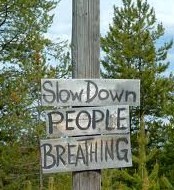
SLOW DOWN!
Driving was my first focus. I have stopped trying to make yellow lights, I leave earlier for work, and I look for things along the road I have missed in the past in my rush to get somewhere… to actually find pleasure in the trip itself. I have started to work on tasks at a more deliberate, even slow, pace. I have given myself the right to accomplish things on a calmer schedule, or even to leave them undone… to walk thoughtfully, absorbing the moment rather than focusing on the goal, destination, or end product. It requires a good deal of trust to depend less on myself, my efforts, and allow God to cover for me. Giving myself permission to rest is a vital spiritual exercise, one of the oldest life principles in the book, the intentional counterpart to creative work (as the Genesis story of beginnings recounts). My guess is that work is neither creative nor blessed (to ourselves as well as others) if it does not arise from a rested heart. Life isn’t waiting for me at the destination. Life is what happens while getting there.
I married off my sister-in-law today and gave this message.
The Third Strand Makes All the Difference
They say love is one long sweet dream and marriage is the alarm clock. I can testify to the truth of that. But waking up is not a bad thing unless you want to spend your life in a coma. Erin & David have been through a lot together already and gotten to know each other pretty well. I’ve been impressed to see them work through major decisions like buying a house, employment changes and relocation. Still marriage always brings in new dynamics.
Before marriage there is always a question, you have to have a backup plan, you can’t really trust the future. Marriage is a commitment for life. It gives the safety you need to work out personal and relational issues, strength and courage to engage in difficult endeavors, and instead of a place to call home, you will have a person to call home, a resting place for your heart.
No longer I and you, but us: as the song says, “Me and You Against the World”. Everything that happens to you happens to the other as well. Every relationship you have becomes part of the marriage (as you can see here today). No decision you make will be for you alone, but will involve your partner in some way. You start thinking about “us” instead of “me.” What does “our” future hold is a very different question from what does “my” future hold.

In Ecclesiastes, a cord of three strands, is about three persons: husband and wife, and the third I am inclined to believe is God himself. But I would like also to consider the three strands of love, three crucial expressions of love, the dynamics that hold the strands together. I call them “graces” to emphasize that to work well, they must flow not simply from you, but from God’s heart through yours to your mates—loves 3 strands.
Grace of Acceptance
Love is full of delight, so accepting one another should be easy, right? But you are human, you will fail and hurt and misunderstand each other. All marriages have these struggles, but healthy marriages acknowledge and face them honestly. This does not mean detente where you just sidestep issues, but a real effort to understand, respect, and make room for your differences. Learn to recognize and respond to one another’s true needs, the needs of the heart.
I can’t tell you how much personal healing and growth I have gained from Kimberly accepting my weaknesses as well as my strengths. It is scary. It may feel uncomfortable to cry in front of your wife, for instance, but if I do not let her in, I stay locked inside myself. When you are given permission to be yourself, to bring all of who you are into relationship, and be embraced as a whole person, it gives you the safety and strength to accept yourself and grow into the beautiful person God designed you to be.
The problem comes when your spouse is just “wrong.” How can you accept that? Trying to settle who is “right” and “wrong” will probably make matters worse. Accepting them is not agreeing with them–it is rather trying to understand where they are coming from, what their needs are, and how those needs can be met. Where do you get the strength to love unconditionally? Only from God.
Grace flows from Him into us before it flows out from us to our spouse. We need to discover ourselves as loved unconditionally before we have the strength and security to love another truly. Author and minister Brennan Manning says, “God loves you as you are and not as you should be! Do you believe this? That God loves you beyond worthiness and unworthiness, beyond fidelity and infidelity, that He loves you in the morning sun and the evening rain, that He loves you without caution, regret, boundary, limit, or breaking point?”
Grace of Trust
Giving someone your trust is a great act of love. You can only be vulnerable with the deepest parts of yourself, those things you want to hide from everyone, to the extent you can trust the other person. But you can’t order trust for overnight delivery. It is a life long intentional process. You can’t make someone trust you and you can’t simply choose to trust another. A deep level of trust is never simply granted to someone, even the one closest to you, but is earned step by step as you share your inadequacies and receive empathy in return. Everyone doubt’s their own loveliness. You can each be the reflection of God’s loving eyes to the other.
There will be stumbles and falls along this journey of building trust. Expect it. The pressures of the world blast against you and blow you off course, but this is the bedrock to which you always return, this commitment you make today and every day after: to live in integrity–being honest, understanding, and accepting, out of a heart growing in love. I have seen that you two have such a commitment to being honest with one another, that you are willing to show each other your emotions, even the difficult ones.
Nothing is more powerful a support than someone knowing your failings and loving you regardless, I don’t mean the failings that are obvious, but the ones you have hidden all your life. Out of fear of rejection you covered them up, you felt unlovable because of these shadows. But how can we ever feel secure until we find someone who will love us after knowing us completely? God does this for us, but we need someone to show us this, someone with skin on, with a voice and smile and hug we can really hear and see and feel. Having experienced this with Kimberly, I can say this has been the truest revelation of love to me.
Grace of Sharing (Listening, Understanding, Respecting)
Set aside regular times when you turn off the TV, turn off your cell phones, forget your To-Do lists, and concentrate on listening to one another. It will take hard work and a lot of time. I can tell you ahead of time that you will need to learn a new language and culture, become an anthropological researcher.
Erin, you women are complicated creatures. You understand each other by some magic telepathy. Please remember that our brains don’t tune to that channel. If the man asks, “How are you?” and you say, “Fine!” he will take your word for it, give you a peck on the cheek and sit down with the remote. You have 49 distinct meanings for ‘fine’ depending on your intonation, your eyebrows, your lips, your hands, your posture. You are so eloquent… but we completely miss your subtlety. We can only understand what you say plainly with words.
David, never assume anything. You don’t know women, not even Erin. The good news is you can learn, the bad news is it will take a lot of effort and patience. You have to ask questions repeatedly. You probably won’t even know the right questions to ask, which is okay because Erin already knows what she wants to say. You just have to open the door. Even if you don’t understand at first, but really listen, she will feel better. By listen, I don’t mean nodding and saying “uh huh” as you watch the Colts fumble. The DVR was invented to save marriages.
 Kimberly and I come from different families, backgrounds, experiences, and personalities, and when she shared bits and pieces of her perspective with me, they didn’t fit into my worldview. It sounded like Chinese.
We all have unique perspectives, which seem normal to us. If my point of view is normal to me, then your point of view has to be abnormal. We all stand at the point we think is the correct balance. To the right of us are conservative tightwads and to the left are profligate spendthrifts. To the right of us are workaholics and to the left are lazy bums. On this side are the messy and on the other are the clean freaks. Where you stand is always “reasonable” (otherwise you wouldn’t stand there). This means the other person’s position is “unreasonable.” So you will always grudge yielding.
Kimberly wanted me to vacuum behind the sofa where no one could see the dust, not even us. It was “unreasonable.” Many of you say “Your wife is right, that is very reasonable. What is unreasonable is cleaning behind the hot water heater.” But those who clean behind the hot water heater see that as normal, it is the people who scrub their driveways that are bonkers. Whatever your position, it is what it is. Erin, your view is entirely legitimate. David doesn’t have to agree that you are right and he is wrong, but he needs to respect your perspective and make room for it as much as he is able. And the same for you Erin. That big scrap of metal he wants to keep looks like trash to you, but to him it is a little piece of a dream. Let him have a shed to stack his dreams in.
The source of these expressions of love, these graces of trust and vulnerability, listening and understanding, respect and acceptance, the source is God, the strand that keeps the cord from unraveling. It is crucial to your marriage that each of you individually and as a couple develop a deep, honest, trusting relationship with God, find in him the grace you need for yourself and one another. His love is limitless as the sky, constant as the sun, deeper than the ocean, eternal and unconditional as only God Himself is. In Him you will find life, and through him your marriage will be a little taste of heaven (with a few quarrels mixed in).

Mark’s beloved dog Arden, a lab mix, is sick with perhaps a terminal illness. One option, says the vet, is to keep an eye on him and hope for the best. Mark writes about himself and his friend Paul:
“Emily Dickinson says that hope, that thing with feathers—That perches in the soul, cannot be silenced; it never stops–at all–but because she is a great poet, in a little while she will say a completely contradictory thing. She who felt a funeral in her brain, the underlying planks of sense giving way, most certainly understood depression and despair. Perhaps even in her famous poem figuring hope as a bird, she hints at the possibility of hope’s absence, since if hope has feathers, it is most likely capable of flying away.
“Paul has a bracingly Slavic attitude toward hope. His ancestors starved in the fields outside of Bratislava, between plagues and invasions, and their notion that hoping for a better future would have been a costly act of self-delusion seems practically written into his genes. He would agree with Virgil, who says in his Georgics, “All things by nature are ready to get worse.”
“But this is ultimately something of a pose, a psychic costume for a sensibility no less vulnerable than my own. He believes that low expectations about the future will protect him—whereas I, six years older and thus a child of the sixties, can’t stop myself from thinking, perhaps magically, that our expectations shape what’s to come.
Though it’s true that I, who am more likely to hope overtly, publicly, am also more likely to crash the harder when that hope is voided.” Mark Doty in Dog Years.
Stoicism and hope can each be coping mechanisms in the face of potential disappointment. Conservative Christians tend to blame the stoics for having no faith before the disappointment and blame the hopeful for having no faith after the disappointment. That seems unfortunate to me because I believe neither perspective is inherently godly or ungodly, that belief or unbelief can be just as certainly present in both views. There are advantages and disadvantages to either outlook, differences in personality that can be embraced as each valuable in its own right. Our American society has a strong commitment to happiness as a value, even a fundamental right… it is written into the preamble of our founding document as a nation, so optimists are consistently lauded in every niche of our society (except art, where it is often seen as disingenuous).
A January 17, 2005 Time article reports a revealing psychological study “In the late 1970s… most therapists took the Freudian view that depressed people–and by extension, pessimists–were out of touch with reality. It made sense, since depression was considered an aberrant mental state… In carefully designed [seminal] experiments, psychologists Lauren Alloy and Lyn Abramson sat students in front of a panel featuring a green light and a button that they were told would activate the light when pressed. In fact, the amount of control students had over the light varied from 0% to 100%, with many points in between. When they were asked how much control they thought they had over the light, the answers surprised the psychologists. Optimistic types (who scored low on tests for depressive symptoms) consistently overestimated their influence. By a lot. On average they believed they had 60% control even in sessions in which their button pressing had purely random effects. ‘The nondepressed had an illusion of control when in fact they had none,’ says Alloy. By contrast, more pessimistic students (those who had more depressive symptoms) judged their performance more accurately. The finding that depressive types were ‘sadder but wiser,’ as the researchers put it, rocked conventional thinking in psychology.”
The article goes on to explain that optimists showed a more accurate estimate of other folks than did pessimists (who thought others were more in control than they themselves were). I expect that the presence of faith plays out in different ways in each personality type and is not simply present in the one and not the other. Hope may come from many sources other than faith and may be a coping mechanism to stifle insecurities. Stoicism, even pessimism (expecting negatives), may be the result of faith in openly acknowledging one’s insecurities (which takes a great deal of courage). May we all find ways of appreciating and benefiting from one another’s differences.

EMBRACING DIFFERENCES
“To live in community with others, which is what God created us to do, means I not only don’t always get things done the way I would prefer them to be done, but that I am called to something much higher; to show grace and kindness toward others and to even get happy about things being done in a manner that I do not prefer. Sometimes, there’s a greater right than being right.” (Randy Booth)
Randy makes an important point, one that I would take even farther by throwing a question over the very certainty of my “right”-ness. I have discovered over the years that “right” is far from clear in most situations. Here are a few of the things that make me more tentative about my correct assessments:
1) My overall idea might be right, but I might be wrong in important details which throws the whole thing off. The words they spoke were untrue, but this came from an honest misperception, not intentional deceit.
2) I might know a truth with certainty but apply the wrong truth for this particular context (because I don’t know all the circumstances, the minds and hearts of those involved, the right valuation of priorities, the plan of God, who often takes a much less direct route than I). Who knows whether mercy or justice should be applied, for instance.
3) The truth might be the right one to apply, but I may apply it with the wrong motive, the wrong method, the wrong timing, the wrong perspective. Ungracious truth is untruth.
4) I might be certain I am right (about the principle, the circumstance, the person, the act) and discover later that I was wrong. This has happened often enough to me that it makes me a bit more humble in my assumptions and assertions.
Truth in the abstract (principles) is such a very different thing than truth in the application.