Archive for the ‘thoughts’ Category
A week ago I was sitting at the library reference desk and one of my student workers was talking to a couple of friends. We allow this for a couple of minutes, but they kept jabbering. When there was a pause in the conversation I said, “If you want to keep having this discussion, why don’t you take it elsewhere.” The visiting students were clearly embarrassed and immediately apologized and headed out the door. The student worker continued with her shift, but at the end of her hour she got up and left in complete silence. I’m not deaf to social cues and guessed she was upset with me. Sadly, I can come across as more harsh than I feel… something in the tone of my voice, the look in my eyes, the cock of my brows.
I know this because Kimberly regularly yanks my chain about what I have said or done with others that seems completely tame to me–I was not barking, I was not even growling. Apparently my perception of “normal” is skewed towards blunt and angry. I take umbrage easily. I lack grace. And even when I manage to have a gracious mindset, my frown lines still crease–my mom was right: making ugly faces does stick. I have improved a great deal, but Kimberly keeps wincing, so I’ve clearly got a ways to go.
Every plain statement comes with assumptions, context, implications, connotation… in short, the unspoken part of our message is often more powerful and important than the spoken part. This is true not only because we can give it more weight, even unintentionally, but because the unspoken has unusual advantages, being unseen it easily slips past all our defenses.
- It’s often felt, but not identified consciously, so the person falls under its influence without a chance to examine and question it.
- It’s hard to call out because it can easily be refuted with “that’s not what I said” or “that’s not what I meant.”
- The person reacting has no “proof” so he doubts himself and may not even understand why he is reacting as he is, even blaming himself for feeling blamed, a double whammy.
When dad says, “That was a great science project. Next year you’ll probably get first place,” his words are floating in a relational stew. The boy knows his father, knows what he thinks about science versus sports, knows how he weighs second place versus first, knows how he values his son’s achievements compared to his job or favorite sitcom or other kid’s accomplishments. The father’s sentiments override everything else, and his actual words are powerless in such a competition. We are all born intuitively perceptive, remarkably so, even if we cannot put it into words or rational explanations.
No amount of care in choosing my words or facial expressions is going to change the experience others have of me, except in the most superficial interactions. My only hope is to grow more into a gracious heart, for the heart always comes leaking out between and around all my words, my polite behavior, my planned smiles. The truth has an inevitability, even when I try to suppress it, even when I’m blind to it in myself. Sometimes people know me better than I know myself. So I listen to them, even when it sounds like poppycock 😉 .
 This morning I came back from washing the breakfast dishes and crumpled onto the floor, burying my face in the sofa cushions. Kimberly simply said, “Why don’t you take a nap.” So I did, curling up next to her, and it helped. Moved me up the scale from minus bad to “it doesn’t hurt as long as I don’t move.”
Sadness comes in shades so different they seem like contrasting emotions. There is a sadness, like today’s, which is desolate and drains the heart of life and knots up the words. It feels bottomless and endless and inescapable. It isolates, so that even fellow mourners bring no more companionship or connection than fellow prisoners in solitary confinement.
 In contrast is the sadness which fills the heart and cascades down the cheeks. It creates bonds of camaraderie and sympathy and understanding. It makes me feel more connected and in tune with my soul, harmony in the minor scale. It feels pregnant with meaning, pain that carries purpose and life, a deepening of my being that opens me up to others. A healthy, hearty grieving.
In the first sadness, the music of melancholy scalds me and the sympathetic presence of others suffocates. In the second, shared melancholy gives me the comfort of allies, of support and hope, even with strangers like Leonard Cohen. Were I a drinker, the first would be a half-empty bottle in a darkened room, the second, a circle of folding chairs at an AA meeting.
The first blocks all means of resolution; nothing I do matters. It stops without warning and starts up again without reason. The second sadness has potential movement, a sense that time and effort will eventually lead to greater peace and maturity. It makes me a better and more whole person. But the first melancholy unmans me. Why?
~ ~ ~ ~ ~ ~ ~ ~ ~ ~ ~ ~ ~ ~ ~
I read this to Kimberly so we could toss it around looking for answers–what makes the difference? At least the relational element seemed to come into focus–if there is some disconnect in the empathy of others, then their presence is painful instead of comforting. If they are unsafe or just seem to me to be unsafe, the empathetic connection shorts out. Perhaps they don’t understand or care or don’t have time or can’t be trusted or have too much of their own baggage or too little energy to give. Unfortunately, even a compassionate presence seems to give little relief to a sadness which is indecipherable.
I share my life this way, dark as it is, not because I have answers, but to offer some identification of feeling to those who struggle as I do.
One of my friends posted this to Facebook yesterday:
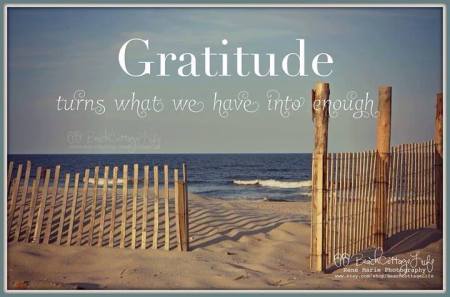
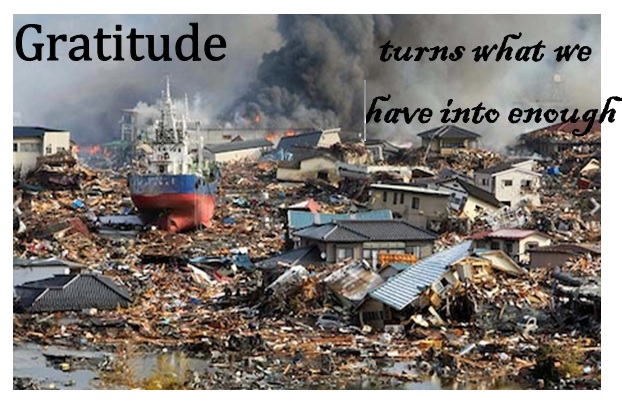
Right then I was in an emotional place to find that picture encouraging, but often I’m not. The friend who posted this is gracious and gentle, so I would not take offense even if I were in the throes of despondency, especially since she did not send it personally to me. I only want to underscore the importance of context–my emotional framework shapes my understanding of the message (and this message of positive spin is one of the fundamental tenets of our American culture). Notice how crucial the background picture is to the sentiment–its impact is subtle but powerful. Let me demonstrate:

That is a profoundly different message, hugely dissonant. What was a nice nudge towards contentment is suddenly disturbingly trite. When someone’s inner world feels this broken, thankfulness will not fix it. Gratitude has a role even in tragedy, but it is not the remedy for tragedy. The hungry need food, the homeless need shelter, the lonely need companionship, the vulnerable need safety, the wounded need healing. Sometimes what I have is not enough, even if I’m grateful. Scripture wisely tells us to weep with those who weep rather than give them reasons to cheer up.
I realize some folks want to be pointed to the positives, but for many, the chipper “Be grateful!” can be code for “Stop whining!” and that shaming message discredits their needs and belittles their distress. Perhaps what they need is permission to feel the injustice, encouragement to sit with their sadness, help to empathize with their own sense of loss. Maybe the very words they need to hear are, “Yes, it is bad, very bad. You must feel awful,” rather than, “It’s not as bad as it seems. Look on the bright side.” Perhaps we could all benefit from learning to sit longer with our sorrow.
I woke up this morning with spare change on the clock to get to church on time, but my soul was out of sorts, so I lay still, sensing its pulse instead of pushing myself out of bed. For the last decade I’ve honed the skill of listening to my feelings without judging them, but I’m only gradually learning to then respond with compassion, a crucial second step. Since I spent most of my life judging my feelings and driving them out with shame–calling them stupid or weak or petty–it was a giant step for me to learn to accept them as legitimate and meaningful, and it took years of stiff work.
That tenacious acceptance opened a huge cache of information about myself, a way to sort through my junk and set the furniture back on its feet. But with my cognitive bent, I’m slow on intuition, a key conduit to feelings. I often get stuck in my head, my thoughts going in circles like bugs around a rim, emotionally trapped, unable to move forward until I understand it.
I failed to realize that understanding someone and embracing him are quite distinct, and I don’t need to diagnose him in order to love him. Empathy can be profoundly healing even without an emotional biopsy. When I focus on fixing a “problem,” I default to analytics, but I can’t support the feelings when I treat them as the problem, a roadblock instead of a signpost. A hug is often better than a flow chart, not just for my wife, but surprisingly for me, the thinker.
When I’m busy dissecting feelings, I can forget compassion, especially for myself. Love seems a distraction from analyzing and engineering a solution… unless love IS the solution. “1+2 = love” does not make sense because feelings cannot be reduced to equations or formulas. But if love is not the answer, then perhaps I’m asking the wrong question, and if I’m not ending up at compassion, then I’m really off track. How would it shape my experience of life if I lived for love, not just for others, but for myself?
I know how to be a good friend to others: to listen, love, be gentle and patient, kind and thoughtful. But I don’t treat myself that way. I bully myself. I push and prod, roll my eyes, belittle pain, ignore my needs, devalue my efforts. I’m a really bad friend to myself.
So this morning I lay in bed, fully present to God and myself, ignoring the clock, being patient and gentle and sympathetic to my struggles like a good friend should. I took a feel-good shower instead of skipping it and rushing to church, and I discovered that being a better friend to myself made me a better friend to those I met. I’ve found a new buddy, and I think I’m going to really like him.
Following the great literary tradition of Dr. Seuss, someone coined the phrase “Fake it till you make it,” meaning that if you can’t do something good from the heart, do it without the heart until the heart catches up. If you hate someone, smile and be nice anyway. If you are frightened, affect a bold, unflinching attitude. If you are upset, act as though you are calm. Fake it.
Pretense never appealed to me. I take the honest approach. If I hate someone or think he’s stupid, I let him know it, scowl at him across four lanes of traffic or shake my head in pity. There’s a reason I don’t have any Jesus bumper stickers on my car–it would be false advertising. “Receive Jesus and you can be just like me” has some major shortcomings as a marketing strategy. To be honest (I’ll try to stick with that), I’ve noticed that when I force a smile through clenched teeth, and he smiles back, good happens, a sliver of peace accidentally slips down into my heart and relaxes my jaw.
Or not. When I try to stuff the bad feelings and force myself to be virtuous, it doesn’t work so well. I wrestle down my aggravation over this lane-hogging driver… and the one who dilly-dallied till I missed the green light… and this guy who parked so crooked I can’t pull in, and each time I push down the bubbling anger, it comes back up hotter. Putting a lid on it can make things boil over.
So which is it–does it help or hurt to act good when I don’t feel good? Why does positive behavior sometimes pull my reluctant heart along and at other times trip it up?
For me, it depends on the impetus. When I choose to do good in a way that seems to devalue and override my feelings, it turns radioactive. When I give grace to others by denying it to myself, it poisons me. In fact, I don’t think it’s real grace. Picture grace as electricity–I am the cable, and God is the generator, and when I cut myself off from grace, I also cut off those who receive it from me. Being only the wire, I can’t crank grace out on my own, especially not from legalism (which is the impetus if I am moved purely by obligation). Or to say it without wires and sparks: I cannot shame and fight my feelings and then hope to be accepting and generous towards others.
Here is how it plays out for me in two traffic scenarios. First, under law. I try to clamp down on my irritation by “shoulding” on myself, forcing down my feelings. Legalism makes me very conscientious as a driver–I don’t tail-gate, I let others merge in front of me (one car only, thank you), I don’t hold people up at traffic lights as I text on my phone. I work hard at it because my self-worth is tested daily, and I have to pass every section, even the driving part, to get my human license re-validated. If God’s keeping a scorecard, I can’t afford to make mistakes, and If I can’t have excuses, neither can you. It’s a tense way to be a driver… and a husband… and an employee… and a neighbor… and a human.
Grace only has room to flow in when I change the game from whack-a-mole to save-a-mole. I decide to accept myself and others with our mistakes instead of trying to beat out the faults till we deserve acceptance. Instead of saying in my head, I drive right, so you must drive right, I say, I make mistakes, so you may make mistakes. Now this is not a new equation of fairness on a different standard as though I am saying I will allow you as many mistakes as I allow myself, but if you cross the limit, I’ll whack you. Grace is unlimited. It is no longer based on fairness. Whatever I need I get and whatever you need you get.
But what if it goes past mistakes into meanness–she is deliberately unkind. Then grace takes the form of forgiveness, and since I need a lot of that too, I want forgiveness to be woven into the ambiance of grace in my relational world. I’m not suggesting a world without boundaries, leaving us defenseless. But walls are not weapons, so personal boundaries are not a conflict with grace, but a concession to our limitations. In fact, boundaries are a form of grace to myself, providing support for my weaknesses and security for my fears, and only then will I have the resources to offer grace to others, even to trolls, who are no less deserving. None of us have merit badges–that’s why we need grace.
I was a 45-year-old bachelor when I started dating Kimberly, and my friends, assuming I was girl-dumb, insisted I romance her with flowers, fancy chocolates, and fru-fru gifts… take her to see a chick-flick… say “I love you.” I smiled and nodded to placate their eagerness, but I knew they were wrong. For starters, Berly prefers cheap chocolate and is ambivalent about gifts. They might have known “women,” but I knew Berly. The problem with our romance pop-culture, and much of the marriage enrichment industry, even many Christian seminars and books, are the notions that all women are alike, that men cannot understand them, and therefore that husbands should simply learn some basic rules for marriage maintenance. Men regularly come home from a weekend retreat with a checklist to follow: kiss your wife goodbye when you leave for work, tell her you love her, have a weekly date night, and for goodness sake drop the toilet seat after peeing. And those are the better men, the ones who are really trying.
It’s a deep sadness that our most intimate relationships are held together with stock routines because we’re convinced we can’t understand each other. The gender gap might as well be an intergalactic separation, after all, women are from Venus and men are from Mars… and we’re apparently lost in space. It’s certainly a nice gesture to take a quiz on our five love languages and task oneself (say) with giving three daily encouragements to a spouse, but how much does that help in understanding one another deeply and thoroughly, which is what the relationship truly needs. It is almost as though we’ve given up on real relationship (vulnerable sharing, open listening, trusting, understanding, accepting, valuing, empathizing) and reduced love to what we do for one another.
Mutual understanding between the sexes is not easy or quick. It takes a lot of time and energy, not to mention fear and pain, and perhaps for that reason our culture has largely abandoned the effort as hopeless. “It has not been tried and found wanting; it has been found difficult and not tried” (as Chesterton said of true Christianity). But nice words and kind behavior can never substitute for the gritty, real work of heart connection. The first is comfortable and functional, like a pair of old shoes, the last is revolutionary.
This morning I was cruising down Lakeside Drive when a pokey car from a side street turned in front of me. That’s one of my pet peeves. If a driver feels some aggressive need to pull in front of me, fine, just go fast enough to stay out of my way. I stepped on my brakes and would have forgotten it, except the guy slowed down even more, creeping into a gas station. “REALLY!?” I ranted to my dashboard, “You had to cut me off ’cause you were in a hurry to… STOP?”
I can self-justify with the best, but I’m not so far gone as to equate my petty irritations with righteous indignation. I knew I wasn’t channeling Jesus with my defensive driving.
This also suggests a serious limitation to that great advice to “be in the moment.” Oh, I was in the moment, all right, totally in the moment, that scowling, growling, hand-clenching moment. Sometimes you need to get out of the moment, be a little less present, to grasp the bigger picture.
So I tried to talk myself down. I noticed that he was a geezer, and they do everything slower, everything. But I’ve played that chess game with myself before, so I know all the moves. I responded with, “Hey, driving faster takes no extra strength. Retirement ain’t gonna slow me down. That’s no excuse.” “Ah,” said my mental opponent, “And how many wrecks will your age-diminished reactions cause before you slacken your speed?” Okay, that was a surprise, a new argument that sounded suspiciously like my wife. How did she get in my head? That’s totally unfair–two against one.
But her voice is the one I really want to hear, not because it is right, making me wrong and bad, but because it is gracious. She wants to find peace through mutual acceptance of our weaknesses. In contrast, I find that when everyone follows the rules, we all get along. Legalistic happiness. It’s pretty common in church.
The problem is when we screw up… and we all screw up. The law has no margin for error, so it makes us all losers, and we scramble to escape that weight of condemnation. Each time others break our rules, rules that ensure our safety, we feel slighted, devalued, and disrespected, and even small slights cut deeply because we already agree with them, we believe we deserve no respect. When someone cuts me off in traffic, I feel less of a person, so I get defensive. In my relationships I push others to change, to conform, to live in a way that does not tear open my self doubt. Everyone, follow the rules!
The voice of grace sounds so small and useless against such visceral drives, and it calls me to abandon the very thing that is protecting my fragile sense of well-being: my ragged record of good, which is my only justification for squeezing others into line. Grace whispers that we are loved regardless of our record, that we are valued fully even in our failures. But I find it hard to trust. Grace is like oxygen–once you let it in, it is available to everyone in the room. If you allow grace to cover you as a loser, then it necessarily covers all losers, and then you have to drop your legalistic demands. But their flawed conformity to rules is the only thing keeping me protected. For all its defects and failures, the legal system looks pretty safe, and grace looks pretty risky. No wonder faith is the only way into grace.
 I grew up believing that I was superhuman, that I could and should have every quality admired in others. After all, my grandfather’s biography was titled “Always in Triumph,” and I was cut from the same cloth. So I inherited a Supersaint cape, but not the genes, expectations without the abilities. Every attribute in others turned into a goal for me, and every weakness of mine must be muscled into a strength. Without asking how a basketball player would fare in a saddle or why marathoners and sprinters had such different builds, I was determined to be a complete spiritual athlete, equally good at figure skating and weight-lifting.
 I did not realize that my qualities as a gift to the church were unique, that my strengths supplied the lack in others’ weaknesses and that their gifts filled in for my inadequacies. None of us were designed to do it all, but rather each is to be a vital member of a team, offering his unique perspectives, abilities, and traits. Someone who is good at sympathizing is shaped differently from someone who is good at challenging. The cheerful and friendly are not usually given to reflection and quiet. Often we assume that maturing makes us all alike, good at all aspects of spirituality. But if each of us is designed uniquely, becoming more mature may well make us more distinct, though each a beautiful aspect of God’s character.
We are God’s orchestra, and the drums are not in competition with the flutes or the trombones fighting the violins. Each has its own music. We can delight in one another’s contributions and seek to find the flow of harmony in concert. I can be inspired by their dedication and enthusiasm, discipline and creativity because we have the same values and shared goals, but my score is my own. May I take satisfaction and pleasure in the instrument God designed me to be.

Grace is truly a mystery. I understand how justice works to set things back to rights, but how exactly does forgiveness work? Isn’t it bound to set things more out of whack? Fair trade makes great sense–everything adds up at the end of the day in the universe’s great balance sheets–but giving things away willy-nilly is going to ruin the bottom line. How will we know who owes what to whom? If you fling the doors of grace wide open isn’t there going to be a run on the bank? And if grace were as common as pebbles, there’d be no market for it–you’d have to give it away without charge. Imagine that: free grace. Who can predict where that would end: the collapse of the world as we know it.
 By this afternoon the snow had mostly melted at our house, and it didn’t feel that cold, so I pulled on my tattered loafers sans socks and drove to the park with Mazie to walk. The asphalt path was mostly free of snow, but by the time I reached the end, my toes were stinging. When I turned onto the wooded dirt trail, I found half an inch of unmelted snow, and I started waddling with my feet splayed to keep from scooping snow into the gaping holes on the out-sides of my shoes. As I walked, something strange happened–my toes began to warm. I was surprised enough to pull out one foot and check that it wasn’t just going numb. It was cool to the touch, but not icy, in spite of the snow that was clinging to the edge of the open splits. Even on cold days my bare feet in loose shoes rub themselves warm against the leather as I walk, and now the broken trail made my feet slide around even more, increasing the friction. There is an upside to friction… even in relationships.
Berly uses her lunch break to stretch her legs, and since I walk Mazie at the same time, we phone-walk together. Today we chatted about yesterday’s blog post and how grace plays such a big role in our relationship. My sketch was true in its broad strokes, but don’t suppose that Berly is always trusting and I am never selfish. We screw up regularly. But we make room for that in our relationship. Our family values are framed by grace–we structure our lives to make space for one another’s weaknesses, fears, needs and the like. Grace designs the principles by which we live but also the manner in which we live these principles, or rather fail to live these principles. In other words, we give ourselves grace for failing to live by grace.
In my last post I said Berly trusts “that I am doing all that I can within the sphere of my emotional strength.” But sometimes I shortchange Kimberly by doing less than I can, intentionally or not (that is, sometimes I am lazy and at other times I simply underestimate my own energy level). We are deeply committed to one another, to mutual understanding, acceptance, and support and we live this consistently, but not perfectly. We have expectations… our expectations are that we will fall short of our ideals on a fairly regular basis. We trust one another not because we live flawlessly, but because we live in grace towards one another’s flaws.
In other words, we live with friction, and we think that’s good. It’s possible to smooth over all interactions, but the cost of such a tightly controlled “peace” is shallow and inauthentic relationships. Nothing is more lonely than a friendship where we cannot be ourselves. If we are unique individuals with our own histories, views, personalities, and preferences, then doing real life together at any depth is going to bring tension. Real life and growth comes from rubbing up against the rough grain of those we love and discovering that our flaws are the basis for our bonding. It is not fixing faults but embracing grace that strengthens relationships and deepens trust.






 Janathan Grace Reflections