Archive for the ‘Uncategorized’ Category
“The beauty of holiness” is a delightful and profound biblical thought. We long for the clarity, simplicity, and certainty that comes from a paint-by-numbers spirituality, to know exactly where the lines are drawn and what colors we should use to fill them, and yet the Bible continually confounds our efforts to make all its truth fit in our neat boxes. We think there is an ideal body weight, a best-practices study plan, one way to be a good Christian employee or manager, and we constantly measure ourselves against these perfect models, the WWJD approach to Christian living.
But from that mindset, “What Would Jesus Do?” is a trick question, making us think that Jesus would always do the same thing in the same situation, and that following him is just about identifying and imitating that action. What if he wished instead for us to absorb his worldview and then shine that out in our own unique way with our own personalities and contexts, spins and quirks, under the individual guidance of the Spirit.
Holiness is not a flow-chart of right choices with everyone responding in the same way to the same situation. From my perspective this would actually undermine God’s design for us as unique parts of the Body of Christ. Some are good at encouragement, others at pointing out problems. Some are gifted in counsel and others in comfort. In this building of God, some are studs, outlets, or flooring, and each has a unique part to play. Walking in the Spirit is organic and dynamic, often surprising and confounding, a constant learning and discovering process where even our faults and missteps contribute.
There is no simple and easy answer to predetermine my response to a neighbor that mows over my petunias or a kid who is afraid of my dog. Love is always the answer, but love has a thousand ways of expressing itself, and if it is truly love, it will be beautiful in each of these expressions–a flowering cactus is just as thrilling as a prize-winning rose. So let us become artists in our own unique way, painting our world with the love only we can give in our inimitable way.
Historical time frames in the Bible move so slowly that if we lived through those daily events, we’d notice no real progress except in rare moments of change. Abram is promised a large family. He must imagine spending his life watching the birth and growth of each child, raising them into men and women, and playing with his grandchildren. Instead he spends his whole life waiting, childless, and at the very end, when he is an old man, he gets one son. Israel is promised a new land, but that whole generation slowly drops dead one by one as they drag their tents through the desert over decades of splintered dreams. Only their children see the promise fulfilled. “All these died in faith, without receiving the promises, but having seen them and having welcomed them from a distance, and having confessed that they were strangers and exiles on the earth.” (Heb. 11:13)
For hundreds of years Israelis waited for the Messiah, passing their sometimes-wavering expectation on to their offspring. They waited, grew old waiting, died waiting, as did their children after them. The Old Testament is one long book of waiting. And then he comes… only to leave his people once more with a promise. Christmas, like communion, is a memorial of remembrance until he comes again.
It seems that faith is given to us less as a means to gain a promise and more as the strength to wait for the promise. Daily grace is more about sustenance in the famine than the bounty that will one day come. Our faith is not measured by how much blessing we enjoy, but by how much faithful endurance we keep without receiving the promised blessing. It is drought, not abundance, that drives roots deep into the earth where they tap into the true, undying water source and build an unshakeable foundation. Grace refuses to settle for the short-lived, easy gains that we so often wish for and rather calls us to the hard road of long-term transformation, the kind of change that radically reshapes who we are.
So our patience is not passive and acquiescent, like a doctor’s waiting room, but active and willful. “Prepare the way of the Lord.” Those hills and valleys that need to be straightened are not the landscape of the world, but the topography of our own hearts. He has not come (or we have not gone) because we are not yet ready for him. When a bush pilot flies into the jungle to deliver supplies only to find no landing strip, his coming brings no benefit. So let us be active participants in his grace, yielding our hearts for the Spirit to clear the brush and fill the holes, preparing for our coming King. Waiting is one of the greatest acts of faith, determination, and diligence.
One of the core reasons for my blog: 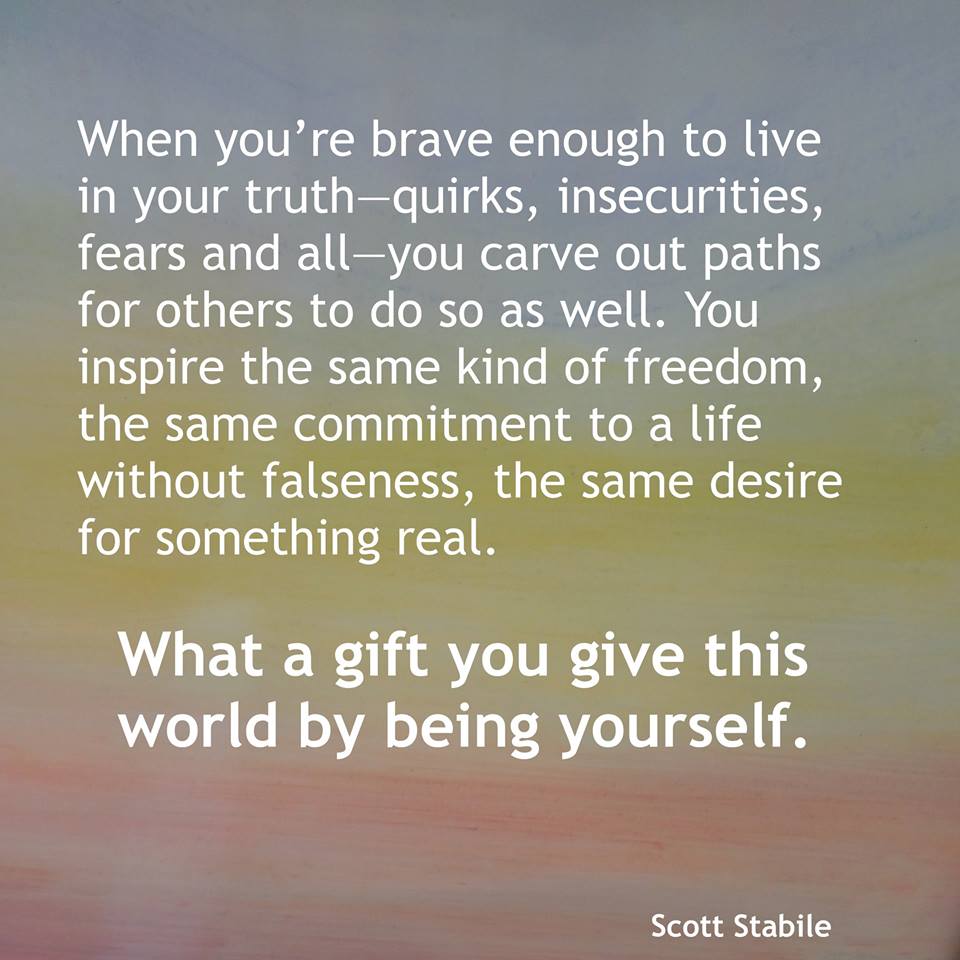
Each year we wait like Israel of old, reenacting the anticipation and longing, the hope and heartache of an oppressed people looking for the Messiah. That night long ago changed everything… and changed nothing to the common eye. The day after Jesus’ birth, the Israelites awoke to the same oppressive government, the same self-righteous religious leaders, the same troubles with which they lay down the night before. Looking around them, nothing had changed.
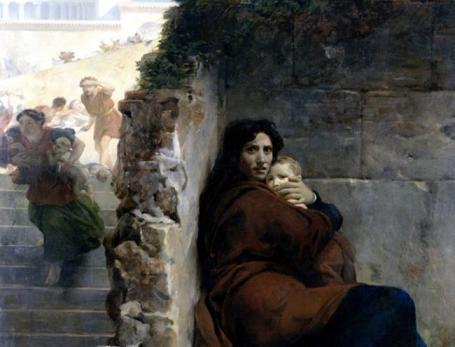
We have our own heartache and hope, and we await our deliverance. But unlike that night long ago, December 25 changes nothing. We awake the morning after with an emotional hangover and face all the same sorrows we set aside for the holidays… except for a lot of extra trash, extra bills, and a long, cold, dark winter ahead. When we call Christmas “advent,” which is to say “coming,” what exactly is coming…in our day, in 2016? What are we expecting?
One day redemption will come, but like that first night, our world is still fractured. As the shepherds trudged back to their sheep that night, nothing had changed around them… but everything had changed in them. They still stubbed their toes in the dark, but aching feet could not detract from that history-smashing story of salvation into which they had tumbled, a story that recast their whole world. Whether they held onto that vision so that their whole lives after were shaped by it or whether that vision slowly dimmed and became just an old tale told by their campfires is the same question that hangs over each of our journeys.
Our God is the same in our celebration and mourning, in our feasting and hungering, in our brokenness and healing: a loving, true, faithful, mighty, gracious God. And he knows that both the shadow and light are essential to our continuing salvation. As we are able, we embrace all that our hearts feel and know, believing that there is hope, that light will spring up for us, even if it delays until the final day. Until then, we walk in the light of that first Christmas, a candle even on our darkest days. He has come and our lives will never be the same.

Last week we unpacked our old nativity scene from it’s wrinkle of wadded up paper and bubblewrap. The set looked a little bedraggled from its journey across two states–the straw was mostly gone, the thatched manger roof was now bare wood, and one of the magi had lost his head. Kimberly laid out each figure along with the headless wiseman, severed head at his feet. After setting up and decorating the Christmas tree, I suggested that Kimberly take a picture for Facebook, which she did, forgetting the macabre detail until we had posted it.
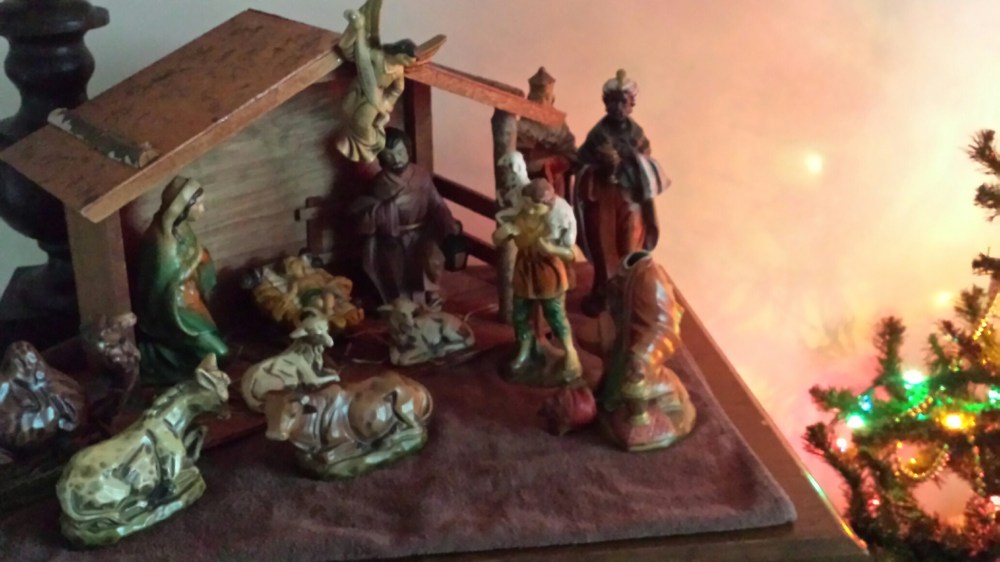
No one would purposely screw up their Christmas decorations–stringing up lights with half of them burned out or hanging up broken ornaments–anymore than they would go to the Christmas eve service with a torn shirt. We sing songs about a perfect baby Jesus (“no crying he makes”), and we sanitize the manger as though it was not a place where dirty, smelly animals kicked up the straw with their poop-coated hooves. Like any birth, there was blood and muck and probably some screaming in pain from the bedraggled unwed teenager from Nazareth.
When we sanitize Christianity, make it respectable, middle-class, comfortable, we lose the radical message of the grace that is offered to those who have nothing to offer. When we lose touch with our own spiritual poverty and the anguish of the world around us, our message is distorted. The gospel of Christ is a bloody affair from the cradle to the cross, and we are called to that same suffering, our own and redemptively for others. Some face this season without loved ones or with new diagnoses, with intolerable pain or lost hope. My deepest sympathies are with you. Let us live into the realness, the wholeness of Christmas, not just the angels and magi, but the blood of the innocents. As one author challenged us: “Keep Herod in Christmas!”
I have been gone for a long time from these pages, struggling to survive the process of moving from Lynchburg, VA to Asheville, NC. It was high stress on every level for the last few months, a story worth telling sometime. I finally feel settled at my new house (rental), new job, new city, and new routines… settled does not mean pleasant or happy, just doable. Kimberly is working as an adoption event coordinator for a local animal rescue called Brother Wolf. My part time Home Depot job transferred, and I just went to interview for a part time job at a community college library. I continue to flounder in life, wishing for some useful, fulfilling role to play in this world, but having little excess energy to invest in that whole pursuit. So I drag along, trying to encourage and support those around me as I look for ways to lift up my own soul, though my soul seems immune to any remedy I apply. For some of us, a participation award is the best we can do.
It took years for me to accept my own ostrich-ness without embarrassment, recognizing and not running away from the disappointment others held towards me. I was sharply reminded of this at my dad’s funeral as I re-connected with acquaintances from long ago, the many who stood in line to offer me their condolences and politely inquire: “Where do you live now?” and “What do you do there?”
The simple answer is, “I work at Home Depot.” There is nothing simple about that response. It is freighted with cultural and religious baggage, and I immediately saw it in their faces when I answered, sudden flickers of questions and doubts tugging at their cheeks and blinking their eyelids. The middle-aged son of a college president working a minimum-wage job? Should they leave it alone and move on or ask me for clarification… and how could they do that circumspectly? Since I wasn’t sitting down with them for coffee, I started adjusting my answer to relieve their discomfort.
I understand their consternation. When I started working at Home Depot two years ago it took me a couple months of building courage to share the news on Facebook. As a culture, when we hear of a college-educated person in mid-career working an entry level job, we feel sure there is a tragic story behind this mishap. Selling hammers is one step above homelessness. I was going to say one step above unemployment, but actually an unemployed professor ranks far above a working stiff–he hasn’t given up on himself yet.
Of course the heavy cultural implications are double-weighted with the religious ones. It is true that Jesus himself worked with hammers and saws, but that was in his youth, just an apprenticeship for what really mattered, we think. The highest accolades in my family and alma mater go to missionaries, secondarily to pastors, thirdly to those in non-profit work, but instead of working my way up that ladder, I slipped down it, one rung at a time. Oddly enough, my soul was gaining depth and strength and wisdom with each lower step.
It seems the Kingdom of God is much less predictable and straightforward than I assumed most of my life. I guess that is why we walk by faith.
My father’s mind began to wane several years ago, and friends encouraged him to give up writing and preaching. He acquiesced begrudgingly since losing his public ministry made him feel useless. When visiting him, one of those friends would ask, “How are you?” and dad would always say, “Terrible!” “Why?” “Because I’m still alive!” He was ready to “go home” and last week he finally did. I expect he was greeted with my mom’s loud, raucous laughter echoing through the halls of heaven.
Family, friends, and colleagues remembered him with admiration at his funeral. He was a good man and a gifted leader, a hero to many. Years ago he asked me if I had any heroes, anyone I admired and sought to emulate. He expected me to point to him and was sad when I didn’t. Though I respect him, I cannot emulate him any more than an ostrich can emulate an eagle. An ostrich hatched by an eagle would simply be lost and confused and self-condemning as long as he tried to imitate the eagle, and all the eagle’s encouragement, advice, and example on how to be a better eagle would only make matters worse.
To his credit, dad eventually made room for my way of being, though he couldn’t understand it. He tried to understand, but he was stuck in his own framework of thinking, as though the eagle saw his ostrich son running and interpreted it to be “low flying” or “slow take-off.” His efforts to accommodate my way of being were inspired by love. Instead of treating me like a deformed eagle, he accepted me as a mystery (because he was unable to grasp the idea of an ostrich). I’m forever grateful that he did not condemn me for who I am and how I live. For that reason, although our viewpoints were so contrary, we were never estranged.
And yet we drifted apart. As I slowly discovered my true self and tried to share it with him, I could not make it comprehensible to him. He could not see outside his own box, and so our relationship devolved into general, disconnected niceties because real relationship requires mutual understanding. Over the years, I have grieved the loss of that relationship as I think he did, and so his home-going was only the final step in that loss. It is sad, but the tears have long since run their course. When I see him again, he will see me for who I am, and that is cause for rejoicing.
In the meantime I will give him his well-deserved honor. God made him an eagle and he was determined to be the best eagle he could be and raise up a huge flock of eagles to follow in his flight. He was admirably successful. For that he will be remembered for a generation. I am glad for those he blessed.
When we face life honestly, bravely, and resolutely, it slices us with a thousand little deaths: truths we are loathe to admit, securities that have blocked our growth, long-fostered hopes that end with a sudden blowout or gradual leak against every effort to re-inflate them. As Kimberly and I prepare to move to Asheville, NC, we are “downsizing,” a smooth word corporations use to put a positive spin on frantically casting everything overboard to save a sinking ship–more like foundering than streamlining.
I had no trouble giving away excess clothes and unused dishes, but when I sold my weight set, it went out the door with my dreams of a buff body still draped over it. To my wife it was a dust-collecting eye-sore, but when I sold that bench, I gave up on a promise and hope. It was my final concession that this frumpy body is the one I will take to the grave. I finally admitted honestly that it was a wasted dream, sitting idle for so many years because my real values lay elsewhere. And that’s okay… it’s even good. I want to live out my true values and not be distracted by false ones. But the good road often forks away from the desirable one. Being good and being happy are often incommensurable.
Stripping away possessions can be a stripping off of dreams and securities, groundings and trajectories, plans and expectations. This morning as I drove my pickup filled with ministry books to donate to a local college, one phrase pounded through my head: “I hate my life!” Those particular books sat in boxes in my basement for ten years, waiting, full of hope for a revived ministry of preaching or teaching or leading, some role to play in bringing God’s goodness into the world. They hung heavy with past joys long gone: the delight in studying and sharing truth with others, the deep satisfaction of experiencing spiritual usefulness by sharing gifts to benefit others.
I have pursued the truth as relentlessly as I can, and it has brought me so much more insight and freedom, self-knowledge and character. I know now that much of what I did before was streaked through with blindspots and immaturity and ungodliness. I had a deeply flawed understanding of God. I am in a far better place personally and spiritually because of all the breaking, but I had hoped to come to the other side of the struggle, to rediscover joy and peace and fulfillment at a new, fuller, more meaningful level. But I am only tired, deeply tired, and crushed and broken-hearted. I feel as though I am on a death-march, lifting one foot after the other in my hopeless, stubborn faith.
If this rings true for your own experience, may you be encouraged that you are not alone. Let us call out to one another in the dark.
We are moving and selling our house. It takes a great deal of work to get a house ready to sell: fixing, updating, de-cluttering, prepping… on top of working two jobs. It is exhausting. All day long I mutter, “I am SO tired.” And the work never ends. I’ve tried multiple fixes and none have worked. Trying to sleep it off just delays the soul and body ache which jumps me the moment I start my day. Every other search for relief has the same dead-end result.
It occurred to me recently that I may need to accept weariness as my current stage in life, like the parents of a newborn must do. Perhaps resignation is my best move since every failed effort at escape simply increases my sense of entrapment. I can live with exhaustion just as others live with arthritis–with a bit of accommodation and commonsense caution, carry on with life each day as it is given me to live. I’ll let you know how it plays out (if I’m not too tired to blog).


 Janathan Grace Reflections