See, I have a very neat and organized view of life and she is all over the map. “Wait,” you say, “aren’t you weighting the whole thing at the start by comparing life to a map? Maybe life is more like a painting.” Well… okay… now you’ve confused me… hold on! Life can’t be like a painting because you can’t live without following the rules, you have to do things in order–socks first, then shoes; toothpaste first, then brushing; shopping, chopping, cooking, eating, all in that order. Life is like a map.
“Okay, if you lack the creativity to see life as anything but a map, what about off-roading? With the right vehicle, you can go anywhere on the map at any time.” You’re making me very uncomfortable–if you don’t stick to the roads you’ll get disoriented and lost and never make it to your next stop. “Who says there is a next stop, who decides the destination and how to get there? Aren’t you assuming a few things? In fact, what does ‘lost’ even mean?” Lost is when you don’t know where you are or how to get where you’re supposed to go, and everybody knows where you’re supposed to go. “And if Kimberly doesn’t see it that way?” Then she’s wrong!
“Ah, well, that sounds like a good way to resolve differences–declare yourself right and the other person wrong!” Look, I’ve tried seeing things her way, but it’s like looking at a Picasso, it makes no sense. “Maybe that’s the point.” To make no sense?! “That the problem is with the sense rather than the painting, maybe it’s the way you are looking rather than what you are looking at… and by the way, I notice you brought back the life-as-a-painting metaphor.” So you are suggesting the problem is with my mind and how it is structured, that I have to change my mind? “Well, let’s just say broaden your mind–the goal is to understand Kimberly, not abandon your own perspective in favor of hers. But you have to understand her from her perspective not from your own.” You mean I have to see Hip-Hop like Snoop Dogg sees it, not like Julie Andrews sees it? Because I don’t get Hip-hop either… and I’m not sure I want to get it. “Baby steps. Start with Kimberly.”
Yesterday Kimberly and I were walking the dogs in our neighborhood. My brain was stuffed with thoughts that were spilling out everywhere. (This is not as common as you might think since I’m an internal processor.) Towards the end of my rambling monologue I commented that I was slowly coming to realize people are not very logical. She responded, “That’s what everybody thinks. Everybody believes their arguments are more rational than everyone else’s.” With that short exchange our conversation slid into the ditch. It is our most familiar, but still unavoidable, conversational pile-up. We don’t see it coming, we don’t know how to avoid it, and once we’re off the shoulder, we don’t know how to recover. The best we can manage so far is an autopsy after the talk has crashed and the dust settled.
In short, we each hear the other stating an absolute position that leaves no room for our own perspective. In this case she heard me saying that I was smarter than everyone else and I heard her saying that everyone is equally logical. My approach is to try to make some room for my view, in essence saying, “Will you give me this half of the room? This end? This little corner?” It seems to me that I am negotiating for space for my viewpoint, smaller footage with each argument I propose, and after the third or fourth try, I give up, growing silent. There is not even a cubbyhole in her outlook for my perspective (in this case, that logic is important but underused). She, of course, hears something entirely different. For her, every time I give a reason for my view, I am demanding her total capitulation. It seems to both of us that the other one refuses to yield an inch. On this occasion I tried to assert, “Logic is very important… logic is kind of important.. logic has some small role to play,” but each time, she hears me giving one more argument for why logic is king and I am his chief officer.
When the topic is minor, we just let it go. It’s not worth the trouble to sort out. But when it is a personal issue, touches a core value, or has significant practical implications, we are too emotionally invested to welcome the opposing viewpoint. So this conflict pattern that needs a clear-eyed examination arises when the fog is thickest. Initially we don’t recognize it, but the deeper into the conversation we push, the more emotionally invested we become, so that ironically, the more obvious the situation grows the less possible it becomes to resolve it.
All our standard relational conflicts take this path of growth. We start to recognize the pattern in hindsight and discuss it. Then we begin to realize when we are in the middle of it, but we still can’t figure out a solution. Then we take some baby steps that slowly grow more helpful. After falling in the same ditch hundreds of times, we find a way to sometimes avoid the ditch, slowly becoming more adept. We’re still at step one on this particular dynamic. But we’ll figure it out. We always do.
Last night as I prepped for bed, I said to myself, “This has been a good day.” In the last twenty years I must have felt that at times, but I can’t recall any… partly because they have been rare, partly because a depressed mind easily forgets the ups. “Why was it good?” Kimberly asked. Nothing exceptional. I enjoyed my walk with the dogs… and some other incidental positives I couldn’t remember. Incidentals don’t usually change the feel of a day for me.
The things that encourage others don’t sink deep enough to change the life experience of the depressed. We see a beautiful waterfall, earn a compliment at work, or find a love note in our lunch, but like a cold sip on a blistering day, it tantalizes without refreshing. It is the surface waves that leave the depths unmoved. For all of us, emotional responses are spontaneous, unchosen. We can tweak the flow of our feelings–calm a fear or encourage gratitude to some extent–but our influence on them is limited.
It’s the unwanted emotions I’d really like to avoid, but I can’t. We melancholics are highly sensitive to our deeper selves, so we can’t work or play or friend away our feelings. And even if I could snub them, I wouldn’t. I need to hear what they have to say. Emotions are dispatches from our psyche, so killing the messenger simply cuts that line of communication to a huge, vital source of personal insight. In fact, it is to this core place alone that real healing must come. Good feelings are yard sticks, not hammers: you use them to measure your soul, not to fix your soul. Like your spouse, feelings are better listened to than controlled, understood than manipulated. Insisting on positive feelings can be a form of self abuse.
The mundane events of Saturday felt good to me, and that’s a hopeful sign. It suggests that a much deeper good is awakening in some part of my soul.
I’ve been missing lately from my blog because I’ve been mysteriously content of late, and I’m doing all I can to step gingerly and avoid jostling anything that might splash unwanted bits on my day, a very closely managed contentment! It is like having a badly burned part of my body–my most recent bout with serious depression–that is painless as long as I don’t move, and stings a warning if I take any chances… enforced relaxation… sort of like prison… like hiding in the bushes from a stalking bear and bating my breath to avoid detection… very much like that since I don’t know when and from where a new round of aggressive depression might pounce.
A harsh word, a guilty memory, a snub, a glimpse of an unfinished project and depression gets in a quick slap. I feel it, and I will myself to breathe deeply, relax, let it go. At other times it is the slow, almost undetectable drips of growing emotional dis-ease, when I go two days without exercising, for instance, or I avoid dealing with a niggling problem. I can always feel it brushing past in the dark, know that I have a very thin emotional barrier protecting me. Perhaps the clearest evidence is that even though I don’t currently feel bad, I have very little energy to take steps to enhance my life, and pushing myself past my energy level is sure to tip over my precarious detente with depression.
Certain things seem to keep me steady–walking daily for two hours, going to work each evening, talking through stuff with Kimberly, loving on my dogs–and my hope is that over time a steady pace will yield more stability. There are hopeful signs. I am finding some comfort in books as I have not in years, and I catch myself whistling or singing snatches of verse. But all those gradual gains could be swallowed up overnight, without warning, and without explanation. So for today, let me just breathe steady, walk slowly, and hope for the best.
For 45 years B.K. (before Kimberly) I did life on my own. Going from single to couple in midlife can’t compare to marrying young, and though it has big pluses, I’ve felt the loss of her absence from my history: so many key events that are not shared moments, so much of who I am pieced together without her. But after my blog post yesterday, I have to recalculate. Missing those years has given her a clearer sense of who I am now, a view untainted by past distortions. In a way, she knows me better than I know myself because those years marred my self-understanding, not just my spirit. Without that baggage, she can see more objectively.

 I truly don’t know how younger couples manage to navigate any sort of major life transformation after marriage if they don’t somehow make those transitions in step. Kimberly and I are both dramatically different people from our young adult selves. Had we met then, our false selves would have been inimical. Instead of helping one another towards genuine self-discovery, we would have driven each other into deeper hiding. It would have been a disaster. Our paths only crossed when our souls were ready. Since most of my life was a quick march in the wrong direction, how did I hit the right intersection at the crucial moment? The magic fingers of grace.

I was walking in the misting rain today, the dogs pulling eagerly at their leashes to sniff out delights tucked into the roadside weeds, and I was thinking about my long journey back to myself. At the age of 40 I realized I’d been fast-marching down the wrong road, chasing my false self–the self I thought I should be and could be with a little more effort. It was not a journey of discovering myself and blossoming into that person God created me to be, but a suppression of my true self and imposition of duty-bound goals. And as I grew ever farther from my true self, I had only a fabricated self to share with others.
So many of us are like bumper cars trying to connect, but instead deflecting. “Hi, how are you?” bump, bump. “Fine, thanks.” bump, bump. “I had a rough night, but I won’t bother you with that!” smile, bump, bump. It’s a dangerous place to be without a bumper, so we cushion ourselves well and keep at a safe distance. As protection, I used tight self-discipline to outshine others, to prove my worth, to earn their respect, and to safely pad the vulnerable parts of my soul from access to others. If you hide long enough, you lose your orientation and eventually lose yourself.
Who am I really? Am I a naturally disciplined, organized person, or am I a naturally spontaneous, creative person who has wrapped himself tightly in this cloak of spiritual conformity? Am I essentially easy-going and relational, or am I hard-driving and goal oriented? Would I make a better therapist or lawyer? I worked so long and tirelessly to become the person I thought God demanded, suppressing my true inclinations, desires, and gifts, that I struggle now to recognize the real me. For the last 14 years I’ve been finding my way back, sloughing off layer upon layer of spiritual accretions that suffocated my spirit and that carefully buffered my friendships. I still have a long way to go, but at least I’m on the road back to my true self shared in genuine relationships.
I often wonder where I would be now if my true self had been embraced and celebrated and my path had been the natural opening of my heart to a God full of grace and welcome.
Perhaps that’s only possible in an unscarred world.
Early this summer I dragged out a cardboard box from my closet, blew off years of dust, and opening it, pulled out a stack of notecards. Each card held a quotation, insights that inspired and challenged me, scribbled down from a decade of reading, and I planned to transcribe them to my computer. For two months I couldn’t muster the energy, but last week I finally plunked them down in my lap and started flipping through for some encouragement to share on Facebook. I read through ten cards… and then ten more, pulling them randomly from the pile, and discovered that what I meticulously recorded and saved was toxic. They were snippets of a mindset that dragged me into darkness and despair, a spirituality that was intense and genuine… and deeply flawed.
One of those treasured nuggets read, “A really humble man would rather let another say that he is contemptible and worth nothing than say so himself…. He believes it himself and is glad that others should share his opinion.” Another famous divine wrote, “Strive always to choose not that which is easiest, but that which is most difficult; not that which is most delectable, but that which is most unpleasing; not that which gives most pleasure, but that which gives least; not that which is restful, but that which is wearisome; not that which gives consolation, but rather that which makes disconsolate.”
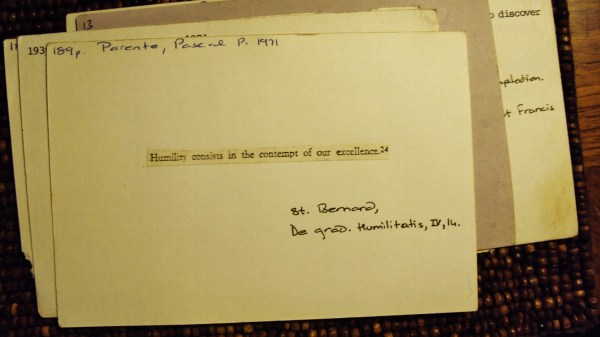
“HUMILITY CONSISTS IN THE CONTEMPT OF OUR EXCELLENCE”
Even when the quotations were “positive,” they crushed me with their impossible standard, like this prayer: “Grant that every word I speak may be fit for you to hear; that every plan I make be fit for you to bless; that every deed I do may be fit for you to share” –flawless speech and thought and action daily. I was a very committed young man. If this was the measure of true spirituality, then I was determined to reach it. With all my heart I drove myself to meet this standard, redoubling my efforts when I fell short, and finally I despaired.
In my brokenness, the grace of God found me. In my years of striving I would have looked on such a free gift as “cheap grace,” as taking advantage of God’s goodness, as spiritual lukewarmness like the church of Laodicea. But once I despaired of myself, grace was the only hope left to me. We cripples cannot earn our keep. It must be given to us.
For years after stumbling into the light of grace, I blamed myself for that twilight of wandering, of waste, of wounds to myself and others, but that murky stretch of my journey may have been inevitable, even necessary, since only the destitute embrace grace. Moses spent four decades in the backside of the desert herding sheep. David spent years running from Saul, sleeping in caves, being tagged a traitor. Demolition sets the groundwork for re-creation, so that the very strength and success of the unbroken stunts their souls. So let me, like Paul, brag about my weaknesses and magnify the grace of God.
I’ve been staying with dad for 10 days, keeping an eye on him while his wife is in Australia. Dad is a man of habit, finding comfort in a daily routine. I think he would call it discipline. Each morning he gets up, makes a cup of coffee, and takes it into his office where he has a long-established pattern of devotions: singing old hymns, reading the Bible, and praying through his list of requests. I expect he would feel discombobulated all day if that pattern was knocked loose.
Each morning here I go for a walk along the Broad River Walkway. At first I was taking along Barney, their border collie mix with long, thick, uncontrollable hair, but he kept falling behind, so I started walking alone. The solitude crowded my head with thoughts, mostly reflections on childhood and its repercussions.

Broad River Walk
This morning, prompted by the choruses I sang with dad last night, I headed out to walk with the old hymnbook tucked under my arm. The red cover was warn smooth and dark from years of family devotions, the ancient supportive tape on the corners blending seamlessly. As I stood and watched the water cascade over the spillway that stretches between the banks, I flipped the book open and the pages divided at “Nearer My God to Thee.” Those words dusted off cob-webbed memories of my deeply religious youth when I was “sold out to God” as we called it. I spent hours in prayer and Bible reading, I listened to sermons and worship on the radio, on tape, and at church. I read Christian authors and talked with Christian friends.
All this effort was to reach an oasis, relief for my parched soul, but the God I sought was a mirage. The farther into the desert I pushed myself, year after year, the more lost I became, until I was crawling through the sand towards water that wasn’t there, and I finally collapsed. Every step in the direction of a misconceived God is a step away from the true God.
I worshiped a God who was harsh and judgmental, and based on these assumptions, all my Bible reading and prayer and devotion simply drove me deeper into this skewed faith. I read verses about God’s wrath and judgment that negated for me any verses about His gentleness and love. Sermons about God’s kindness came across to me as soft and insubstantial, as merely a carrot to get me to work harder at being good so God would accept me. The more I sang “Holy, Holy, Holy” the more unworthy and rejected I felt–who could ever measure up to absolute perfection? I worked to strengthen my faith, but it was faith in God’s power and omniscience and righteousness that were scrubbed of any scent of His patience and mercy and grace. That is, his power and omniscience and righteousness were frightening, not encouraging, the basis for his condemning me, not his rescuing me.
Love was there, but it was not foundational as these other attributes were. Fundamentally, God was pissed off at me and could only be mollified by the death of his son. Jesus kind of forced God into accepting me against his better judgment, bought God off so to speak. The harder I worked to be the person God wanted me to be, the more I realized how far short I fell. I heard Amy Grant’s song “My Father’s Eyes” and knew the look in those eyes: eternal disappointment.
This was not the kind of error that I could tweak my way out of. It was fundamental, all encompassing. It was not until my worldview, my belief system, crushed me beyond recovery that I was able to let go and discover the God in whom I now believe, a God of infinite grace. It has taken many years to unlearn, discard, loosen my fearful grip from my long held false securities and to cling stubbornly to my new faith, my new God, my new life and relationships… and even a new Bible and hymnbook. Nearer my God to thee.
Humans of New York is a wonderful website produced by Brandon, a photographer who is brilliant at drawing out the personal journeys of his random subjects in the city, recording their answers to his sensitive questions. I am linked to his page through Facebook and receive a post or two each day. They are very touching and heart-warming and the encouraging comments from others are worth reading as well. Here is today’s post:
 “Are you lonely?”
“It’s been a lifetime of loneliness. I decided early on that I better get used to it. I go to movies by myself. If the movie theater is completely empty, I’m even happier. I learned early on that if I wanted to go to restaurants, I better learn to go by myself. One benefit to being big is that people don’t bother you. I’m shocked that you came up to me. Nobody’s ever done that. When I started to go to therapy, it took me several sessions before I even spoke a word. I’d just sit there and cry. And honestly, you caught me on a tough day. I was sitting here feeling really bad about myself. Because I went to the doctor today, and I was sure that I’d lost weight. But I’d gained some.”
It was the last straw. Pastor Rick had already cancelled the men’s group, just because, and it was the only reason I was attending his church, the one touch of real grace. Without that solace, I found myself struggling to survive the Sunday service, trying to keep my soul intact under a less than gentle preacher. Then last month he cried out, “I can’t STAND negative people! I won’t have anything to do with them!” That flash of accidental irony pushed me out the door. I can’t listen to a preacher who hates others, publicly, in a sermon… especially when his contempt may be directed at depressives like me. That was not a slip of his tongue, like dropping an F-bomb, but a slip of his mindset spilling out in the open, a thought so comfortable that he didn’t flinch to hear himself say it, out loud, in the pulpit. Perhaps I’m too sensitive… but if so, I need to stand up for that vulnerable part of myself.
This morning I sat in a different worship service and felt the singing stir my emotions, but I ducked tightly inside myself like a threatened turtle. In the stadium or theater, my emotions splash out with abandon, so why does it feel unsafe in church? Because my feelings about basketball are incidental, but my feelings about God are deep and core and private. In the genteel South of my upbringing, only real friends were invited from the living room into the kitchen, but God alone got into the bedroom. Shared intimacy requires safety, because the deeper in you go, the more power you wield for good or harm.
I realize that many folks have a public persona to protect their true hearts from danger: polite banter, chumminess, faux cheerfulness and interest. They invite you so warmly into the yard in order to divert you from the house. But I was born with a glass facade–you can see everything from the yard. If I don’t feel safe with you, I will give you a tight smile and a polite nod before averting my eyes because I’m no good at using politeness as a shield. I can go for about three sentences before tripping into a genuine heart issue.
However, the real vulnerability for me comes not from reporting about my feelings, but actually showing my feelings. I can emotionally keep folks at arms length while talking all about my feelings, but to express my feelings directly is the real risk, allowing them to react to my heart rather than my words and thoughts, which are my own protective layer against the harshness of others. For me intellectual validity has always been an escape, but emotional validity a pitfall. If you invalidate my ideas, I made a mistake, but if you invalidate my emotions, I AM a mistake. Showing my feelings invites you into my heart, and once you’re inside, I’m no longer safe. A new church is a new challenge emotionally, especially for those of us who aren’t good at shallow connections.







 Janathan Grace Reflections