Kimberly and I were visiting her relatives in Arkansas for a week, and some days after that, my laptop died. It is much easier for me to pick up my laptop as I sit on the sofa and begin to compose, but now I must come into our office and sit at a desk to compose, and it takes away the spontaneity and ease (and requires coordination with my wife). So I’ve been missing. Kimberly read to me this morning from a book written by the father of a boy with disabilities. He quoted a poem by Wendell Berry that I appreciated and so will share here:
You will be walking some night
in the comfortable dark of your yard
and suddenly a great light will shine
round about you, and behind you
will be a wall you never saw before.
It will be clear to you suddenly
that you were about to escape,
and that you are guilty; you misread
the complex instructions, you are not
a member, you lost your card
or never had one. And you will know
that they have been there all along,
their eyes on your letters and books,
their hands in your pockets,
their ears wired to your bed.
Though you have done nothing shameful,
they will want you to be ashamed.
They will want you to kneel and weep
and say you should have been like them.
And once you say you are ashamed,
reading the page they hold out to you,
then such light as you have made
in your history will leave you.
They will no longer need to pursue you.
You will pursue them, begging forgiveness.
They will not forgive you.
There is no power against them.
It is only candor that is aloof from them,
only an inward clarity, unashamed,
that they cannot reach. Be ready.
When their light has picked you out
and their questions are asked, say to them,
“I am not ashamed.” A sure horizon
will come around you. The heron will begin his evening flight from the hilltop.

To celebrate our fifth year anniversary (May 10), Kimberly and I took advantage of her sister Kristen’s gift to eat at Peaks of Otter restaurant overlooking the lovely lake and we hiked up Flat Top Mountain with Mazie. The weather was perfect and everything was dressed in fresh green. Though the rhododendron had not started to bloom on the mountains, down at the lodge they were bursting out with abandon… more like a tree than a shrub!
The Peaks of Otter is “Our Place,” where I asked Kimberly to marry me February 14, 2007 on Sharp Top Mountain. As many times as we have been there, we have never hiked up Flat Top until last Thursday. Our creaky joints and straining muscles reminded us of our age as we climbed the fairly steep 2 mile trail up, but we finally made it. You will notice the blue plastic retractable leash in most pictures as the one holding the camera could not hold the dog.

The view was spectacular, even better than Sharp Top in my opinion, though the wind was brisk and a little too chilly for my short sleeves.

As I say, the view was spectacular 😉

Kimberly sang me the song from our wedding.
Standing on this hill, I can see for miles
Creation moves my soul with childlike wonder
All the shades of earth
The greys, greens and browns
The blue and white maned sky
And the only words that come
I say like a prayer
I love the view from here

Lying in your arms, like a little child
Your eyes speak the words
Of kindness and courage
I see in your face
Wisdom, grace and warmth
The smile that lights my world
And the only words that come
I say like a prayer
I love the view from here
And Mazie completes our Grace family:
 Usually when I am absent from this blog for a while it indicates that I’m fighting to keep my head above the water. For the last several weeks, melancholy has been dragging down my spirit. I think I am beginning to understand the cycle. Many folks suppose that depression comes from current external circumstances. Certainly there are trigger situations that fire up an emotion, but if the emotion is more than brief and reactive, if it hangs on for some time, then something else is at work. The feelings were awakened by the situation, but they are being powered by old, deep wounds of the heart. A pinprick will make little effect on a flat balloon; it is the balloon packed with the tension of air pressure which the needle will explode. The power is from the balloon, not from the needle. My melancholy comes from within, not from without. It is my soul purging the muck from within.

The balloon analogy would suggest that all melancholy is from a single source, a single wound, but I have discovered countless wounds in my own soul, a multilayered mosaic of pain. It is a web of entanglements, and I can only work on a bit of it at a time. Thankfully, life seems to bring these to my attention consecutively, activating the same emotional struggle repeatedly and so giving me plenty of opportunity to work through the issue involved before moving on to the next concern. I say “life” because it is the stimulating events that activate the feelings, but I am realizing now it is my own soul that directs the progress. I cannot reach the feelings below and behind until I have unpacked the ones above and in front of them. My issues seem to come in layers, and a fear cannot be identified (for instance) until the anger or defensiveness covering it has been understood and worked through.
Unfortunately, I can’t figure out the basis of my current melancholy. It has been very disheartening. But even as I write, I am realizing a pattern. When a new emotionally charged issue crops up, I cannot sort it out easily. It has been silenced for so long that it takes time for it to develop a clear voice… or I could say that because the sound is new, my soul does not recognize the language yet. The melancholy feels so repetitive, the same old misery cropping up again, stuck in an endless repeat cycle.
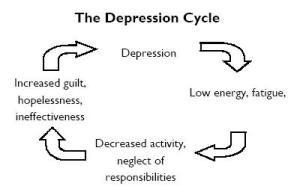
But the truth is quite different–as I work through each issue, it really does slowly heal and the next wave of depression arises from a different wound that also needs the healing touch of grace. Perhaps I will never reach the end of this progressive redemption, in which case my depression will be life-long, but it is a great encouragement to know that I am on a path of hope and healing and not trapped in an inescapable morass.
That thought gives me the patience and hope to deal with my present depression. It is not my failure or stupidity that blocks me from quickly identifying the source of my depression, and it is not a meaningless melancholy, suffering without purpose or benefit. My soul is doing its vital work, and it will just take time to come to more clarity and resolution. I have hope again. Thanks for being there to listen!
This is not a thought topmost on my mind these days… I wrote it some time back. But I thought it was worth sharing.
Many conservative Christians direct their lives by a long list of expectations handed down to them from various sources (family, church, tradition, culture, etc.), many of which purport to be fundamentally grounded in Scripture. I know this is how I spent most of my life, but for me it was the letter that killed the spirit.

I was raised to believe and obey the Bible. At a foundational level were direct and clear commands that seemed to make a lot of practical sense, saving myself and my relationships much grief: don’t lie, don’t cheat, don’t gossip (or in positive terms, be honest, be fair, be kind in what you say about others). It doesn’t take much wisdom to understand the importance and relevance of these commands.
But along with these direct commands, I was taught to identify and live by biblical principles. Here the footing got very unsteady, for who was to say what principles should be applied in this way by this person at this time to this situation? Let me give one general principle, stewardship, focusing on one of its corollaries, efficiency, limited to one resource at my disposal, money. The principle is: spend as little money as possible for the greatest good. The Bible does not say this directly, but we all know this is what it means when it warns us against greed, tells us to be generous instead of self-serving and to be “rich towards God,” etc. I said “we all know,” but some of us struggle with such a simple reduction of many passages to one principle. Even if we agree that a given principle is worth following, we still find the devil in the details–a given application of that principle. Let me list a few quandries:
 1) How do the hundreds of other principles laid out by levels of priority interact with this principle, limiting it, redirecting it, even overriding it? What kind of good should be done (for instance, is it more important to give Bibles or give bread); who will receive this good (for whom am I most responsible); what other resources will be used in the accomplishing of this good (will it be cheap but take “inordinate” time); may I consider my own interests, talents, vision; what positive or negative side effects may come from this expenditure; am I permitted to solicit money or borrow money for this goal; and I could go on for many pages.

Quantity or Quality? Brand or Generic? Organic or Inorganic?
2) How does this principle apply to purchases for myself? What must I buy cheaply, and what may I take into account in deciding (the more expensive laundry soap that smells better, the fine quality suit, attending an ivy league school over a local state college?); what percentage must I give away (based on income, cost of living, family concerns, etc.); who decides and how does one decide what is lavish, normal, or frugal living; how much latitude (freedom) do I have; do my feelings matter in any way in making a decision.
 3) What role do love and grace play? Using this principle of financial efficiency, the disciples criticized the woman who anointed Jesus’ feet with expensive perfume instead of giving to the poor, and they were rebuked. It would seem the heart of the matter is the heart matters most, more than the behavioral choices we make, and that we need a level of freedom and faith to live out of grace rather than law. (I packed way too much into that sentence.) As Augustine said, “Love God, and do what you want,” or as Paul said, “Love is the fulfilling of the law.”
 Yesterday Kimberly was reading to me from Anne Morrow Lindbergh’s “Gift from the Sea,” a breeze of calm and insight from the ocean by way of the author’s soul. Anne spoke of the slow drift between spouses and the need to restore the purity and simplicity of the first wave of love. Berly and I are coming up on our fifth anniversary (May 10), and neither of us want to return to those early days of our relationship. Folks remember the romance, the excitement, the uncomplicated acceptance of one another, the overlooking of each other’s faults and feel sad that those intense feelings and sense of inseparability are gone.
Kimberly and I feel sad rather for a culture that believes romance is the fullest expression of relationship. We would never want to trade what we have now for what we had then. It was pure and simple then because it was so superficial. We spent many hours every week for two years sharing openly with one another about the things closest to our hearts, so we knew one another fairly well at a basic level before we married, but knowing the basic truths about someone is so far short of really knowing them and connecting with their heart, which is why the first year of marriage is often so hard. I know it was for us.
 Like marriage, a sailboat on her maiden voyage looks sleek and beautiful, there are no rents or dings, and she slices effortlessly through the water. But it is only after years of riding with her through the storms, risking life and fortune, and recalling the story of every rattle and dent that the captain knows his boat as no one else ever will, and the bond is deep and fierce. As we share life with mutual understanding and love, the original beauty and delight I found in Berly fills with meaning and substance. For me, every line of her face is an etching of her soul. The roots of our hearts grow ever deeper and more entwined. To pull us apart now would rend our vitals.
 Perhaps those who are concerned about my emphasis on grace are worried that I may encourage irresponsibility. Some folks seem inclined to let things slide, choose the easy way, care too little for the concerns of others. We think they need a “kick in the pants.” I use “seem” to describe them because we really don’t know the issues they are struggling with, the energy, insight, support they do or do not have and so forth. The closer I am to them, and the more perceptive I am at understanding others deeply, the more clearly I may be able to see what is at work inside them, but if they are clueless about themselves, I can easily be misled. It is common to confuse fear, shame, depression, fatigue and the like with laziness, and the last thing such folks need is a kick.
As I see it, those who are truly irresponsible create two problems, and these can be profound depending on the level of their negligence. The first is what it does to them, and the second is what it does to others (and their relationships). When  we say that these folks “take advantage of grace,” I think we mean that grace allows them to be irresponsible (does not force them to be responsible). But when they choose this course, they are retreating from grace rather than embracing it, and the result, far from being to their happiness, is to their unhappiness. They do not “get away” with it because sin always has its natural consequences–sin is always a harmful choice, to the ones acting as well as to everyone whom they touch (that’s why God warns us against it). Grace can only bring redemption to such a situation if it is embraced, and this can only be done by faith, which is to say the slackers now see things God’s way. Given this vantage point, I think we would pity the irresponsible, and if we have some role to play in their lives and are motivated by love, we may wish to warn them from this folly and invite them back to grace.
The second problem with the neglectful is their impact on others and their relationships, and this is where many feel grace is inadequate and the law must be applied. What do we mean by “law” and “grace” in this context. Is there something one does that the other does not? If law is about restriction and grace is about freedom, then our call to apply law is to bring force to bear, either the force of a guilty conscience (say, by rebuking him) or the force of retribution or punishment (say, by taking his keys). But why do we think these actions are connected to law and disconnected from grace? Is it not possible for grace to stir the conscience or give a wake-up call of negative consequences? To my mind, the whole distinction lies in what motivation prompts the act.
 It seems to me that I turn to the obligation and punishment of law not from concern for the slouch, but from concern for the law (that the law is respected, obeyed) or concern for the “victim” (who may be me). It often seems to us that in order to side with the victim, we must side against the negligent. Thankfully, the grace of God does not need to love one less in order to love the other fully. He wants the best for all concerned, and he will do what is best for all concerned. If grace sends negative consequences on the irresponsible, it is not because God takes umbrage and is punishing them, but because he knows this is the best he has to give, the choice of extravagent love, not love withheld. It is his invitation to redemption. The exile of Israelis from their land is a prime example of this “tough love.” Far from this being an act of God’s impatience and abandonment, it was the richness of his love at work to restore them to their true selves and reawaken their immensely fulfilling love relationship with him.
Mike Yaconelli in Messy Spirituality:
 It was time for the Scripture reading and a girl shuffled toward the front of the church. What a moment for Connie. She had finally mustered enough courage to ask the pastor if she could read the Scripture. Without hesitation, he said yes. For years Connie had stifled her desire to serve in the church because of her “incompetencies.” Reading was extremely difficult for her, and Connie had a terrible time enunciating clearly. But she had been in this church many years, and she was beginning to understand the grace of God. Jesus didn’t die just for our sins; he died so people who couldn’t read or speak could read and speak. Now she could serve the Jesus she loved so much. Now she could express her desire for God in a tangible way.
Connie’s steps were labored as she made her way to the front; one leg was shorter than the other, causing her body to teeter from side to side. Finally, she was standing up front, looking at the congregation with pride and joy. The congregation was silent. Too silent.
 The screaming silence was covering up the congregation’s discomfort. Clearly, most of them were trying to understand what Connie was doing, and they were trying not to notice her many incompetencies. Her eyes were too close together, and her head twisted back and forth at odd angles while her face wrenched from one grimace to another. Connie began to read, and stammering, stuttering, she stumbled proudly through the passage in a long sequence of untranslatable sounds, garbled sentences, long tortuous pauses, and jumbled phrases. Finally, the reading was over, and the congregation was exhausted.
Connie didn’t notice the exhaustion. She was ecstatic. Her face seemed no longer distorted, only full of joy. Her cheeks were flush with pride; her eyes were sparkling with the joy of accomplishment; her heart was warm with knowing she had served the congregation, participated in her faith. Yes, she would remember this day for a long time. How wonderful it was, she thought, to no longer be a spectator in church; she was the church this morning!
Thank God her mental capacities were limited. Thank God she was not able to discern the faces of the congregation or she would have crumbled in despair. Thank God she wasn’t able to sense what people were really thinking. Almost everyone in the congregation was thinking, This is an outrage! I know this is what they were thinking, because the senior pastor, my father, was ordered to attend an emergency board meeting after the service.

Stain Glass Masquerade
by Casting Crowns
(click image to hear)
“How did this happen?” they demanded to know. “What were you thinking?”
“Connie wanted to read the Scripture,” he replied softly.
“Well, let her stand at the door and pass out bulletins, or help in the mailroom, but don’t have her read! The girl can’t read or speak. Her reading took ten minutes! The church,” they said, “is not a place for incompetence.”
My father believes, as I do, that the church is the place where the incompetent, the unfinished, and even the unhealthy are welcome. I believe Jesus agrees.
Matthew 1:2 Abraham fathered Isaac, Isaac fathered Jacob, Jacob fathered Judah and his brothers.
Finally brothers! Until now this family, chosen to be a great nation, barely survived with one child of promise per generation. The world must wait until Abraham’s great-grandchildren before the redemptive family tree grows more than one branch. I know that feeling well—-waiting. When God’s promises to redeem my situation seem long overdue, I begin to doubt God’s love. Why is he taking so long to respond? Doesn’t he care? For instance, why is God taking so long to fix my depression?
 Peter throws out an intriguing idea, “The Lord is not slow about His promise, as some count slowness, but is patient toward you.” God is not distracted, uncaring, or negligent about my needs. It is not we who are waiting for God to act, but God who is waiting for us to be ready, who watches our progress with sympathy, not disappointment. His patience is not a bridled impatience, but genuine good will. He knows it takes time. He is okay with it taking time. In fact he plans for it to take time. He is patient. In my urgency to reach the resolution, I want to hurry the process, but God’s focus is on the journey, his grace is at work in the process itself. Too often I miss his grace for today in my anxiety for the bigger deliverance that is farther down the road. My impatience is really towards myself rather than God. I blame myself for not growing faster, for bungling his stream-lined plans for me. But should we suppose that if Abram had had greater faith and faithfulness, he would have had a dozen sons at 39 instead of one at 99? Why have I always thought that God was in a rush?
 I think I have long been under the impression that God’s attributes are somehow in competition with each other. In this instance, his righteousness is at odds with his sympathy. He wants to hurry me into holiness, but he is being “patient” with me, which basically means he is holding himself back from chiding or nagging or otherwise showing his frustration at my slow growth. He is impatient, but hiding it. I guess that is how I have always pictured his so-called patience, and why I am so prone to agree with “God’s” condemnation of me. I need a new God, a good God, a God who is truly patient, not just pretending to be patient.
Matthew 1:2 “And Isaac the father of Jacob”
 No, that was not Isaac’s choice. He wanted to be known as “Isaac the father of Esau.” Esau was the first born, a macho man, and his favorite son. For those familiar with the Bible stories, “Jacob and Esau” rolls easily off the tongue, but for Isaac it was “Esau and Jacob.” Everyone knew Esau was heir apparent, standing in the wings for his call onto the stage as head of the family and forefather of the covenant people. And I expect most folks approved. Esau was clearly the one who commanded respect, the one with courage and boldness, the natural born leader. Jacob was a mama’s boy, always running away, always cowering behind some trickery. In the hard-scrabble land of the Middle East, Jacob was a Loser.
When Isaac was old and blind and felt death approaching, he prepared for Esau’s coronation, only to have Jacob filch the throne by deceit. Oddly enough, Jacob was God’s pick from the beginning. What did God see in him that made him the obvious choice? Even children know who to pick for their team—the one with the most abilities—and through that lens we read Scripture. We suppose that God chose Mary to be the mother of his Son because she was pure and good and obedient, so good as to be sinless according to some theologians. But the angel of God in Luke clearly tells us why she was chosen—it was based on God’s grace he says twice over, not on Mary’s virtue. The Greek word for grace, Charis (in KJV “highly favored”), is not a reference to how deserving Mary was. She was picked by grace, not merit. “How Lucky!” would be a closer rendering than “How worthy!”
All through history God chooses those who don’t deserve him, who know they don’t deserve him, who are convinced they will never deserve him, and have at last opened to his welcoming embrace. It is the strong, talented, and self-sufficent who find grace, full grace, undeserved grace, hard to swallow. I am so grateful that our God is “the God of Abraham, Isaac, and Jacob,” yes, even Jacob… especially Jacob. God loves me with all the strength and intensity of his great heart. How lucky am I?!
Matthew 1:2
“To Abraham was born Isaac.”
 Those five words are packed with dramatic history. The first seed in the family tree of salvation was barren. I think I would have written it, “To Abraham…. was……. born…………….Isaac. Abram had reached the end of a century with no son by his wife. He is known as the Father of faith, the Father of the nation of Israel. His very name meant father, from the Hebrew Ab, and if this were not enough, God renamed him Abraham, father of a multitude! No wonder he and Sarah laughed, though it was a bitter chuckle I’m sure.
God does not set his watch by the earth’s revolutions. He is unhurried, sometimes maddeningly slow. “Patience” is one of the major Old Testament virtues, and it is not primarily an exhortation to longsuffering with our fellow men, but with our God! That is why it is often used as a synonym for faith. We usually think of faith as the courage  to confront great odds, when in fact, it refers more often to doing nothing at all, to simply waiting on God to act. For most of us the second takes far more faith than the first, and far longer faith. It is not God who is impatient with our progress, but we who are impatient with His. We cry, “How long, O Lord?!” and he says, “Trust Me. Wait.” Especially in our hurried day, slow is a 4-letter word. I wonder if we have lost our peace because it couldn’t keep up with our quick pace.
This is a wonderful word of grace to those of us who fear that God is disappointed, tapping his foot in impatience till we get it right. It is the direction we are going rather than the length of our stride which keeps us in step with God. He is not waiting for us to catch up, running after him with our little legs. He is here for the relationship, not for the performance. He wants the journey to be full rather than the destination to be reached quickly. Slow is a word rich with peace, wisdom, and power.