Continued from “Addicted to Effort”
 As a boy I believed my worth depended on being good, on meeting expectations, especially God’s expectations. So when my worth seems challenged, I try to rescue it with redoubled effort driven by a sense of should. As long as I keep feeling this weight of duty, I know that below the level of conscious thought, my heart is entangled in fear, and by acting from fear, I strengthen its power over me. It is no use to tell myself, “Okay, regardless of how I feel, I am now going to act out of a security in God’s grace instead of from obligation.” Motivations are deeper and more complex than that, often tied to subconscious beliefs, and so they can’t be controlled directly by an act of the will.
Every time I “do right” from obligation, I feel better about myself and more secure in God’s love, but it is a false security based on my good behavior. Each “good” choice then strengthens my belief that God’s love depends on what I do. As long as law and grace agree on what is best to do, and I conform (successfully meet the expectations), I assume my trust in God’s grace. Just as a rich man can trust God’s provision easily, so I can trust God’s love when my cache of good behavior is full. But an empty account reveals the source of my trust, and failure forces me to face my fears. If failing is my door into self-knowledge and grace, should I aim for it, shirk my duties in order to grow in grace?

Too Much of a Good Thing Is a Bad Thing
That sounded wrong. So I kept meeting all the demands of duty while constantly identifying and challenging my underlying legalism. It was a long, slow process in which my choices to satisfy the should seemed to continually pull me back from grace. Then I started realizing that my perceptions of responsibility were largely shaped by my insecurities and the expectations of others, present or absent. Those who promoted these duties tried to anchor them in Scripture as divine law, but the great majority came rather from culture, family, tradition, personality, and the like—a prescription of what good people do.
Good people get up early, make their beds, take a shower, eat a healthy breakfast. They mow their lawns, wash the dishes, exercise, change the oil in their car every 3,000 miles. They limit their TV viewing, work hard at school and office, live within their means, answer emails and phone calls in good time. They don’t cut folks off in traffic or spend too much on luxury items or make others wait for them. I could go on for 1,000 pages. If I don’t conform, my sense of worth languishes. I spot it in my tendency to deny my own needs in order to meet these obligations, in my embarrassment (i.e. shame) if others find out what I have or have not done, or in my need to find an excuse for my behavior—I didn’t have the time, money, strength, opportunity, support. I could never appeal to my own needs, desires, or feelings as a legitimate reason to ignore these expectations, for that was simply selfishness. Perhaps no confusion has done more damage to us all than equating self-care with selfishness.
 Since my (faulty) conscience cried out against me if I chose my needs and desires over these duties, I found a huge opportunity to face my own shame. I really could “shirk my duties” as a means of spiritual growth! I could choose for myself against these demands, feel the sting of shame, and then apply grace to this fear. The question stopped being “What would people think?” or “What should I do?” and became “What does my soul need.” Unfortunately my soul was so long ignored, that it had no voice. I often did not know what it needed. But I knew one thing for sure–it needed fewer demands placed on it.
The strange path to freedom.
 I have many coping mechanisms to protect me from the prickly world, a combination of defenses unique to myself. I was a compliant child, a trait sometimes mistakenly referred to as “good” or “obedient,” so I responded to my insecurites by trying to make the grade (measured by my approval ratings). This was my basis for self-worth: scoring a 10 on my performance. When I was judged as inadequate, my deeply ingrained, almost instinctive reaction was to rachet up the effort. I proved my value as a person by doing more, better, faster, by never repeating failures or mistakes, by meeting or exceeding every expectation that appeared worthy.

CHASING SUCCESS
Perhaps the hardest coping mechanisms to overcome are those which are inescapably tied to the necessities of living. Every addiction has its unique power of control. Bulimics, unlike alcoholics, literally cannot live without the substance to which they are addicted, and that significantly complicates their deliverance. In the same way, I cannot live without doing. I cannot abandon all tasks in order to break free from my addiction to effort–I am forced to keep succeeding at a job, at finances, at relationships, and all the other tasks essential to life. They say success breeds success, but in my case, success breeds bondage (and unfortunately so does failure).
For me, at a subconscious level, every task accomplished inevitably feeds my sense of worth and every task unfinished feeds my shame. I don’t knowingly tell myself, “See what I have done. I am a good person after all.” The telltale sign of this malady may only be a sense of satisfaction, which is natural enough, but the reason for my satisfaction is largely a sense of worth based on my work.
In short: I have an addiction to effort as a means to gain worth, I cannot live without doing, but each time I do something and feel better as a person, I subconsciously strengthen my addiction.
Let me give an example. I have said something that has hurt my colleague Mike. I am afraid of what he now thinks of me, especially because his evaluation of me feeds my doubts of my own worth. Since love is the best motivation, I tell myself to reach out to him in love and concern for his well-being. These are my conscious thoughts, but underneath, my very value as a person depends on his renewed approval of me. My fear escalates as I ask for a minute of his time. Why fear? Because my worth is at stake. If he is reconciled by my apology, my fear turns to pleasure. “See,” I tell myself, “love works!” when in fact I have just succeeded in strengthening a false basis for my worth as a person–I am worthy because of what I do, in this case reconciliation.
 The motivation for what I do is the key. I can act out of a place of grace or a place of should and shame, though that makes it sound dichotomous when really my motives are always mixed to some degree. If I complete a chore more out of fear than of grace, I strengthen my doubt in God’s love. If I act more from grace, I strengthen my faith in God’s love. But if I am pressured by ‘should,’ how can I respond out of grace? For me at least, operating out of a sense of should is really responding from a doubt of God’s acceptance, from a sense that his love depends on my behavior, from a fear of being unworthy. I find that if I do not first challenge the should, face it down, call out its lies of conditional love, then I feed my doubt and insecurity with each task I complete. I feel better, but am worse for it.
Back to Mike. If he is unwelcoming, I become defensive–I try to “explain” more clearly, I express my hurt at his response, I point out his matching faults. Unlike my successful attempt, my failure to win him over suddenly reveals my real motivation. It was not love, but insecurity. Insecurity will always be present, but if it predominates as my motivation, it will harm me and my relationships. It may feel better to both of us if it “works,” but it is a sugar high that eventually leads to diabetes. I am most aware of my insecurities when my coping mechanism fails, when my “right” actions for self-redemption flounder. If at first I don’t go to Mike, but sit with my insecurity long enough to find saving grace, to believe my worth has no basis in what I do, then I can go to Mike in a way that leads to wholeness for us both.
 In certain situations, this time of processing is effective, but often, the longer I delay acting, the more anxious I become. I am constantly being pressured by a “should,” and this crowds out the emotional space I need to find grace. In the past I often had to go ahead and complete the task (and so remove the pressure), and then try to deal with the shame-based motivation. My grasp of grace was not firm enough to escape self-condemnation if I failed to act, but at least being aware of my true motivations was a fundamental step to addressing them.
To be continued…
Matthew 1:1 The record of the genealogy of Jesus the Messiah the son of David, the son of Abraham:
 Both Abraham and David understood God’s plan as universal rather than solely Jewish (as the calling of each clearly states). Therefore, this is the history, salvation history, of the world, not just of one small nation. Both men are seen here primarily as avenues of salvation rather than centers of political control. Jesus, being the denouement, becomes the lens of interpretation for all of history. He gives to both Abraham and David their historical and spiritual meaning, so, as the first verse states, this family tree is about Jesus, not just (for example) a rehearsing of Jewish history. The history of the world (and of Israel) can only be understood by seeing all through the person and work of Jesus. He is the defining point of history.
Even though the focus is entirely on Jesus, it is not “the record of Jesus,” unconnected to history, as though God let the world wander on its own and then finally sent a Savior. The whole history is part of a closely laid plan from the beginning of time, the beginning of man and his fall, the beginning of Israel. It is the record of the genealogy of Jesus. History—factual events that really occurred—is fundamental to the Christian faith. Existentialism, much as I like it, tries to de-contextualize Jesus and personal faith, but faith must always be firmly rooted in our reality and past. Theology, as much as each individual life, cannot begin in the middle in dismissal of the past.

IF ONLY
We are not controlled by our past, but we are at every point a direct outgrowth of our past (though every present moment is an opportunity for re-directing our future history). Every step of a journey takes you to a very specific location. You can change direction at any point, even radically, but you cannot change the previous steps taken which have brought you to this place. If you have walked to Central Park, you cannot take your next step from Times Square, you can only take your next step in that direction. Even the greatest redirection in life, spiritual regeneration, does not suddenly change your personality, biology, total sum of a lifetime of thoughts, family and friends, skills and talents, likes and dislikes, or even your character. It gives the power to change in ways never before possible, and it begins to change everything, but we all start that journey with the first step.
It is because every present moment is so weighted by our past that it takes a lifetime and more to be restored to the persons we are meant to be. You cannot wake up tomorrow and live as though you had no past or precedent… even if you had amnesia. Who you are is a continuous flow, not disconnected states of being. Some truths can have profound impact on the flow of our lives, but being transformed by a given truth is a process. This is very frustrating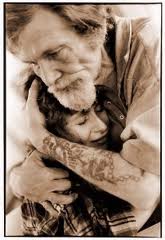 for many of us. It all seems to take so long, especially when the embedded lies are still wounding us and our relationships. But this forces us to fall back on grace for ourselves as well as for one another. The quality of our relationships is not determined by our goodness (thankfully), or even our maturity, but by grace to us, in us, through us. And the source of this grace is Jesus who is just as much a part of our life’s history as he was of Jewish history.

I wanted to thank you who read my blog. There are only about 30 or 40 of you out there, but it makes all the difference to have readers. I wanted to say thanks because the writing of these posts are a big blessing to me… It requires me to process and I re-read them more than anyone because I am helped by what I share, but I would not take the time to write without folks like yourselves who read (and occasionally comment) on the posts. So I am doubly encouraged, by the blessing I get and the blessing I sometimes hear that others get. I just feel grateful and wanted to share that.


For the last few days things have been looking up, I have felt more positive than negative, more times of calm than of anxiety. I would even say I have been happy. But I have been reluctant to share for fear that folks will suppose me “back on my feet.” We all give a break to those who are going through a hard time–we give them more patience, gentleness and concern, and a lighter load. But once they have “recovered,” we suppose their strength has returned and put them back in the harness. My personal experience is very different from this picture of energy simply lost and regained.
I once had armor so thick nothing could touch my soul, including real and deep love. Those defenses by which I kept the world at bay I laid aside to seek my true self and connect vulnerably with others. And once I stepped into the wind of my fears, the wounds that had been festering for decades were exposed. I have been attending to them now for ten years, but they are forty years deep and my soul is still quiveringly sensitive to any scrape against them.
Kimberly and I talk about our personal and marital “bubble.” When I am in my own bubble, untouched by the storms of life, I can eventually come to a place of peace as I have in the last few days. When Berly and I are on the same page, which is most of the time, we share a bubble and reinforce that sense of security. I can nestle into God’s love. But the bubble is easily burst as the wind and sleet dash against our nest–a phone call or email, a memory, a bill, a frown… even a sunny day (like yesterday) can depress me, reminding me how dependent we are on lawn mowing jobs that I have no energy to hunt down.


FROM THE NEST LOOKING OUT
I can be content and even happy inside our bubble, but it is a very fragile peace, constantly threatened and often breached. Without some refuge from the world’s criticisms, disparagements, impatience, and harshness, I am simply battered relentlessly. And my spirit can find no air to breathe, no space to move, no pause to rest. I am reduced to emotional survival. So I withdraw to my nest to build up strength to face the next nor’easter. This, to my mind, is the biblical “fight of faith.” Unfortunately, the storm can reach inside my little knothole, and often does. Sometimes all my energy is used to keep it out. It is always threatening to strike, and the closer it gets, the more difficult it is to find a place of peace, a gentle space in which to rest and heal.
But in the last few days, I sense a change. an ability to keep the storm outside and God and me inside the bubble of faith that keeps the shame and doubts at bay, a potential to respond in healthy ways to shame-driven tasks of the past. I am able to see God as on my side regardless of my weaknesses, blunders, myopia, and erratic progress. Perhaps I am finding a new way through the hurricane, though it is a strange direction to take as I will soon share.
 The truth is that my soul asks for very little. It mostly just needs to be heard and affirmed. It is sad that I have spent my life denying it this small benefit, that my automatic response is still to shame it into compliance. My Lenten fast from haste has inclined me to be gentle with my soul, and with the support of my wife, it seems to be making a real difference. I think I may make this my year’s resolution, “be gentle to your soul, listen to it and affirm it.”
This afternoon with many tasks pressing for attention, my soul said, “I need a little care.” So I left the tasks aside and followed my heart. After an hour with a soft puppy, a soft pillow, soft music, and gliding birds on our wide-screen, my spirit relaxed and set me free to be “productive” without choosing against my own needs. Forcing my soul to comply to the demands of duty tears at its very fabric. My soul is far more important than the leaky faucet, dirty living room, or ragged lawn.

OUT OF SEASON
My heart is even more important (dare I say it?) than satisfying others with birthday gifts, a lift to the airport, or help painting. If I wound my soul by caring for someone else, I not only harm myself, but prevent God from using alternative means to meet that need (or get in God’s way of teaching them an even greater truth). My giving to others must come from genuine resources that I have to offer. If it is squeezed from me by obligation, fear, shame, or the like, it will hurt both me and the one I am intending to help. Giving sacrificially is a part of genuine love, even to the point of giving my life for another. But God forbids me to sacrifice my soul.
This year I really need to give up my role as Savior of the world… or even of this particular situation or person. I need to learn to trust God with others’ needs and respect myself even if others blame me, reject me, or try to otherwise manipulate me to meet their expectations. That is a very tough thing to do without strong human backing, especially since my emotions are quick to agree with their evaluations. Thankfully, I always have Kimberly’s support (not on every occasion, but always in the set of her heart towards me… I think she is more supportive of me than I am of myself).
If I feel pressured by the expectations of others, I will try not to protect myself by minimizing their need (shaming or blaming them in return). Their need is legitimate and significant whether or not I can meet it. Caring about their need does not mean I must care for their need. What a heavy yoke I have been dragging around most of my life. In spite of how I imagined it, Jesus did not say, “Come unto me all you who are weary and heavy laden and I will give you more to do,” but he said to the weary, “I will give you rest.”

A blog post well worth reading:
My son Cade is a survivor.

Eleven years ago this week, Rebekah and I celebrated the birth of our first-born. Despite his Down syndrome diagnosis, we were overjoyed to welcome this new life into our family.
But not everyone welcomes children like Cade.
It’s no secret. People with Down syndrome have been targeted for extinction. In November, the New York Post heralded The End of Down Syndrome and profiled a new, safer test for pre-natal detection. Before this test was available, 92% of Down syndrome diagnoses (and many times false diagnoses) resulted in the mothers choosing to terminate their pregnancies. With these new tests, some experts foretell the end of Downs.
Why the rush to rid the world of people like Cade?
Certainly, it isn’t because his disability physically threatens anyone. Rather, Down syndrome children pose adifferent kind of threat to society—the in your face reminder that our aspirations for “perfection” may be flawed. People like Cade disrupt normal. Whether it’s his insistence that everyone he says “hello” to on the busy streets of Manhattan respond in-kind or his unfiltered ability to hug a lonely, wheelchair-bound, homeless man without hesitation: people like Cade bring new dimension to what normal ought to be.
I’ve been encouraged to see several pop-culture venues putting on display just how normal children like Cade—and the surviving 8%—really are.
I was surprised and delighted when I opened a Nordstrom catalog a few months back and saw a young boy with Downs syndrome posing as a model for children’s clothes. No mention or special attribution was made of it. But there he was, hanging with a few other boys, included as one of the gang. The way things ought to be.
Then again, last month, dozens of major news outlets picked up this story line when the same young model was included in the latest Target ad campaign. One father and advocate, Rick Smith, took the story viral when he posted 5 Things Target Said Without Saying Anything on his blog.
Only two weeks ago on the popular show Glee, a sixteen-year old girl with Down syndrome was portrayed beautifully. Her character showed life as a high school teenager, a member of the cheerleading squad dealing with the pressures of modern teen life. During the episode, you could hear her internal thoughts playing out as the writers took a bold step forward in portraying how it might feel to walk in her shoes.
But these public displays of inclusion are only part of how we counter the extinction of those with Down syndrome.
Why do the majority of expectant parents determine not to carry these pregnancies to full term?
Fear. [for the rest of this insightful article, connect to http://www.qideas.org/blog/to-cade-and-the-eight-percent.aspx

In the Shadows
I was pushing my grocery cart slowly down the aisle this afternoon when I felt my soul stabbed. This was one of those emotional spasms that spring without warning or excuse… sudden and sharp, making me feel physically ill or out of breath or as though I need to double over and grab my stomach from a knifing. When your psychic energy is chronically low, even small things can cause a short-out.
Just now as I write, I stop to recall my shopping and identify where I got jumped. At the entrance to Food Lion, I picked up the sales leaflet and wended my way through the produce and baking sections, making the cheapest selections and asking with each item, “Can we do without this?” My conscious mind was sorting through ounces and labels, but down below that, economic claustrophobia started squeezing my heart. Then I saw the ground beef. After 5 p.m. meat is marked down, sometimes as much as half off (depending on how old it is). At a 50 percent discount, hamburger was still $2 a pound.
That shock connected viscerally to my concern over whether I can make enough mowing lawns this spring and summer, whether it really was a good financial choice to buy a truck and mower (what do I know about lawn care anyway?!), whether Kimberly or I might have some major medical issue now that our health insurance has lapsed. These worries intermingle with fears of inadequacy, poor planning, stupidity, limited energy… a hundred whispered concerns babble in the backroom of my mind, and when I don’t recognize the source of my anxiety, it is difficult to calm the muttering. At least now I see what the clammer was about. Why the fear?
I know God can be trusted, but living involves my (faulty) input. It seems that however good and great God is, I can screw things up, make bad decisions, miss a turn. God has his hands full to keep me from driving into the guardrails, and I never know when God might see fit to let me “learn my lesson.” I tell myself that God is not like that. He is full of grace and patience and protective care. And I believe it… mostly… for now. I snuggle up next to my wife, scratch my dog’s ears, and find the shadow lifting.

Light In The Forest

I love this photo. The truths most crucial for my transformation are inevitably the truths that awaken me to my own personal terrors. I find I cannot grow in freedom, understanding, acceptance, relationship and other facets of genuine spirituality without facing my fears. To rescue me from my fears, grace leads me into them, or as John Newton sang, “‘Twas grace that taught my heart to fear, And grace my fears relieved.” Courage is gained slowly, one step at a time, and if I brave too much, more than my soul is ready to bear, I get knocked back a few paces. We must be gentle with ourselves, have compassion for our quaking spirits, take things slowly and with as much patience for ourselves as the God of all grace has towards us. Yet I must also find a way to pacify my tremulous soul, to discover the power of that truth which is embraced, trusted, fought for… truth about my wounded self and my infinite worth in God’s eyes.
When I step towards my fears, uncover them and open myself to feel them, to understand their deep hold on me, they increase and seem to gain strength. I try to face them with a spirit of self-compassion and faith in God’s love, but I can only take so much stress before my courage wavers, and I need to take a break from the battlefield, withdrawing for a time from people and situations that provoke my fears–fears of rejection, inadequacy, shame. I keep whispering the truth to myself and my trusted others until my faith is renewed enough to speak truth once more where it is unwelcome, resisted. It is my truth. You do not have to agree with me or consider this the right way to live your life (or even that it is the right way for me), but if you cannot trust me with my own life, then at least trust God with my life, in spite of my wavering steps, to draw me by grace along the way of growing integrity and harmony.
I just felt like stopping by and posting, but I don’t have much time. Today was better than yesterday, mostly because I was more attentive to my Lenten commitment to relax and give myself (and others) a break. Few things matter as much as I think they do, but having been ingrained with values I now intellectually deny, I very easily fall into old patterns without noticing. Unexplored emotions are much more likely to control me than strong conscious emotions, and my reasoning power is more likely to be manipulated by those hidden emotions than the emotions by my rational brain. I think architect Louis Sullivan was referring to outward more than inward observation, but I find his words true for both:
Attention is of the essence of our powers; it is that which draws other things toward us, it is that which, if we have lived with it, brings experiences of our lives ready to our hand. If things but make impression enough on you you will not forget them; and thus, as you go through life, your store of experiences becomes greater, richer, more and more availablel But to this end you must cultivate attention… the art of seeing, the art of listening. You needn’t trouble about memory, that will take care of itself; but you must learn to live in the true sense. To pay attention is to live, and to live is to pay attention….


 Since my (faulty) conscience cried out against me if I chose my needs and desires over these duties, I found a huge opportunity to face my own shame. I really could “shirk my duties” as a means of spiritual growth! I could choose for myself against these demands, feel the sting of shame, and then apply grace to this fear. The question stopped being “What would people think?” or “What should I do?” and became “What does my soul need.” Unfortunately my soul was so long ignored, that it had no voice. I often did not know what it needed. But I knew one thing for sure–it needed fewer demands placed on it.












 Janathan Grace Reflections