Archive for the ‘relationship’ Tag
Today is our anniversary. Since I come home from work after Berly is in bed, I was able to do some shenanigans to surprise her in the morning. She woke up Wednesday to banners draped from the rafters reading “BERLY IS THE BEST”. On Thursday she found a 3 foot paper flower I had made and a love poem. This morning she came downstairs to see an 8 foot tall card I made her covered with a list of her attributes. Here’s a snap of the card and the ten page list of attributes follows (I could have written hundreds more)–hey she deserves a lot more than a giant card! I spent some time this morning selecting a few of her good points and expounding on them to her. I was thinking to myself, “Hey, she’s married to me, so that wealth of goodness is all mine too!
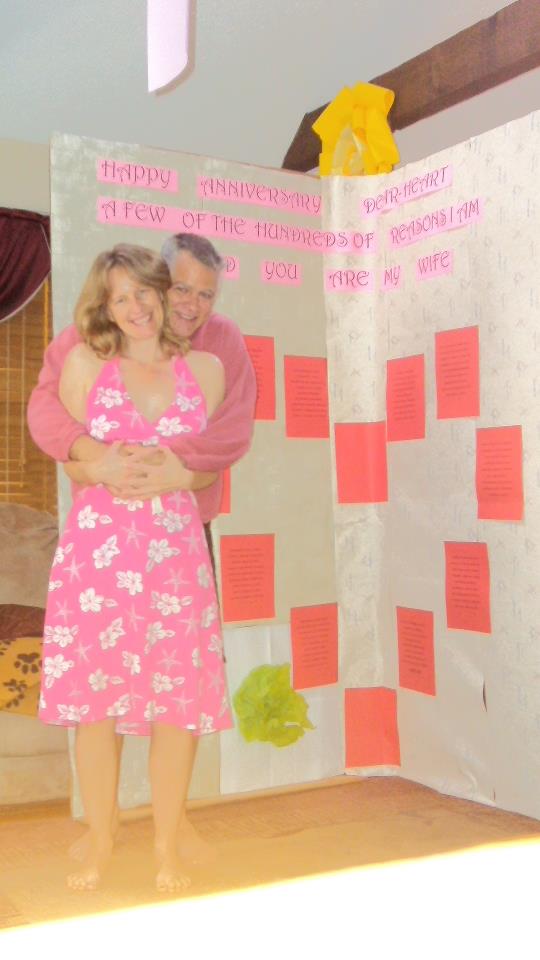
“A few of the hundreds of reasons I am glad you are my wife”
CAPABLE, ENDURING, FORBEARING, FORGIVING, GENTLE, LONG-SUFFERING, MEEK,
MILD, PERSEVERING, PERSISTENT, SELF-POSSESSED, SERENE, TOLERANT, TRANQUIL,
UNDERSTANDING, CONSIDERATE, CALM, COMPOSED, EQUABLE,
KIND, TEMPERATE, CONSIDERATE, RESPECTFUL,
* * * * * * * * * * * * * * * * * * * * * * * *
MILD-TEMPERED, ACCOMMODATING, VALOROUS, ATTENTIVE, BENEVOLENT,
GLADDENING, COMPASSIONATE, KINDLY, MINDFUL, OBLIGING, SOLICITOUS,
SYMPATHETIC, TACTFUL, TENDER, LEVELHEADED, TENACIOUS, THOUGHTFUL,
UNSELFISH, WARMHEARTED, UNCRITICAL, UNDEMANDING, UNHURRIED,
* * * * * * * * * * * * * * * * * * * * * * * *
DISCERNING, STABLE, STEADY, TOLERANT, FORGIVING, UNDAUNTED,
MERCIFUL, MILD, DILIGENT, STEADFAST, AFFECTIONATE, VALIANT,
APPRECIATIVE, BENEVOLENT, CARING, CONCERNED, EARNEST, EXPRESSIVE,
COMPETENT, FAITHFUL, LOYAL, SWEET, THOUGHTFUL, GOOD,
COURTEOUS, FRIENDLY, PERCEPTIVE,
* * * * * * * * * * * * * * * * * * * * * * * *
GOOD-HEARTED, GRACIOUS, KINDHEARTED, LOVING, STRAIGHTFORWARD,
TENDERHEARTED, CONSIDERATE, RESPONSIVE, CONSCIOUS,
PEACEABLE, ENCOURAGING, HEARTENING, COURAGEOUS, INSPIRING,
ADMIRABLE, DELIGHTFUL, ENGAGING, ENJOYABLE, GRACEFUL,
DAUNTLESS, REFLECTIVE,
* * * * * * * * * * * * * * * * * * * * * * * *
LIONHEARTED, STRONG, BRAVE, PEACEFUL, TRUE,
VALOROUS, HOPEFUL, SELF-RELIANT, SELF-SUFFICIENT, TRUSTING, WISE,
INTELLIGENT, TOUGH, REASONABLE, ASTUTE, AWARE, CAREFUL,
FRANK, CONTEMPLATIVE, INSIGHTFUL, PRUDENT, SENSIBLE,
TACTFUL, SOFTHEARTED, ATTENTIVE,
* * * * * * * * * * * * * * * * * * * * * * * *
SUPPORTING, AWAKE, GROUNDED, RECEPTIVE, SENSIBLE, CLEVER,
ABLE, BRIGHT, DEEP, GIFTED, TALENTED, COOPERATIVE,
TRUTHFUL, CANDID, ABOVE-BOARD, AUTHENTIC, CONSCIENTIOUS,
DECENT, DIRECT, EQUITABLE, GENUINE, INTUITIVE, HONORABLE,
INGENUOUS, OBLIGING, OPEN, PLAIN, REAL, RELIABLE,
* * * * * * * * * * * * * * * * * * * * * * * *
SINCERE, STRAIGHT, STOUTHEARTED, TRUSTWORTHY, TRUSTY,
UNFEIGNED, DIRECT, GENUINE, GUILELESS, UNCONTRIVED, UNPRETENTIOUS,
DEPENDABLE, COGNIZANT, RELIABLE, SOLID, SIMPLE, MINDFUL, THOROUGHGOING,
LOYAL, RELIABLE, CONFIDING, CONSTANT, ENDURING, HONORABLE, STEADY,
* * * * * * * * * * * * * * * * * * * * * * * *
ACCOMMODATING, SOUND, AUTHENTIC, REAL, SOUND, STERLING, UNADULTERATED,
UNALLOYED, UNVARNISHED, PRAISEWORTHY, GENUINE, PROFOUND,
CONSCIENTIOUS, FORTHRIGHT, GUILELESS, COMMISERATING,
RESPONSIVE, SENSITIVE, SOFT, SUPPORTIVE, SYMPATHIZING,
* * * * * * * * * * * * * * * * * * * * * * * *
EMPATHIC, RESOLUTE, HARMONIOUS, LISTENING, ACCEPTING,
ATTENTIVE, INTERESTED, OBSERVANT, ACCEPTING, DEPENDABLE,
AFFIRMING, TRUSTING, RESPECTING, AGREEABLE, EMBRACING,
COMPANIONABLE, SUPPORTIVE, ENCOURAGING, REASSURING, COMFORTING, GROWING,
DEDICATED, HARD-WORKING, FAITHFUL,
* * * * * * * * * * * * * * * * * * * * * * * *
PURPOSEFUL, DETERMINED, ENGAGED, INDUSTRIOUS, UNFEIGNED,
SOFTHEARTED, SHARING, INTIMATE, PRINCIPLED, CONSISTENT,
UNBREAKABLE, BROKEN-HEARTED, EMPATHETIC, UNDEMANDING, WELCOMING,
WOUNDED HEALER, OPEN-HEARTED, WILLING, COMFORTER
AWESOME
Forgiveness 4: Seeking Understanding

When I get whacked by the blunt end of a relationship, I first need to assess the bruising and salve it with compassion. From this haven of acceptance and support, I can draw enough grace to respond in a healthier way to the bruiser. But before forgiveness is even an option, I need to piece the story together: why did he act that way? Easy forgiveness brushes aside this opportunity of better understanding. What are his heart sores and life hurdles? How did he see and experience our social fumble? We also need a better grasp of the relationship. Every interpersonal dynamic is involved here: truth-seeking, communication, perception, relational history, roles, expectations, and a hundred other facets. Forgiveness is only part of this complex relational feng shui, so if it is my only consideration, I turn a vivid social mosaic into a black/white toggle switch of blame.


Quick forgiveness looks so gracious, and long discussion seems so dramatic. Both of us may want a quick fix, and perhaps it’s the right choice for now, but we should remember that this tables the issue, it doesn’t resolve it. The same conflict will pop up again and again until we sort it out. Deferring until later may feel better in the short run, and may be a necessary strategic move, but it does not enrich our bond. And slowly over time little resentments will build up like barnacles on a boat or relational callouses will form to deaden the pain and with it the vibrant connection.
So I begin to unfold the map of who he is. I’m not looking for evidence to accuse him. I simply want to understand him, see things from his perspective. Since resolution requires mutuality, I share with him in turn my struggles, without implying fault. Just as my own heart hides when I am gruff and suspicious with it, he cannot be honest and forthcoming about his genuine feelings and thoughts if I don’t invite him with gentleness and love. I can accept him without approving of or excusing his behavior. He is precious regardless of what he does or doesn’t do. I want to know what he feels about our scrape and why he feels this way. If he is dismissive or defensive as I probe, then he’s not at a safe place with me. He may not even feel safe with himself because of the shaming voices in his head. When he closes the gate on this part of our relationship, I must honor it—I cannot force him to share. In response, I may also need to stake down a boundary marker to protect my heart. Perhaps a better time will come if I stay open and gracious.
DO YOU SPEAK RABBIT?
If we can break through into deeper mutual insight, we will then want to reflect also on our relationship. This will spark memories of past conflicts, a rich resource to ponder if we don’t use it as ammunition but as sutures. Why do we react to one another in this way in these situations? What are we feeling and thinking? Do we respond to others in similar ways? Why or why not? What patterns does this reveal about our interactions? Since honesty and openness depend on our sense of safety, the one issue we overlook at this point is blame. It may be that neither of us is guilty or both are guilty or that the problem lies in a completely different direction. But once we are sharing, the issue of fault and forgiveness often becomes moot.
Forgiveness Part I: Framework
 Forgiveness is a small portion of how I respond to others when I am hurt, and this in turn is a small part of the much bigger framework of human relationships. To understand any piece of this jigsaw puzzle requires me to know its connection to the other pieces and to have a general grasp of the whole. So let’s peek at the box top.
This is a profoundly social cosmos. A pro�foundly conversational cosmos. In a social cosmos, a talking cosmos, a muttering, whispering, singing, wooing, and order-shouting cosmos, relationships count. Things can’t exist without each other. And the ways things relate to each other can make them radically different from their fellow things. –Howard Bloom, The God Problem
Everything from the dance of electrons and protons to the gravitational pull of the Milky Way finds its place in the universe by its connection to other things. As part of this social cosmos, we humans are profoundly shaped by our relationships–our families and communities and cultures. We largely understand ourselves and our place in this world based on the input we get from others. This is both wonderful and awful, for our greatest joys come from love and belonging but our worst wounds come from separation and rejection.

We don’t really have much choice about this fundamental social reality. We can’t invent our own language and still hope for connection. We speak our mother’s tongue or stay mute. In the same way, our thoughts and actions are channeled by the perspectives of our families and cultures. Our whole world is organized and explained to us from one specific vantage point so that even to argue with it, we have to speak from that context. We can’t disagree with our English-speaking mom in Hindi. We are inextricably tied to our relational ecosystem. We may be able to switch contexts, but we always have a context, and we always crate our past along with us (ask any married couple).
 Life is a web of relationships, and so to discover who I am in distinction from others, I must understand them and how I relate to them. I soon realize that although there are individual strands in this system, they’re all interconnected. When I put my hand on any one relational dynamic all the rest vibrate. Anger is connected to shame and fear, shame impacts perspective and motivation, motivation informs decisions, focus, resources, and a hundred other elements. It is not only that I am connected to my brother, but that I am tied to him in a thousand complex ways. Each interaction sets the web twitching, and before I respond, it is best to understand myself and my brother and the relational dynamics between us. I should not have a default response, not even forgiveness. Trying to fix every problem with forgiveness is like repairing a house with just a saw.
Kimberly and I have had rough weather for the last few months, not only in our individual souls, but in the soul of our marriage. We have wanted to sort it all out and have tried, but we’re still baffled, unable to do anything but cling to our seats as we ride out the turbulence. In spite of the conflicts that keep popping up, I want her to know that she is precious to me, and sometimes words of appreciation ring truer when we overhear them, so let me share with my friends here the treasure she is to me.
She is gentle. She is accepting. She is courageous. She is true and genuine. She is self-reflective and in touch with her soul as few people are. She is determined and tough in spite of setbacks. She is vulnerable and open. She naturally believes the best of others, and stands up for the underdog. She is empathetic and understanding. She is a great listener. She is wise and insightful and talks for hours about deep things. She is welcoming of the weak and broken and marginalized. She is responsible and capable. She calls out the best in others by being okay with their faults and foibles and valuing them for who they are, not what they do or fail to do. She is a woman of grace, even when it hurts her. She shares her true self with others even when they have crushed her spirit, but she is also good at keeping healthy boundaries. She never gives up on herself or on others.
She accepts me as I am and makes room for my weaknesses, encouraging me to support myself even when it is hard on her. She has an incredible commitment to personal growth and wholeness, and though she started out far behind others in her childhood environment, she has far surpassed most others in becoming her true self. She welcomes all of who I am, even the broken parts, and loves me as I am, and so she has taught me to love myself. In other words, she is for me the truest experience of the gospel with skin on. When my insecurities and weaknesses break out against her, she does not retaliate, but hangs on through the tensions until we work it out.
She is not perfect, and I wouldn’t want her to be (how intimidating would that be!). She has her own hangups, insecurities, and weaknesses. But we have discovered that the deepest and truest bonds come through our frailties more than our strengths. I’ve never met anyone like her, and we do life together in extraordinary fashion… even our stumbles seem to add something beautiful to the rhythm of the dance. We’re still figuring out the steps to this new rumba, and we often as not step on each other’s feet, but we’ll keep swinging till we get it down. It is in the hard times that love proves its character. Ours is a tough love.
From one of my new favorite blogs:
What’s that in the Pool?
Parts of the Rocky Mountains look like
algae bloom out in the Indian Ocean.
Parts of me look like parts of you
and here we go with oneness
being nothing more than
pattern recognition and optical illusion;
though I hope there is more to it than that.
My hurt might not be your hurt,
but I have a sense of it.
Likewise your hope may not resemble mine,
but it cheers you just the same
and we are all the better for it.
We needn’t replicate each other
or attempt imitation,
but recognition is a kind thing
and art is what we all have to share.
 “Is it God’s voice I hear in my heart or my own voice mimicking God? How can I tell the difference?” I asked Kimberly tonight as we stared at the candle flames. It was more a doubt than a question. “Even if it IS God talking to me, I may hear it all wrong, just like I do with you,” I continued. God’s voice may be in my head, but it is hardly the only voice there. In fact, as a boy I assumed dad was God’s mouthpiece. I still have trouble telling apart their voices inside me, not because they sound so much alike, but because the mix-up was so long standing. Over the years I have internalized more inflections–preachers, authors, teachers, Christians. So who’s talking now? I am learning to distrust those messages that do not harmonize with grace. God’s heart-songs are always the cadence of love–even if it is a hard scrabble love.
 When I have a friend with me, it colors all that I do, how I do it, and how I feel about it. If he is critical by nature, I will be cautious and inhibited, tense and doubtful. If my daily companion is God, what kind of God is he? If my hours are spent with a God who is focused on fixing my flaws, I will live out of fear and shame. I will be worse off for all my spiritual intent. It is crucial for me that the God I chat with over the dishes and in my car is the God of all grace. It is not only his presence I need, but his compassionate presence. I have enough harsh voices in my brain without adding Sinai to the cacophony. “Perfect love casts out fear.” May we all drink from that stream of redemption.
 Most evenings before supper Kimberly and I light some candles, listen to a word of grace, and invite God into conversation with us. Tonight I told him frankly I don’t know how to include him in the quagmire of my life. All through the day I talk to him and wait on him, but hear no answers for my doubts, feel no healing for my pain, see no clarity for my path, find no energy for my tasks. When I bring God my suffering and weakness and lostness, why do I find no comfort or strength or direction? Why does he leave me sunken in misery? Faith grows haggard without tokens of hope.
 I wrote that paragraph last night and sat thinking for a long time. If God is not in my life to fix me, then why is he here? Somehow, all my theology seems to circle back to relationship… where it should start in the first place. It took me years to learn this with Kimberly–what we both need from the other in our brokenness is compassionate presence, not problem-solving. But God is different from Kimberly–she can’t fix me but he can. He knows exactly what I need and how to provide it. So why doesn’t he?! oh… maybe he does… maybe what I truly need is his compassionate presence.
This is so counter-intuitive for me. If he loves me, doesn’t he want to remove my pain? If he can heal me and doesn’t, is he not callous and unloving? Imagine a doctor with wonderful bedside manners who refuses to cure his suffering patient. And perhaps here is the answer to my riddle. When I treat God as my doctor, I forget he is my friend, my dearest friend who holds my broken heart in his tender hands. My focus locks on my disease instead of our friendship.
I woke up this morning with a nameless dread which slowly distilled into a sense of the pointlessness of my life, and a fear that nothing will change. What did I do this week? I stained the wooden borders around our yard, but in a couple of years I will have to do it again… and to what end? I exercise, clean, shop, cook… a meaningless round of repetition. I enjoy my job in the library, but what difference does it make in the world? Well, it provides me a salary so that I can repair appliances, buy groceries, pay bills… and then do it all over again. When will I find real purpose and direction for my life, something meaningful? As I lay in bed, the thoughts of last night drifted into my mind. So instead of asking God for a fix, I simply shared with him my anxiety. In the end, what if the great purpose of my life is not something, but Someone?
 Yesterday Kimberly was reading to me from Anne Morrow Lindbergh’s “Gift from the Sea,” a breeze of calm and insight from the ocean by way of the author’s soul. Anne spoke of the slow drift between spouses and the need to restore the purity and simplicity of the first wave of love. Berly and I are coming up on our fifth anniversary (May 10), and neither of us want to return to those early days of our relationship. Folks remember the romance, the excitement, the uncomplicated acceptance of one another, the overlooking of each other’s faults and feel sad that those intense feelings and sense of inseparability are gone.
Kimberly and I feel sad rather for a culture that believes romance is the fullest expression of relationship. We would never want to trade what we have now for what we had then. It was pure and simple then because it was so superficial. We spent many hours every week for two years sharing openly with one another about the things closest to our hearts, so we knew one another fairly well at a basic level before we married, but knowing the basic truths about someone is so far short of really knowing them and connecting with their heart, which is why the first year of marriage is often so hard. I know it was for us.
 Like marriage, a sailboat on her maiden voyage looks sleek and beautiful, there are no rents or dings, and she slices effortlessly through the water. But it is only after years of riding with her through the storms, risking life and fortune, and recalling the story of every rattle and dent that the captain knows his boat as no one else ever will, and the bond is deep and fierce. As we share life with mutual understanding and love, the original beauty and delight I found in Berly fills with meaning and substance. For me, every line of her face is an etching of her soul. The roots of our hearts grow ever deeper and more entwined. To pull us apart now would rend our vitals.
One of my favorite poems:
Something is there that doesn’t love a wall,
That sends the frozen-ground-swell under it,
And spills the upper boulders in the sun;
And makes gaps even two can pass abreast. The work of hunters is another thing:
I have come after them and made repair
Where they have left not one stone on a stone,
But they would have the rabbit out of hiding,
To please the yelping dogs. The gaps I mean,
No one has seen them made or heard them made,
But at spring mending-time we find them there.
I let my neighbour know beyond the hill;
And on a day we meet to walk the line
And set the wall between us once again.
We keep the wall between us as we go.
To each the boulders that have fallen to each.
And some are loaves and some so nearly balls
We have to use a spell to make them balance:
‘Stay where you are until our backs are turned!’
We wear our fingers rough with handling them.
Oh, just another kind of outdoor game,
One on a side. It comes to little more:
There where it is we do not need the wall:
He is all pine and I am apple orchard.
 My apple trees will never get across
And eat the cones under his pines, I tell him.
He only says, ‘Good fences make good neighbours.’
Spring is the mischief in me, and I wonder
If I could put a notion in his head:
‘Why do they make good neighbors? Isn’t it
Where there are cows? But here there are no cows.
Before I built a wall I’d ask to know
What I was walling in or walling out,
And to whom I was like to give offense.
Something is there that doesn’t love a wall,
That wants it down.’ I could say ‘Elves’ to him,
But it’s not elves exactly, and I’d rather
He said it for himself. I see him there
Bringing a stone grasped firmly by the top
In each hand, like an old-savage armed.
He moves in darkness as it seems to me,
Not of woods only and the shade of trees.
He will not go behind his father’s saying,
And he likes having thought of it so well
He says again, ‘Good fences make good neighbours.’
– Robert Frost
Kimberly and I are enjoying a sci-fi series called “Haven.” Last night they ended the show with a short dialogue I thought was profound. Chris is hugely popular, and he uses his popularity to manipulate others, though he knows he is not being his genuine self in doing so. He can only be himself when he is with Audrey, his “love” interest.
Chris: I want to be with you Audrey. I need to be with you.
Audrey: You once told me, ‘I want you because you’re you.’ Wanting me and needing me are two different things. I can’t be the person that keeps you you. You have to do that on your own. You’d eventually start resenting me for it.

THAT WAY!
God often uses us as his channels of grace, and we can support others in their efforts to heal and grow. But if we take responsibility for their change, it will prevent them from truly growing. They lack the courage or desire or understanding to move forward, and eventually they will resent us for obstructing their default path. We must all choose for ourselves the path of life and growth and the pace we take on the journey, and then others may support our will rather than substituting for it.
I’ve discovered that all the support in the world is of no use to me if I cannot receive it. No amount of compliments or empathy or affection can heal my heart unless I am somehow able to open to it. But opening to love makes me vulnerable… I can be hurt much more deeply by those I trust (and all humans fail). Kimberly and I have each discovered that unless we can find a means to value ourselves, external validation will make little impact. Grace knocks at our door but is also on the inside encouraging us to open. Grace is on the giving side, but also on the receiving side, supporting us with the courage and faith to accept. But we must acquiesce, for grace forces itself on no one.







 Janathan Grace Reflections